
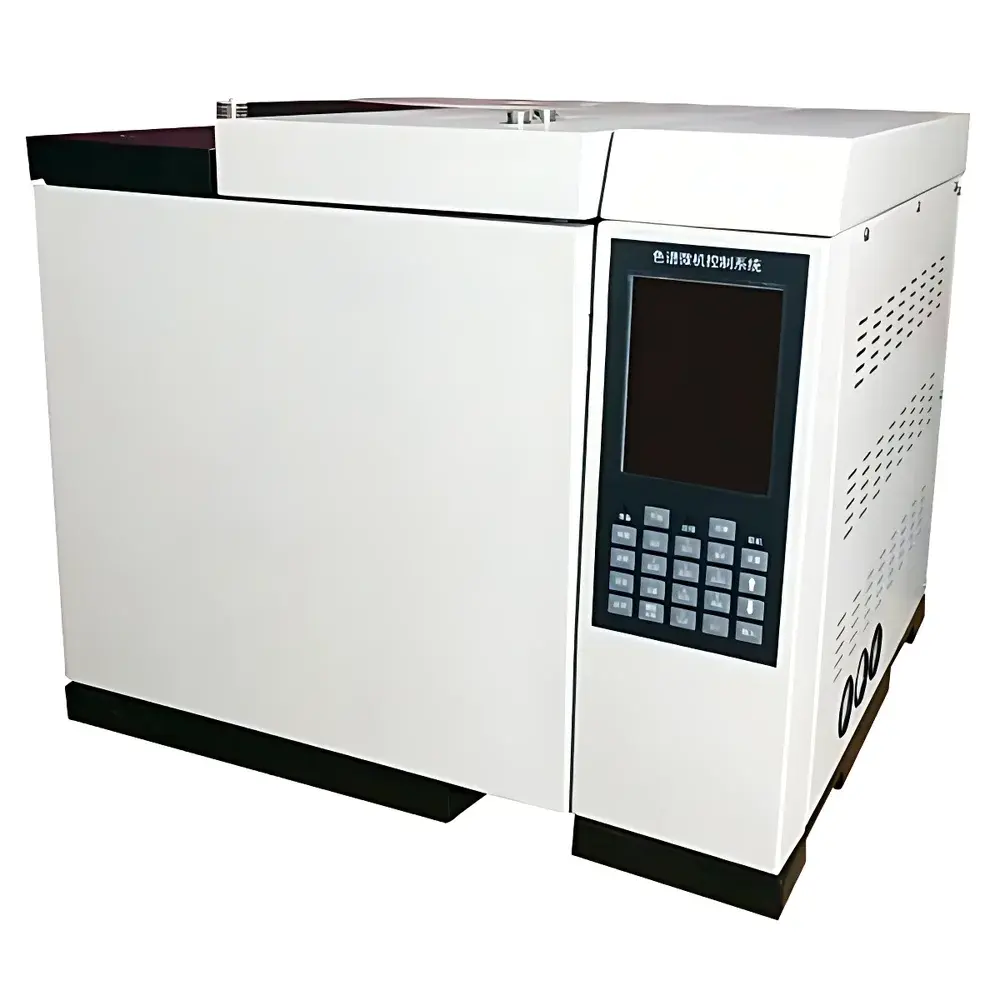
TimePower TP101D Gas Chromatograph
| Brand | TimePower |
|---|---|
| Origin | Beijing, China |
| Manufacturer Type | Direct Manufacturer |
| Product Origin | Domestic (China) |
| Model | TP101D |
| Pricing | Available Upon Request |
| Column Oven Temp Range | Ambient to 200 °C |
| Detector (FID) Temp Range | Ambient to 300 °C |
| Methanizer Temp | 380 °C |
| TCD Sensitivity | ≥1000 mV·mL/mg (benzene) |
| FID Detection Limit | ≤5×10⁻¹² g/s |
| TCD Baseline Noise | ≤0.1 mV |
| FID Baseline Noise | ≤1×10⁻¹² A/30 min |
| TCD Baseline Drift | ≤0.2 mV/30 min |
| FID Baseline Drift | ≤1×10⁻¹¹ A/30 min |
| Temperature Control Accuracy | ≤±0.3 °C |
| Display Resolution | 0.1 °C |
| Warm-up Stability Time | <1.5 h |
| Detection Limits | CH₄ 0.1 ppm, CO 1 ppm, CO₂ 1 ppm, H₂ 5 ppm, C₂H₂ 0.1 ppm, C₂H₄ 0.1 ppm, C₂H₆ 0.1 ppm |
| Dimensions | 620 × 445 × 485 mm |
| Weight | 31.8 kg |
Overview
The TimePower TP101D Gas Chromatograph is a benchtop analytical instrument engineered for precise separation, identification, and quantification of volatile and semi-volatile organic compounds in complex gaseous or dissolved matrices. It operates on the fundamental principle of gas–solid or gas–liquid partition chromatography: sample components are volatilized, carried through a thermally regulated capillary or packed column by an inert carrier gas (e.g., He, N₂, H₂), and differentially retained based on polarity, molecular weight, and interaction with the stationary phase. Detection is performed using dual complementary detectors—Thermal Conductivity Detector (TCD) and Flame Ionization Detector (FID)—enabling simultaneous analysis of permanent gases (H₂, O₂, N₂, CH₄, CO, CO₂) and hydrocarbons (C₂H₂, C₂H₄, C₂H₆, etc.) at trace concentrations. The system integrates a methanizer furnace (380 °C) for quantitative conversion of CO and CO₂ to CH₄ prior to FID detection, significantly enhancing sensitivity and accuracy for carbon oxide speciation. Designed for routine QC/QA, environmental monitoring, and forensic gas analysis, the TP101D meets foundational operational requirements aligned with ASTM D1945, ISO 6974-1, and USP for residual solvent analysis.
Key Features
- Multi-dimensional gas chromatographic architecture supporting single-injection, dual-column, dual-detector analysis with integrated methanization—eliminating need for re-injection or method switching.
- High-stability temperature control system: column oven precision ≤±0.3 °C with 0.1 °C display resolution; detector zones independently programmable up to 300 °C (FID) and 200 °C (oven).
- Low-noise detection electronics: TCD baseline noise ≤0.1 mV and FID baseline noise ≤1×10⁻¹² A over 30 minutes, ensuring high signal-to-noise ratio for sub-ppm quantitation.
- Automated self-diagnostic routines including real-time sensor validation, overtemperature cutoff for all heated zones, and audible/visual fault alerts for gas leaks, flame-out, or column blockage.
- Optimized gas flow management via precision pressure/flow controllers and leak-tested stainless-steel pneumatic pathways—validated to <1×10⁻⁸ atm·mL/s helium leak rate.
- Rapid thermal equilibration: achieves operational stability in under 90 minutes post-power-on, minimizing downtime between analytical sessions.
Sample Compatibility & Compliance
The TP101D accepts gaseous samples directly via gas-tight syringe or pressurized loop injection, as well as headspace-derived vapors from liquid or solid matrices (e.g., transformer oil, blood, soil extracts, beverage headspace). It supports standard 1/8″ or 1/16″ stainless-steel or fused-silica columns, compatible with common stationary phases including Porapak Q, Molecular Sieve 5A, and Carboxen-1000. All hardware and firmware comply with IEC 61010-1 safety standards for laboratory electrical equipment. Data acquisition and reporting workflows support audit-trail-enabled operation per FDA 21 CFR Part 11 when paired with validated chromatography data systems (CDS). Instrument calibration protocols follow GLP-compliant practices, including multi-point bracketing with certified reference gas mixtures traceable to NIST SRMs.
Software & Data Management
Bundled TimePower Chromatography Workstation software provides full control of instrument parameters—including oven ramping profiles, detector gain settings, valve sequencing, and methanizer activation timing. Raw chromatograms are acquired at 20 Hz sampling rate and stored in vendor-neutral .CDF format compliant with AIA/ANDI standards. Quantitative analysis employs internal standard, external standard, or area normalization methods with linear/nonlinear curve fitting (1st–3rd order polynomial, quadratic spline). Software includes automated peak detection, retention time locking, and integration of custom calibration templates built from certified standard gases. All processing steps—including baseline correction, peak deconvolution, and report generation—are timestamped and logged with user ID, enabling full traceability required under ISO/IEC 17025 accreditation.
Applications
- Petrochemical QA: Dissolved gas analysis (DGA) in transformer oils per IEC 60599 and ASTM D3612 for predictive maintenance of power infrastructure.
- Pharmaceutical manufacturing: Residual solvent testing in APIs and excipients per USP and ICH Q3C guidelines.
- Environmental air monitoring: Quantification of VOCs, BTEX, and greenhouse gases (CH₄, CO₂) in ambient, indoor, or stack emissions per EPA TO-17 and ISO 16017-1.
- Forensic toxicology: Detection of volatile substances (e.g., ethanol, acetone, chloroform) in blood and tissue headspace per SWGTOX best practices.
- Food & beverage safety: Flavor compound profiling, adulteration screening (e.g., methanol in spirits), and packaging migration studies.
FAQ
What carrier gases are compatible with the TP101D?
Helium, hydrogen, and nitrogen are supported; hydrogen is recommended for fastest analysis and highest FID sensitivity, while helium offers optimal TCD performance and method transfer compatibility.
Is the methanizer module field-replaceable and user-calibratable?
Yes—the 380 °C catalytic methanizer uses a standardized Ni-based catalyst cartridge with documented lifetime (≥12 months under continuous operation); calibration is performed via CO/CO₂ challenge gas injections with automated response factor update.
Does the system support unattended operation overnight?
Yes—equipped with scheduled shutdown/startup, auto-zero functions, and watchdog timers; optional UPS integration ensures safe power-fail recovery without data loss.
Can the TP101D be integrated into a LIMS environment?
Yes—via ODBC-compliant database export (.CSV, .XML) or direct API access to raw data buffers; metadata fields (sample ID, operator, method version, audit trail hash) are embedded in exported reports.
What maintenance intervals are recommended for routine operation?
FID jet cleaning every 2 weeks; column trimming and inlet liner replacement every 3 months; detector alignment verification and leak checks quarterly; full system performance qualification (SPQ) annually per ISO/IEC 17025 Annex A.2.






