
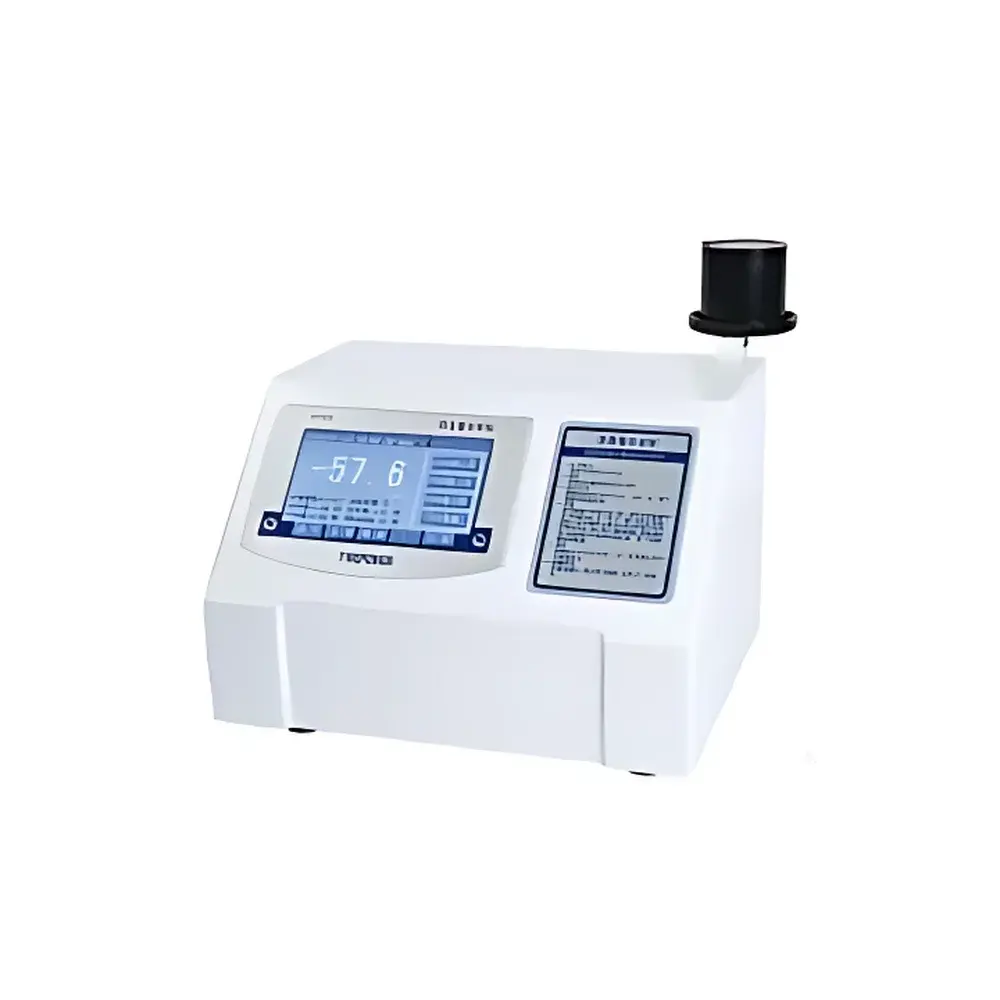
Copper Content Analyzer – TimePower TP305 Photometric Analyzer
| Brand | TimePower |
|---|---|
| Origin | Beijing, China |
| Manufacturer Type | Direct Manufacturer |
| Country of Origin | China |
| Model | TP305 |
| Pricing | Available Upon Request |
| Display | 5.0-inch color touchscreen (Chinese UI) |
| Measurement Principle | Photometric colorimetry based on Lambert-Beer law |
| Method Compliance | Chinese National Standard method using bis-cyclohexanone oxalyldihydrazone (BCO) reagent |
| Measurement Range | 0.00–200 μg/L |
| Accuracy | ±3% FS |
| Resolution | 0.1 μg/L |
| Repeatability | ≤1% |
| Stability | ±1.5% FS / 4 h |
| Operating Temperature | 5–45 °C |
| Relative Humidity | ≤90% RH (non-condensing) |
| Power Supply | AC 85–265 V, 45–65 Hz |
| Power Consumption | ≤30 W |
| Dimensions | 260 × 200 × 180 mm |
| Weight | 3.2 kg |
| Data Storage | Cyclic memory for up to 256 test records |
| Calibration | Zero-point blank calibration and periodic calibration curve verification |
| Light Source | Imported monochromatic cold LED source |
| Circuit Design | High-integration SMT PCB architecture |
| Microcontroller | Advanced low-power embedded MCU |
| Environmental Compliance | Designed for industrial water chemistry labs per GB/T standards |
Overview
The TimePower TP305 Copper Content Analyzer is a dedicated photometric instrument engineered for trace-level copper ion (Cu²⁺) quantification in ultra-pure and process water streams. It operates on the fundamental principle of spectrophotometric absorption analysis, applying the Lambert-Beer law to correlate absorbance at a defined wavelength (typically ~530 nm for the BCO-Cu complex) with analyte concentration. The system employs a stable, temperature-insensitive monochromatic cold LED light source—selected for minimal thermal drift and extended operational lifetime—to ensure consistent optical path performance across extended measurement cycles. Designed specifically for power plant water chemistry applications, the TP305 delivers reliable, repeatable results in boiler feedwater, condensate, steam, generator stator cooling water, drum boiler water, and natural surface waters where copper contamination poses corrosion or deposition risks to high-pressure turbine and heat exchanger systems.
Key Features
- High-stability photometric platform utilizing an imported monochromatic cold LED source—engineered for low thermal noise, minimal spectral shift, and >50,000-hour service life.
- Integrated SMT-based electronics architecture with embedded low-power microcontroller unit (MCU), ensuring robust signal processing and immunity to electromagnetic interference in industrial environments.
- 5.0-inch capacitive touch color LCD interface with intuitive Chinese-language navigation—optimized for rapid method selection, real-time data visualization, and on-device calibration management.
- Automated timing functions including countdown prompts for reaction incubation, enabling strict adherence to standardized BCO color development kinetics (e.g., 5–10 min post-reagent addition).
- Dual-stage calibration protocol: zero-point blank compensation eliminates electronic and optical baseline drift; periodic multi-point calibration curve verification corrects for reagent aging and photometric sensitivity decay.
- Cyclic non-volatile memory storing up to 256 measurement records—including date/time stamp, sample ID, absorbance value, and calculated concentration—with automatic overwrite of oldest entries upon buffer saturation.
Sample Compatibility & Compliance
The TP305 is validated for use with Type I and Type II reagent water (per GB/T 6682–2008 and ISO 3696:1987) and supports direct analysis of unfiltered liquid samples meeting turbidity <1 NTU. Sample introduction is performed via supplied disposable polypropylene cuvettes or reusable quartz cells (optional). The analyzer implements the nationally standardized bis-cyclohexanone oxalyldihydrazone (BCO) colorimetric method (GB/T 12149–2019), which offers high selectivity for Cu²⁺ in the presence of common interfering ions (Fe³⁺, Ni²⁺, Co²⁺) when masked appropriately. While not FDA 21 CFR Part 11 compliant out-of-the-box, audit-ready operation is achievable through documented SOPs, manual calibration logs, and external LIMS integration via RS232 output.
Software & Data Management
The TP305 features embedded firmware supporting full local data handling without PC dependency. All measurements include timestamped metadata and are stored in a linear, non-editable sequence within internal flash memory. Export is supported via USB host interface (FAT32 formatted drive) for CSV-formatted reports compatible with Excel, LabArchives, or ELN platforms. Firmware updates are delivered via encrypted binary files loaded from USB media. No cloud connectivity or remote telemetry is implemented—ensuring data sovereignty and alignment with air-gapped laboratory security policies typical in nuclear and thermal power facilities.
Applications
- Continuous monitoring of copper ion breakthrough in mixed-bed demineralizers and condensate polisher effluent.
- Routine surveillance of generator stator cooling water circuits to prevent copper oxide deposition on hydrogen-cooled windings.
- Verification of copper removal efficiency in chelant-based cleaning solutions during boiler chemical cleaning campaigns.
- Compliance testing against DL/T 912–2016 (Supercritical Unit Water Chemistry Guidelines) and DL/T 805–2016 (Thermal Power Plant Steam-Water Quality Standards).
- Field-deployable verification of copper leaching from new copper-alloy piping or heat exchanger tubes during hydrostatic testing.
FAQ
What reagent purity is required for accurate copper analysis?
Analytical-grade or higher bis-cyclohexanone oxalyldihydrazone (BCO), ammonium acetate buffer, and ascorbic acid must be used. All reagents shall be prepared in Type I ultrapure water (resistivity ≥18.2 MΩ·cm, TOC <5 ppb) generated by a certified mixed-bed ion exchange system.
How frequently should calibration be performed?
A blank calibration is mandatory before each analytical session. A full multi-point calibration curve verification is recommended every 14 days—or immediately following reagent batch change, lamp replacement, or environmental temperature shifts exceeding ±5 °C.
Can the TP305 measure copper in seawater or high-salinity samples?
No. The instrument is designed exclusively for low-conductivity, low-turbidity aqueous matrices (<10 µS/cm). Seawater, brines, or wastewater require pre-dilution, matrix-matched standardization, and interferences assessment per GB/T 12149–2019 Annex B.
Is the device suitable for GLP or GMP-regulated laboratories?
It supports core GLP practices (traceable calibration, defined operator roles, raw data retention) but lacks electronic signature, audit trail, or user access control—features typically required for formal GMP compliance under ISO/IEC 17025 or 21 CFR Part 11.
What maintenance procedures are recommended?
Daily: wipe optical window with lint-free tissue dampened with deionized water. Quarterly: inspect LED intensity stability using factory-supplied reference filter; verify cuvette alignment with alignment jig. Annually: send unit to authorized service center for photometric linearity validation and electronic recalibration.




