
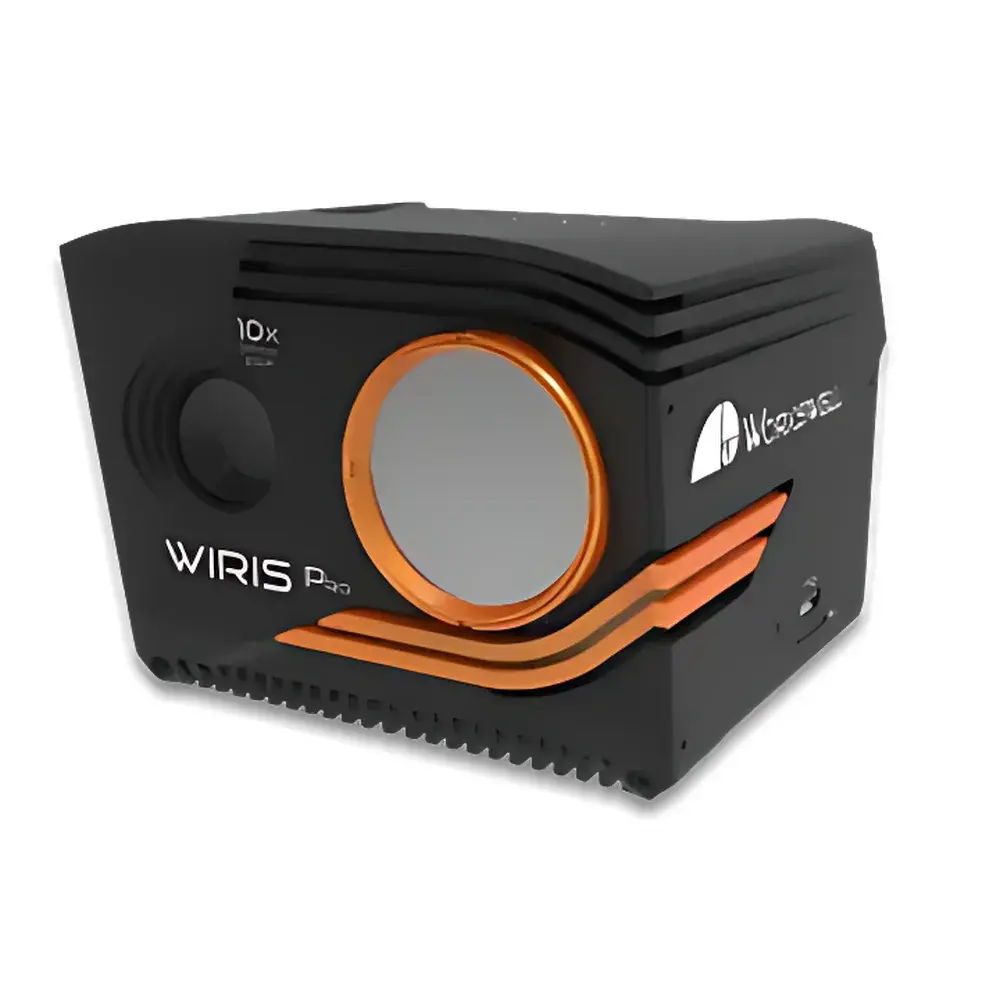
Workswell WIRIS Pro High-Resolution Uncooled Long-Wave Infrared Thermal Imaging Camera
| Brand | Workswell |
|---|---|
| Origin | Czech Republic |
| Model | WIRIS Pro |
| Detector Type | Uncooled Microbolometer |
| Spectral Range | 7.5–13.5 µm |
| Thermal Resolution | 1266 × 1010 pixels (1.3 MPx) |
| NETD | ≤50 mK (standard), ≤30 mK (optional) |
| Temperature Range | −25 °C to +150 °C |
| or extended ranges via spectral filters | +50 °C to +1000 °C and +400 °C to +1500 °C |
| Accuracy | ±2% of reading or ±2 °C (typical measured error < ±1 °C) |
| Frame Rate | 9 Hz or 30 Hz selectable |
| Lens Options | 18°, 32°, 45°, 69° FOV (interchangeable) |
| Digital Zoom | 1×–14× continuous |
| Visible Camera | 1920 × 1080 FHD, 10× optical zoom with image stabilization and autofocus |
| Operating Temperature | −20 °C to +55 °C |
| Power Supply | 9–36 VDC, 12 W |
| Dimensions & Weight | 83 × 85 × 68 mm, <450 g |
| Data Storage | Internal 128 GB / 256 GB SSD + SD card slot + USB 2.0 interface |
| GPS Integration | External GPS data embedded directly into image/video metadata |
| Triggering | PWM, S.Bus, TTL, or CAN bus (DJI M600/A3 compatible) |
| Compliance | Supports ASTM E1934, ISO 18434-1, and GLP/GMP-aligned data logging workflows |
Overview
The Workswell WIRIS Pro is a high-performance, uncooled long-wave infrared (LWIR) thermal imaging camera engineered for precision radiometric measurement in demanding field and industrial applications. Based on microbolometer detector technology operating within the 7.5–13.5 µm atmospheric transmission window, the WIRIS Pro delivers calibrated surface temperature mapping without cryogenic cooling—enabling robust, low-power, and maintenance-free operation across extended deployments. Its 1266 × 1010 pixel (1.3 MPx) thermal sensor provides exceptional spatial resolution for fine-feature thermal analysis, significantly exceeding conventional 640 × 512 LWIR cameras in pixel density and thermal detail fidelity. With selectable frame rates up to 30 Hz, the system supports dynamic thermal event capture—including fast transient phenomena in electrical systems, mechanical friction zones, or combustion processes—while maintaining full radiometric integrity per frame. The integrated visible-light camera (1920 × 1080, 10× optical zoom with optical image stabilization and autofocus) enables precise co-registration of thermal and visual data, supporting accurate georeferenced thermography when paired with external GPS.
Key Features
- Uncooled microbolometer core with NETD ≤50 mK (≤30 mK optional), ensuring high thermal contrast detection for subtle anomalies.
- Dual-spectrum imaging: synchronized LWIR (1266 × 1010) and visible (1920 × 1080) sensors with hardware-level pixel alignment.
- Interchangeable wide-angle to narrow-field lenses (18°, 32°, 45°, 69° FOV), enabling application-specific spatial resolution optimization.
- 14× continuous digital zoom and 10× optical zoom with active vibration compensation—critical for UAV-mounted inspections and long-range surveillance.
- Multi-range radiometric calibration: standard range (−40 °C to +550 °C), high-temperature filter options (+50 °C to +1000 °C; +400 °C to +1500 °C), and emissivity/reflected ambient/atmospheric correction built into acquisition firmware.
- Real-time on-device analytics: automatic hot/cold spot detection with temperature tagging, isotherm overlay, spot/area min/max/mean reporting, and user-defined alarm thresholds.
- Industrial-grade I/O: native support for CAN bus (DJI A3/M600 compatibility), S.Bus (up to 18 channels), PWM, and TTL triggering—facilitating seamless integration into autonomous platforms and test benches.
Sample Compatibility & Compliance
The WIRIS Pro is designed for non-contact surface temperature measurement across heterogeneous material classes—including metals, composites, ceramics, polymers, and organic surfaces—provided appropriate emissivity values are applied during setup or post-processing. Its spectral response aligns with ISO 18434-1 (Condition monitoring — Thermography) and ASTM E1934 (Standard Guide for Examining Electrical and Mechanical Equipment with Infrared Thermography). Radiometric calibration is traceable to NIST-traceable blackbody sources, and raw thermal data retains full 16-bit linear radiance values for third-party analysis. When configured with timestamped GPS metadata and audit-enabled storage (SSD + SD), the system meets foundational requirements for GLP-compliant thermographic documentation and FDA 21 CFR Part 11–aligned data integrity frameworks—particularly in R&D validation, preventive maintenance logs, and energy auditing reports.
Software & Data Management
Workswell’s proprietary WIRIS Studio software provides comprehensive post-acquisition processing, including emissivity mapping, temporal thermal profiling, emissivity-corrected delta-T analysis, and multi-frame averaging to enhance SNR. All thermal video streams are recorded in lossless, time-stamped .seq format containing embedded radiometric metadata (integration time, lens ID, calibration coefficients, GPS coordinates). The SDK supports C/C++, Python, and MATLAB integration for custom algorithm development, automated reporting, and AI-driven anomaly classification pipelines. Internal storage (128/256 GB SSD) ensures secure, high-throughput recording; external SD cards and USB 2.0 interfaces allow flexible archival and remote control—without compromising real-time telemetry or trigger responsiveness.
Applications
- Aerospace: Composite bondline inspection, turbine blade thermal profiling, and UAV-based airframe thermal stress mapping.
- Energy Infrastructure: Substation hotspot detection, photovoltaic panel defect screening (microcracks, PID, solder failures), and transformer winding thermal asymmetry analysis.
- Automotive R&D: Brake rotor thermal decay characterization, battery pack cell-level temperature uniformity assessment, and exhaust manifold thermal cycling validation.
- Building Science: Moisture intrusion detection via evaporative cooling signatures, insulation gap identification, and HVAC duct leakage quantification.
- Research & Academia: Combustion dynamics visualization, phase-change material behavior studies, and microscale heat transfer modeling validation.
FAQ
What is the minimum resolvable temperature difference (NETD) of the WIRIS Pro?
The standard configuration achieves ≤50 mK at 30 Hz; an optional high-sensitivity variant delivers ≤30 mK under identical conditions.
Can the WIRIS Pro be mounted on DJI enterprise drones?
Yes—it natively supports CAN bus communication with DJI A3 flight controllers and M600 platforms, including power delivery, gimbal synchronization, and telemetry feedback.
Is radiometric data export supported in standardized formats?
All thermal frames include embedded radiance values in 16-bit linear format; exports support CSV (per-pixel temperature matrices), TIFF (radiometric GeoTIFF with EXIF metadata), and MATLAB .mat structures.
How is emissivity correction handled during acquisition?
Emissivity, reflected apparent temperature, and atmospheric transmission parameters can be set in real time via the onboard UI or remotely via SDK—applied instantaneously to all live and recorded radiometric data.
Does the system support regulatory compliance for quality documentation?
When used with timestamped GPS, audit-trail-enabled storage, and calibrated blackbody verification records, the WIRIS Pro supports ISO 9001, AS9100, and internal GLP/GMP documentation protocols for thermal inspection workflows.




