
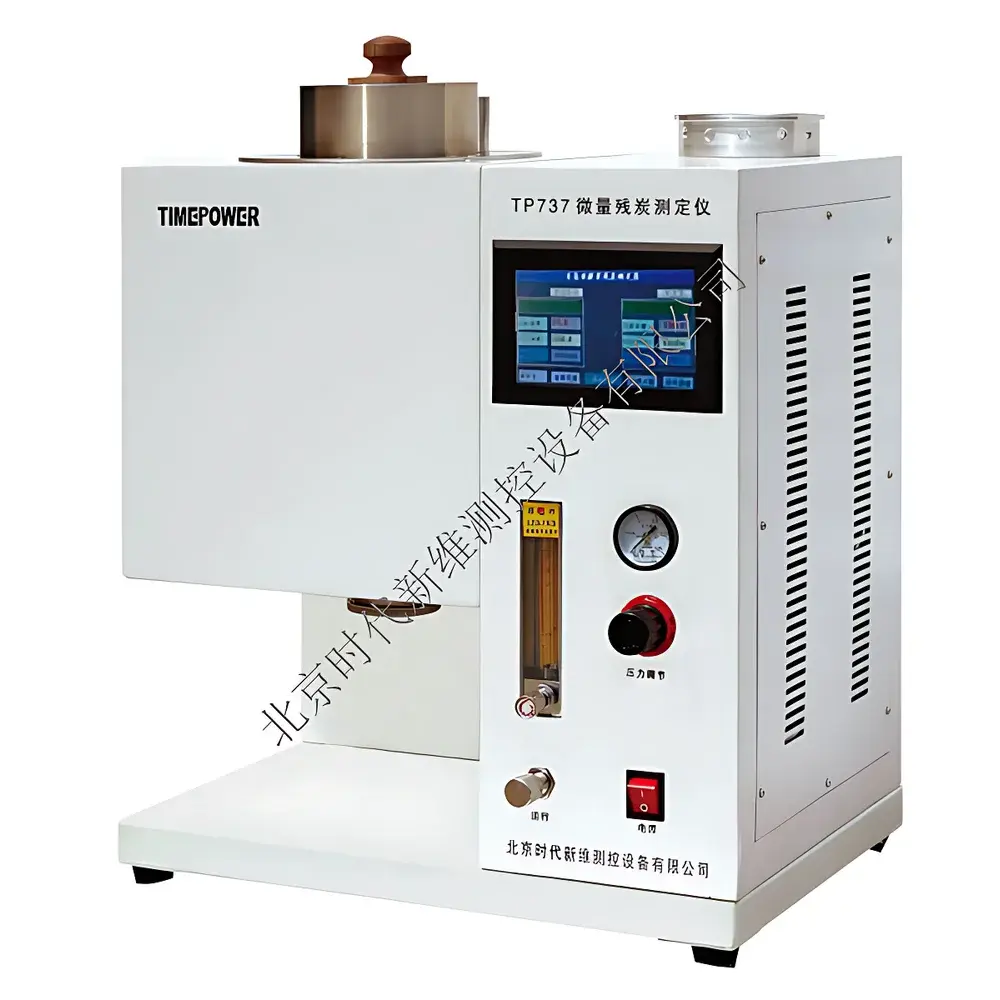
Timepower TP737 Micro Carbon Residue Analyzer for Petroleum Products
| Brand | Timepower |
|---|---|
| Origin | Beijing, China |
| Manufacturer Type | Direct Manufacturer |
| Country of Origin | China |
| Model | TP737 |
| Pricing | Upon Request |
Overview
The Timepower TP737 Micro Carbon Residue Analyzer is a precision laboratory instrument engineered for the quantitative determination of micro carbon residue (MCR) in petroleum products according to ASTM D7042 and ISO 10370 — equivalent to Chinese national standard GB/T 17144–1997. It employs the micro-method carbon residue test principle based on controlled thermal decomposition under inert nitrogen atmosphere. A precisely weighed sample is introduced into a quartz sample tube and subjected to a defined temperature ramp (up to 500 °C) in a sealed, nitrogen-purged furnace. Volatile fractions are swept away by continuous nitrogen flow, while non-volatile carbonaceous residue remains. The residual mass, expressed as weight percent of the original sample, is automatically calculated and reported as MCR value. This method provides high reproducibility for evaluating the coke-forming tendency of distillate fuels, lubricating oils, heavy fuel oils, and cracked stocks — critical for refining process control, fuel stability assessment, and compliance with refinery feedstock specifications.
Key Features
- 5-inch TFT color touchscreen interface with intuitive navigation, real-time graphical display of temperature profile, nitrogen flow rate, and test progress timeline
- Automated dual-parameter control: precise programmable heating ramp (0–500 °C) and regulated nitrogen purge flow (0.1–1.5 L/min), both continuously monitored and logged
- Embedded real-time operating system ensuring deterministic response, system stability, and immunity to external software interference
- Optimized high-temperature furnace architecture with ceramic insulation, uniform axial temperature distribution, and fail-safe overtemperature cutoff at 520 °C
- Manual entry capability for tare mass, gross mass, and sample tube ID — enabling full traceability per ASTM D7042 Section 8.2
- Onboard calculation engine compliant with GB/T 17144 Annex A: automatic MCR (%) derivation using (residue mass / initial sample mass) × 100
- Internal non-volatile memory stores up to 100 complete test records with timestamp, operator ID (optional), sample ID, and raw mass data
- Date-filtered data retrieval function supports GLP-aligned audit trail generation and QC record review
Sample Compatibility & Compliance
The TP737 accommodates standard micro carbon residue sample tubes (10 mL and 2 mL variants) conforming to ASTM D7042 geometry requirements. It is validated for use with diesel fuel, jet fuel (Jet A-1, JP-8), marine residual fuels (RMG/RME), vacuum gas oils, and catalytic cracked cycle oils. Instrument design and operational protocols align with ISO/IEC 17025 general requirements for testing laboratories. Data integrity features — including user-accessible audit logs, uneditable timestamps, and tamper-evident result storage — support adherence to FDA 21 CFR Part 11 principles where electronic records are subject to regulatory review. All thermal calibration procedures follow traceable NIST-traceable reference standards.
Software & Data Management
No external PC software is required for routine operation; all functions execute natively on the embedded controller. Test reports export via USB port in CSV format, containing: test ID, date/time stamp, ambient temperature/humidity, initial mass (g), residue mass (g), calculated MCR (%), nitrogen pressure (MPa), peak furnace temperature (°C), and operator annotation field. Exported files are compatible with LIMS integration and statistical process control (SPC) platforms. Firmware updates are delivered via secure USB media with version-controlled checksum verification. System logs retain last 30 days of operational events (e.g., door open/close, alarm triggers, calibration resets) for internal QA review.
Applications
- Refinery QC labs: monitoring MCR in hydrotreated diesel to ensure compliance with EN 590 or ASTM D975 sulfur and stability limits
- Fuel trading laboratories: verifying contractual MCR specifications for bunker fuel deliveries (ISO 8217)
- Lubricant formulation R&D: correlating MCR values with sludge formation propensity in engine oil base stocks
- Research institutions: studying thermal degradation kinetics of bio-derived hydrocarbon blends under simulated coking conditions
- Third-party inspection agencies: performing accredited MCR testing per CNAS-CL01:2018 (equivalent to ISO/IEC 17025)
FAQ
What safety interlocks does the TP737 incorporate?
The analyzer features dual hardware-level safeguards: (1) independent thermocouple-based overtemperature cutoff at 520 °C, triggering audible alarm and immediate power cut-off; (2) nitrogen pressure sensor monitoring — if inlet pressure falls below 0.08 MPa, heating halts and alarm activates.
Is the instrument suitable for GLP-compliant environments?
Yes. All test records include immutable timestamps, operator-assigned IDs, and full mass input history. Audit log retention and CSV export format enable full traceability required under OECD GLP Principles and pharmaceutical QC workflows.
Can the TP737 be calibrated internally without external equipment?
Yes. Built-in calibration mode supports two-point verification using certified reference thermocouples (Type K, ±0.5 °C accuracy) and digital mass calibrators traceable to national standards. Calibration certificates can be printed directly from the device.
What maintenance intervals are recommended?
Quartz sample tubes should be inspected after every 20 tests for cracks or residue buildup; furnace chamber cleaning is advised monthly using dry nitrogen purge and lint-free swabs. Annual verification of nitrogen flow meter accuracy and thermocouple drift is recommended per ISO/IEC 17025 Clause 6.4.





