
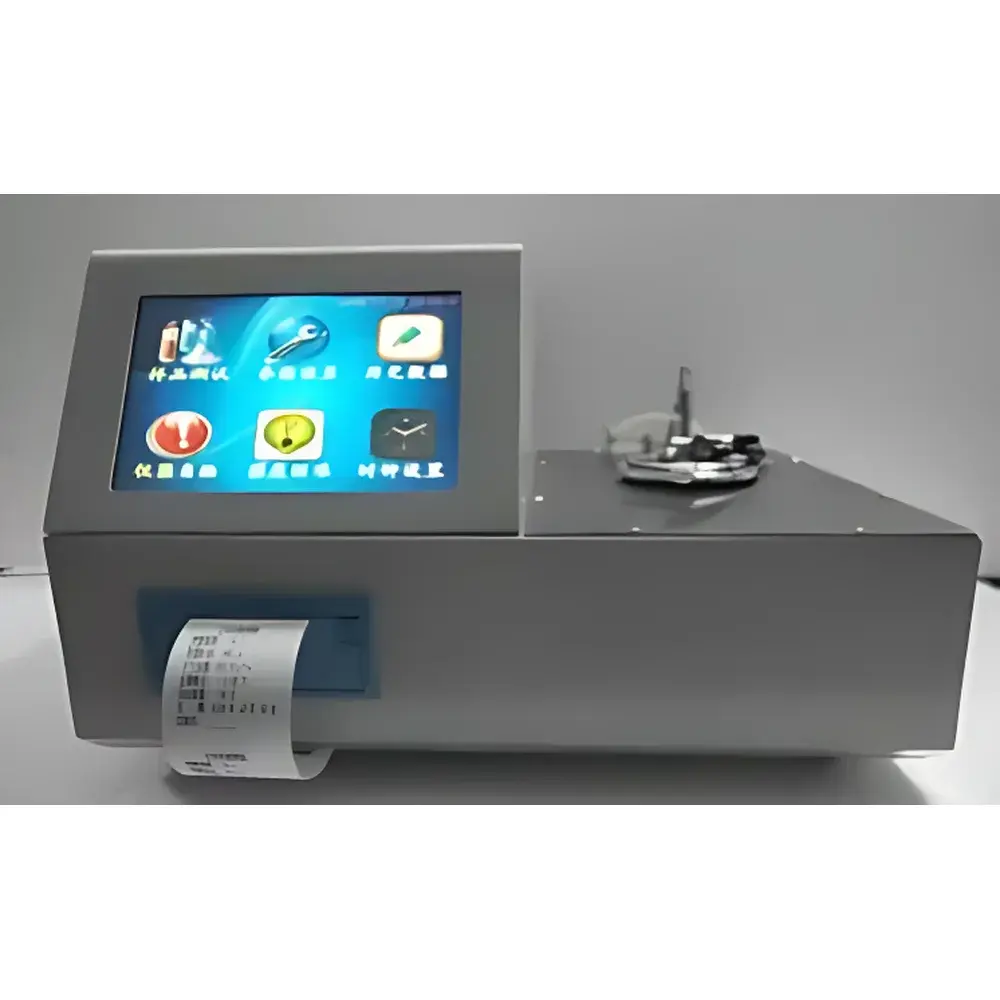
Timepower TP5110 Automated Low-Temperature Closed-Cup Flash Point Tester
| Brand | Timepower |
|---|---|
| Origin | Beijing, China |
| Manufacturer Type | Manufacturer |
| Country of Origin | China |
| Model | TP5110 |
| Detection Method | Closed-Cup (Rapid Equilibrium) |
| Flash Point Range | −20 °C to +80 °C |
| Repeatability | ≤2 °C (same operator) |
| Reproducibility | ≤3 °C (different operators) |
| Temperature Control Accuracy | ±0.5 °C |
| Ignition Method | Electronic Spark |
| Cooling Method | Peltier-based with optional external chilled water circulation |
| Ambient Operating Conditions | 5–30 °C, 30–80% RH |
| Sample Volume | 2 mL (liquids), 4 mL (solids/semi-solids) |
| Power Supply | AC 220 V ±10%, 50 Hz ±10% |
| Power Consumption | ≤300 W |
| Data Storage | 120 test records |
| Display | 8-inch industrial-grade true-color touchscreen (bilingual UI) |
| Sensor | Imported PT1000 platinum resistance thermometer |
| Flash Detection | High-speed millisecond-response optical/thermal hybrid sensor |
| Compliance | GB/T 5208, ISO 1523, ISO 3679 |
Overview
The Timepower TP5110 Automated Low-Temperature Closed-Cup Flash Point Tester is an engineered solution for precise, repeatable flash point determination of volatile petroleum products, solvents, lubricants, and specialty chemicals in accordance with internationally recognized closed-cup equilibrium methods. It operates on the fundamental principle of rapid equilibrium closed-cup testing: a defined sample volume is heated under controlled conditions within a sealed test cup; vapor concentration builds until the mixture above the liquid surface reaches its lower flammability limit. At that point, application of an electric spark induces momentary ignition—defined as the flash point. The instrument dynamically regulates heating rate via real-time feedback from a high-accuracy PT1000 sensor, ensuring compliance with the thermal ramp profiles specified in GB/T 5208, ISO 1523, and ISO 3679. Designed for laboratories requiring traceable, auditable, and operator-independent results, the TP5110 eliminates manual intervention beyond sample loading and ignition initiation—making it suitable for routine QC, safety data sheet (SDS) generation, regulatory submissions, and R&D screening.
Key Features
- True industrial 8-inch capacitive touchscreen with dual-language (English/Chinese) interface and intuitive workflow navigation.
- Integrated atmospheric pressure compensation algorithm—automatically adjusts flash point values using real-time barometric input to meet ASTM D93 and ISO 2719 correction requirements.
- Peltier-based thermoelectric cooling system enables rapid temperature stabilization and sub-ambient operation down to −20 °C; supports optional external chilled water circulation for extended low-temperature stability.
- Millisecond-response flash detection module combining optical flame sensing and thermal transient analysis for unambiguous event identification.
- Embedded Renesas microcontroller architecture ensures deterministic real-time control, data integrity, and electromagnetic compatibility in industrial lab environments.
- Onboard non-volatile memory stores up to 120 complete test records—including timestamp, ambient pressure, raw temperature curve, detected flash point, and operator ID—accessible via USB export or thermal printer output.
- Graphical real-time plotting of temperature vs. time during test execution, enabling visual verification of heating profile conformity and outlier detection.
- Minimal sample consumption (2 mL for liquids; 4 mL for viscous or semi-solid samples) reduces reagent cost and hazardous waste generation.
- Automated test sequence: cup sealing, temperature ramping, vapor equilibration, spark ignition, flash confirmation, result calculation, thermal shutdown, and arm retraction—all without user intervention after initialization.
Sample Compatibility & Compliance
The TP5110 is validated for use with distillates, base oils, jet fuels, diesel blends, biofuels, paint thinners, cleaning solvents, and other low-viscosity hydrocarbon mixtures exhibiting flash points between −20 °C and +80 °C. It is not intended for highly viscous residues, asphaltic materials, or substances with decomposition temperatures below the test range. All operational parameters—including heating rate, stir speed, ignition timing, and cup geometry—conform strictly to the dimensional and procedural specifications of GB/T 5208 (equivalent to ISO 1523) and ISO 3679. The system supports GLP-compliant workflows through audit-trail-capable data logging and traceable calibration documentation. While not FDA 21 CFR Part 11 certified out-of-the-box, the firmware architecture allows integration into validated LIMS environments via RS232/USB serial protocols and standardized CSV data export.
Software & Data Management
The TP5110 operates autonomously without PC dependency. Its embedded firmware implements deterministic state-machine logic for test execution, error recovery, and fault logging. All measurement data—including raw sensor outputs, interpolated flash point, pressure-corrected value, and pass/fail flags per method criteria—are timestamped and stored locally. Thermal printing provides immediate hard-copy documentation compliant with internal QA checklists. For centralized data aggregation, users may connect the device to a laboratory network via optional USB-to-Ethernet adapter (sold separately), enabling scheduled batch exports to shared drives or LIMS ingestion scripts. Calibration constants are protected by password-locked firmware menus and require traceable reference standards (e.g., n-decane, n-dodecane) for adjustment—ensuring metrological continuity across instrument lifecycles.
Applications
- Quality control of aviation turbine fuel (Jet A-1, JP-8) per DEF STAN 91-91 and ASTM D1655.
- Flash point verification of biodiesel blends (B5–B20) prior to distribution, aligned with EN 14214 and ASTM D6751.
- Regulatory compliance testing for solvent-based coatings and adhesives under REACH Annex XVII and OSHA HCS 2012.
- R&D screening of novel low-VOC formulations where volatility must be balanced against flammability risk.
- Third-party certification testing for customs clearance and international shipping documentation (IMDG Code Class 3 classification).
- Internal safety assessments for refinery off-gas condensates, hydrotreater feeds, and storage tank bottom sediments.
FAQ
What standards does the TP5110 comply with?
It fully conforms to GB/T 5208, ISO 1523, and ISO 3679 for rapid equilibrium closed-cup flash point determination.
Is external cooling water mandatory for operation?
No—it is optional. The built-in Peltier cooler achieves −20 °C independently; external chilled water improves thermal stability during high-throughput testing or ambient temperatures above 25 °C.
How is atmospheric pressure correction applied?
The instrument accepts manual barometric input or connects to an optional digital pressure transducer; correction follows the polynomial equation defined in ISO 1523 Annex B.
Can test data be exported to Excel or LIMS?
Yes—via USB flash drive in comma-separated values (CSV) format, including all metadata required for audit readiness.
What maintenance is required for long-term accuracy?
Routine cleaning of the test cup and flash sensor window with lint-free tissue and analytical-grade acetone; annual verification using certified reference materials is recommended.







