
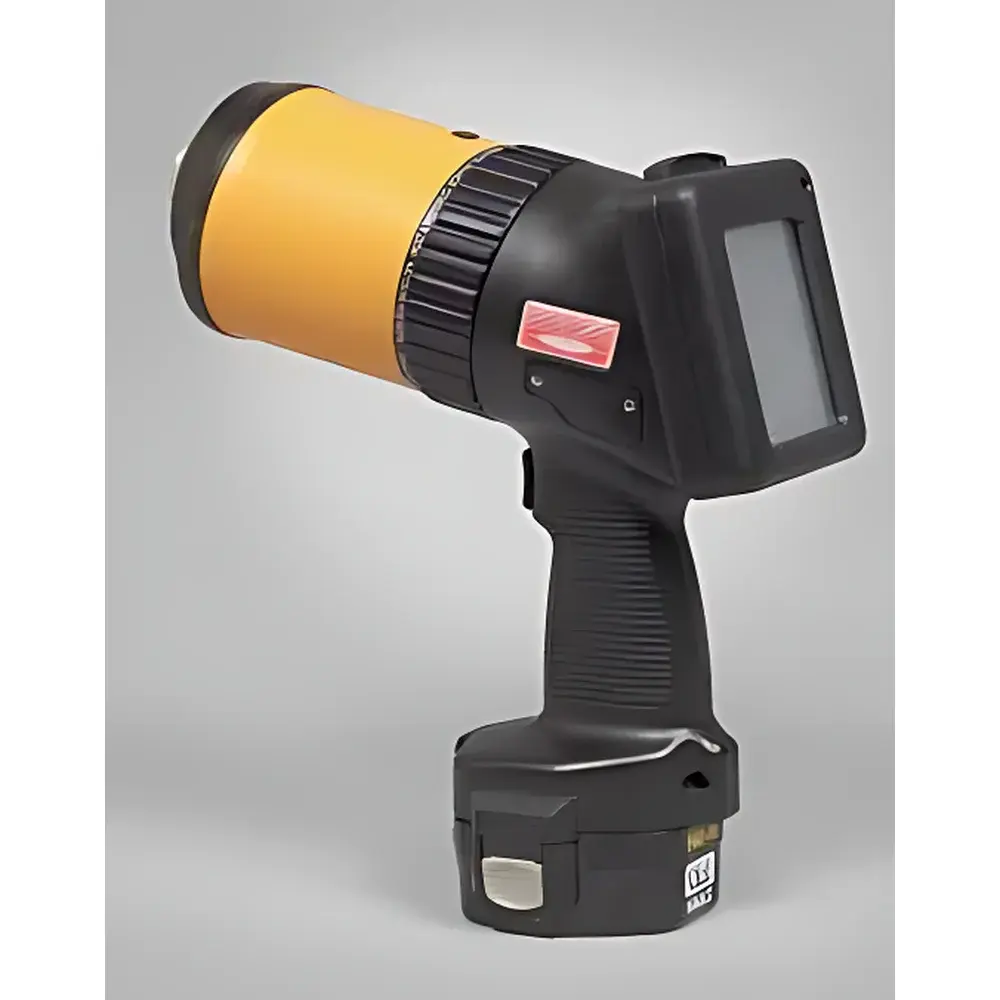
SurfaceOptics 410Solar Portable Solar Reflectance Meter
| Brand | SurfaceOptics |
|---|---|
| Origin | USA |
| Model | 410Solar |
| Measurement Principle | Integrating Sphere-Based Spectral Reflectance Metrology |
| Imaging Type | Interferometric (for spectral calibration traceability) |
| Deployment Mode | Ground-Based Field & Laboratory Use |
| Compliance | ASTM E903, ASTM C1549 |
| Spectral Range | 335–2500 nm across 7 discrete bands |
| Incident Angle | 20° from normal |
| Beam Spot Diameter | 0.250" |
| Beam Half-Angle | 3° |
| Measurement Time | 10 s per acquisition |
| Warm-up Time | 90 s (VIS-NIR tungsten source) |
| Detector | Thermopile + Si/InGaAs array architecture |
| Data Output | Total reflectance, diffuse reflectance, and 20° specular reflectance |
| Calibration | NIST-traceable gold mirror standard included |
| Operating Environment | 0–40 °C (non-condensing) |
| Storage | −25–70 °C |
| Power | Rechargeable NiMH battery pack (dual cells) |
| Weight | 2.1 kg (inclusive of batteries) |
| Interface | Touchscreen LCD with embedded PDA OS |
| Data Storage | Internal SD card |
| Probe Design | Modular, field-replaceable head |
Overview
The SurfaceOptics 410Solar Portable Solar Reflectance Meter is a field-deployable, NIST-traceable spectral reflectometer engineered for quantitative optical characterization of material surfaces under ambient or controlled conditions. It operates on the principle of integrating sphere-based bidirectional reflectance distribution function (BRDF) sampling at a fixed 20° angle of incidence, enabling precise separation and quantification of total, diffuse, and specular reflectance components in accordance with ASTM E903 (Standard Test Method for Solar Absorptance, Reflectance, and Transmittance of Materials Using Integrating Spheres) and ASTM C1549 (Standard Test Method for Determination of Solar Reflectance Near Ambient Temperature Using a Portable Solar Reflectometer). Unlike scanning spectroradiometers or Fourier-transform systems, the 410Solar employs a stabilized broadband tungsten source coupled with bandpass-filtered detection across seven non-overlapping spectral intervals—spanning ultraviolet-visible-near-infrared (UV-VIS-NIR: 335–1100 nm) and short-wave infrared (SWIR: 1000–2500 nm)—to deliver hemispherical reflectance (DHR) data optimized for solar-weighted performance evaluation.
Key Features
- Integrated optical architecture: Combines collimated 20° incident beam, precision-machined integrating sphere (gold-coated interior), thermopile and solid-state photodetectors (Si + InGaAs), and embedded microprocessor control—all housed in a ruggedized portable enclosure.
- NIST-traceable calibration: Supplied with certified gold mirror reference standard; factory calibration certificates include uncertainty budgets aligned with ISO/IEC 17025 requirements.
- Modular probe design: Interchangeable measurement heads support rapid adaptation to varying surface geometries—including convex surfaces up to 6″ radius and concave surfaces up to 12″ radius—without recalibration.
- Field-optimized operation: Fully autonomous with dual rechargeable NiMH batteries; 10-second measurement cycle after 90-second warm-up; touchscreen PDA interface with on-device data logging to SD card.
- Spectral fidelity: Seven discrete bandpass channels ensure compliance with CIE solar irradiance weighting functions and facilitate calculation of solar reflectance (ρsolar) per ASTM E903 Annex A1.
Sample Compatibility & Compliance
The 410Solar accommodates flat, curved, textured, or coated surfaces typical of building envelopes, aerospace thermal control coatings, solar absorber plates, telescope mirror substrates, and optical thin-film stacks. Its 0.250″ diameter illumination spot (3° half-angle divergence) ensures spatial uniformity across heterogeneous samples while minimizing edge diffraction artifacts. Instrument validation conforms to GLP-aligned documentation practices, with full audit trails available for calibration history, firmware versioning, and environmental monitoring logs. Data outputs satisfy reporting requirements for LEED v4.1 Building Product Disclosure and Optimization credits, Cool Roof Rating Council (CRRC) certification, and Department of Energy’s Solar Rating & Certification Corporation (SRCC) protocols.
Software & Data Management
Onboard firmware supports real-time computation of directional-hemispherical reflectance (DHR), including decomposition into specular and diffuse components using validated sphere geometry correction algorithms. Export formats include CSV and XML, compatible with third-party analysis tools such as MATLAB, Python (NumPy/Pandas), and ENVI. Optional desktop software provides extended post-processing: spectral interpolation, solar-weighted integration (per ASTM G173-03 reference spectrum), and batch statistical reporting. All system logs comply with FDA 21 CFR Part 11 electronic record integrity requirements when configured with user authentication and digital signature modules.
Applications
- Aerospace: Thermal control coating verification on satellite radiators and re-entry vehicle heat shields.
- Astronomy: In-situ reflectance mapping of segmented primary mirrors and adaptive optics substrates prior to aluminization.
- Building science: On-site measurement of cool roof membranes, façade cladding, and low-emissivity glazing for ASHRAE 90.1 and IECC compliance verification.
- Photovoltaics: Characterization of anti-reflective coatings, passivation layers, and bifacial module rear-side albedo under variable incidence angles.
- Materials R&D: High-throughput screening of novel IR-reflective pigments, metamaterials, and radiative cooling films across UV–SWIR bands.
FAQ
Does the 410Solar require external power or PC connection during operation?
No—it operates autonomously via internal NiMH batteries and stores all measurement data onboard to an SD card.
Can the instrument measure emissivity directly?
No; it measures reflectance only. Emissivity is inferred indirectly via Kirchhoff’s law (ε = 1 − ρ) under assumptions of opaque, thermally thick, and diffuse-gray behavior—valid for most architectural and industrial coatings in the 2.5–25 µm range.
Is the 20° incident angle configurable?
No; the optical path is fixed at 20° to maintain compliance with ASTM E903 and enable direct comparison with CRRC and ENERGY STAR databases.
How is NIST traceability maintained over time?
Users perform routine verification using the supplied gold mirror standard; annual recalibration by SurfaceOptics’ ISO/IEC 17025-accredited laboratory is recommended for regulatory submissions.
What surface curvature limits apply?
The probe accommodates convex surfaces with ≥6″ radius of curvature and concave surfaces with ≥12″ radius—verified via geometric ray-tracing validation per IEC 60825-1 Annex F.






