
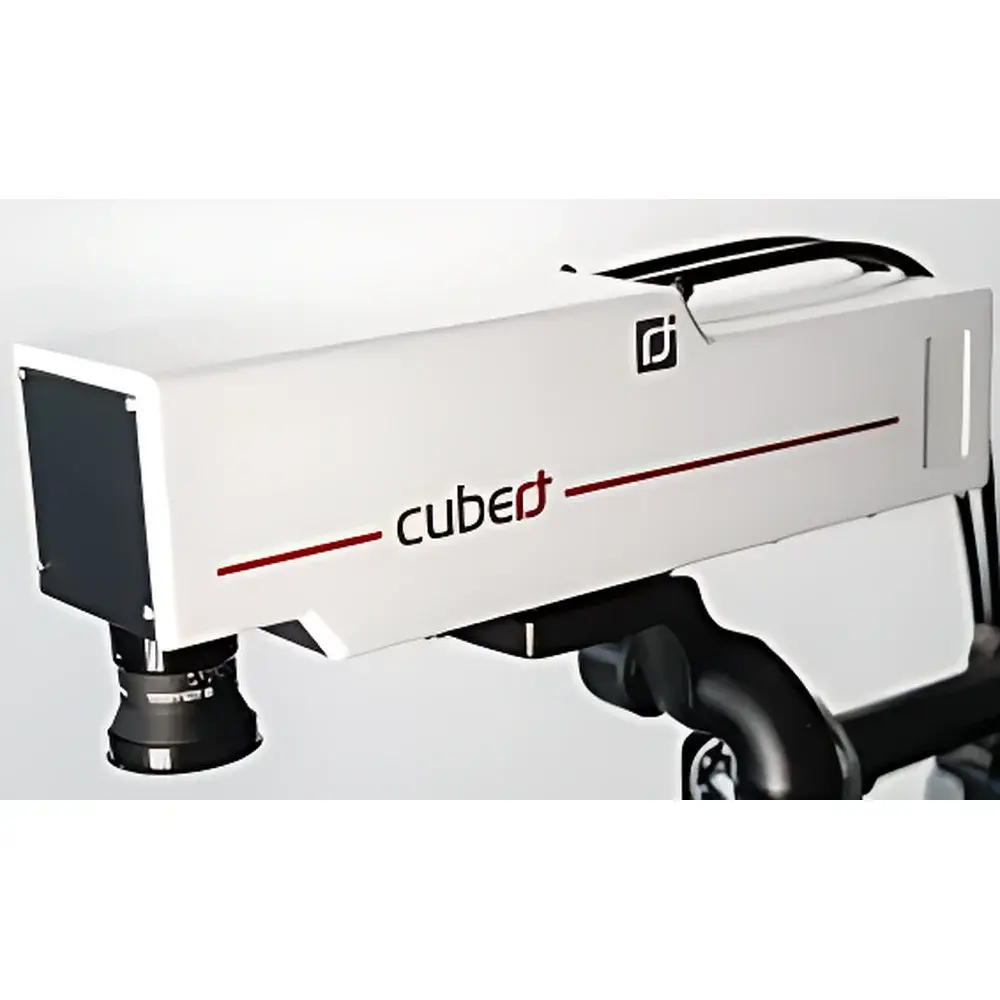
Cubert S496 Blue Snapshot Hyperspectral Imaging Camera
| Brand | Cubert |
|---|---|
| Origin | Germany |
| Model | S496 Blue |
| Spectral Range | 370–870 nm |
| Spectral Resolution | 10 nm @ 532 nm |
| Frame Rate | 15 Hyperspectral Cubes/s |
| Detector | Dual Si CCD (Panchromatic 2 MP + Spectral 1 MP) |
| Digital Resolution | 12-bit |
| Exposure Time | 0.1–1000 ms |
| Interface | Dual USB 3.0 |
| Lens Options | 10 mm, 16 mm, 23 mm, 35 mm |
| Operating Temperature | −10 to +50 °C |
| Weight | 1200 g |
| Power Supply | DC 12 V, 8 W |
| Environmental Rating | Dry, non-condensing |
| Data Output | 4900 spectra per cube |
Overview
The Cubert S496 Blue is a snapshot-based, frame-sequential hyperspectral imaging camera engineered for high-fidelity spectral data acquisition in dynamic airborne and ground-based remote sensing applications. Unlike push-broom or scanning systems that rely on relative motion between sensor and target—introducing geometric distortion, motion artifacts, and synchronization dependencies—the S496 Blue employs a patented snapshot architecture based on image-splitting optics and dual-sensor fusion. This enables simultaneous capture of spatial and spectral information across all 125 spectral channels within a single exposure (as fast as 1 ms), preserving temporal coherence and eliminating parallax-induced misregistration. Its spectral response spans the visible to near-infrared (VNIR) domain (370–870 nm) with a nominal sampling interval of 4 nm and a measured full-width-at-half-maximum (FWHM) resolution of 10 nm at 532 nm. Designed for integration onto unmanned aerial vehicles (UAVs), the system delivers 15 full hyperspectral cubes per second—each cube comprising a 2D spatial array (up to 2048 × 2048 pixels) and a 125-band spectral dimension—without requiring inertial navigation systems (INS) for georeferencing or mosaicking.
Key Features
- Snapshot hyperspectral acquisition: All spectral bands captured simultaneously in a single exposure—no moving parts, no temporal aliasing, no motion-induced spectral smearing.
- Dual-CCD architecture: Separate panchromatic (2 MP) and spectral (1 MP) sensors enable high-resolution spatial context and calibrated spectral fidelity in parallel.
- Real-time onboard preview: Integrated USB 3.0 interface supports live streaming of RGB-composite previews and raw cube metadata to ground control stations.
- UAV-optimized mechanical design: Compact form factor (1200 g), low power draw (12 V DC, 8 W), wide operating temperature range (−10 to +50 °C), and vibration-resistant housing compliant with common UAV payload mounting standards (e.g., DJI SkyPort, custom gimbal interfaces).
- Flexible optical configuration: Interchangeable fixed-focal-length lenses (10 mm, 16 mm, 23 mm, 35 mm) support variable ground sampling distances (GSD) from sub-centimeter to meter-scale resolutions depending on flight altitude and platform velocity.
- Global shutter operation: Ensures pixel-level time synchronization across all spectral channels—critical for quantitative reflectance modeling under variable illumination or rapid platform motion.
Sample Compatibility & Compliance
The S496 Blue is compatible with heterogeneous sample geometries and deployment modalities—including fixed-wing and multirotor UAVs, terrestrial tripods, vehicle-mounted rigs, and laboratory gantries. Its sealed, non-condensing enclosure meets IP52-equivalent environmental protection for field-deployable operation in ambient outdoor conditions. While not certified to specific regulatory frameworks (e.g., FAA Part 107 compliance is platform-dependent), the instrument adheres to electromagnetic compatibility (EMC) guidelines per EN 61326-1 and operates within CE-marked electrical safety limits. Data integrity protocols align with FAIR principles (Findable, Accessible, Interoperable, Reusable); spectral radiometric calibration is traceable to NIST-traceable standards via factory-applied coefficients embedded in each data cube header. The system supports export-controlled spectral data handling in accordance with EAR99 classification.
Software & Data Management
Cubert’s proprietary uSDK (universal Software Development Kit) provides open APIs in Python, MATLAB, and C++ for direct access to raw cube streams, metadata parsing, and real-time preprocessing. The included Cubert Studio software suite enables batch processing of hyperspectral datasets—including radiometric correction, atmospheric compensation (using MODTRAN-derived LUTs), spectral library matching (USGS, ECOSTRESS, SPECCHIO), vegetation index computation (NDVI, EVI, PRI, CIred-edge), supervised/unsupervised classification (SVM, K-means, Random Forest), and large-area orthomosaic generation via feature-based tie-point registration. All processing workflows generate audit-trail logs compliant with GLP documentation requirements. Data output formats include ENVI-compatible BIL/BIP, GeoTIFF with embedded spectral metadata, and HDF5 for scalable scientific computing environments.
Applications
- Agricultural monitoring: High-throughput phenotyping, nitrogen status mapping, early stress detection (water, nutrient, pathogen), and yield prediction at field scale.
- Environmental assessment: Wetland delineation, invasive species identification, soil organic carbon estimation, and post-wildfire vegetation recovery tracking.
- Geological surveying: Mineralogical mapping (e.g., clay, carbonate, iron oxide signatures), lithological boundary detection, and tailings pond characterization.
- Cultural heritage: Pigment identification in frescoes and manuscripts, subsurface layer visualization, and degradation pattern analysis without contact.
- Industrial QA: Coating uniformity verification, polymer blend homogeneity assessment, and counterfeit material discrimination in supply chain inspection.
FAQ
Does the S496 Blue require an INS or GPS for georeferencing?
No—its snapshot architecture allows accurate orthorectification and mosaic stitching using only GNSS-tagged image footprints and SfM-based tie-point matching; INS is optional for enhanced roll/pitch/yaw stabilization in turbulent flight.
Can spectral calibration be performed in-field?
Yes—portable reference panels (e.g., Spectralon® 99% reflectance) are supported via integrated reflectance normalization routines; factory calibration remains valid for 24 months under normal storage and usage conditions.
Is the 125-channel spectral response configurable per acquisition?
No—the spectral sampling grid is fixed at hardware level; however, users may apply post-acquisition band selection, averaging, or PCA-driven dimensionality reduction within Cubert Studio.
What is the maximum sustainable data throughput over USB 3.0?
At full resolution (12-bit, 125 bands, 1024 × 1024 spatial), sustained transfer exceeds 320 MB/s—enabling continuous recording at ≥12 cubes/s to NVMe SSDs with appropriate host buffering.
Are third-party processing plugins supported?
Yes—uSDK exposes low-level memory-mapped buffers and metadata structures, enabling integration with ENVI, ArcGIS Pro (via Python toolboxes), and open-source stacks such as scikit-learn, PyTorch, and GDAL.
Related Products





