
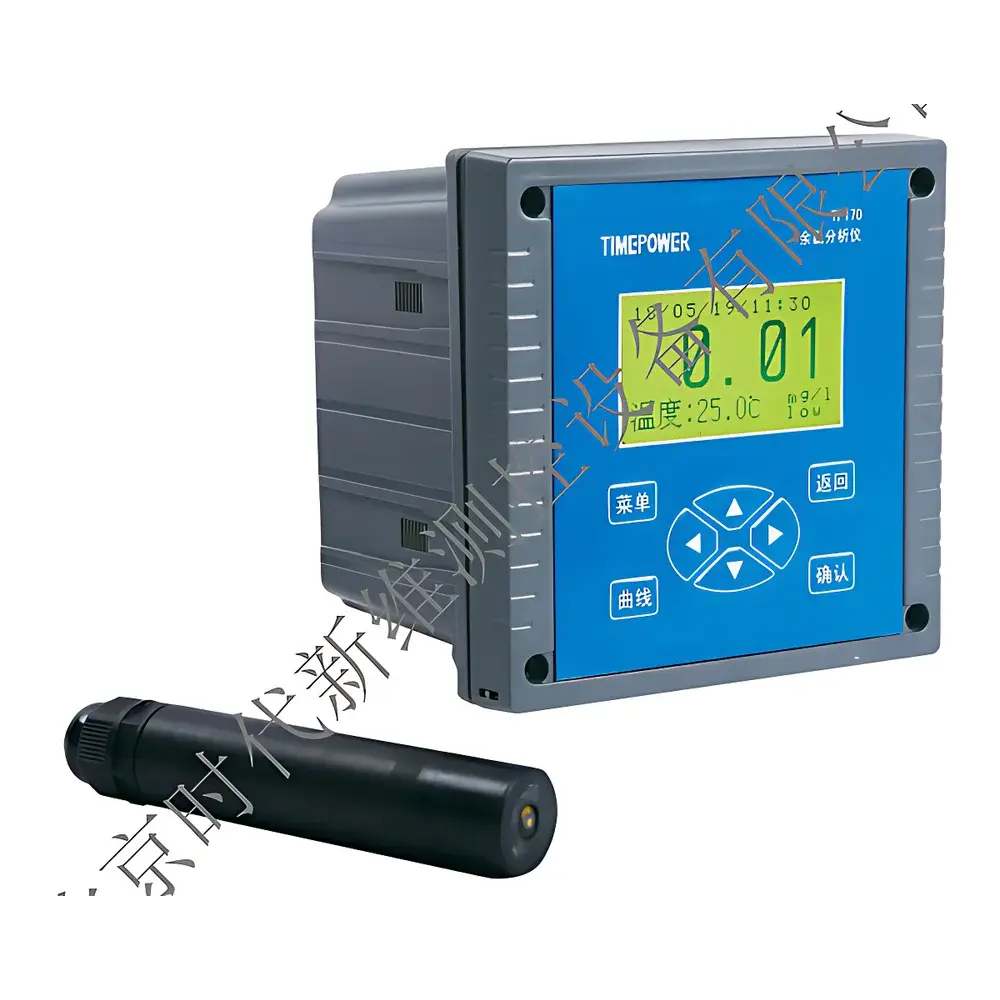
TimePower TP-170 Online Residual Chlorine Analyzer
| Brand | TimePower |
|---|---|
| Origin | Beijing, China |
| Manufacturer Type | Manufacturer |
| Product Category | Domestic |
| Model | TP-170 |
| Instrument Type | Online Analyzer |
| Measurement Principle | Electrochemical Amperometric Sensor |
| Measured Parameter | Free Residual Chlorine |
| Range | 0.01–5.00 mg/L |
| Accuracy | ≤3% of reading |
| Repeatability | ±0.02 mg/L |
| Resolution | 0.01 mg/L |
| Detection Limit | 0.035 mg/L |
| Display | 128×64 Dot-Matrix LCD (Chinese UI) |
| Output Signals | Selectable 0–10 mA, 0–20 mA, or 4–20 mA analog outputs |
| Data Storage | Cyclic memory with auto-overflow management |
| A/D Conversion | 24-bit high-resolution ADC |
| Microcontroller Architecture | Integrated low-power single-chip system |
| PCB Technology | Surface-mount device (SMD) assembly |
| Enclosure Rating | IP65 (industrial indoor/outdoor mounting) |
Overview
The TimePower TP-170 Online Residual Chlorine Analyzer is a dedicated electrochemical monitoring instrument engineered for continuous, real-time quantification of free residual chlorine in aqueous systems. It operates on the principle of amperometric detection—where chlorine species (HOCl/OCl⁻) undergo catalytic reduction at a noble-metal working electrode under controlled potential, generating a current linearly proportional to analyte concentration. This method provides rapid response (<90 seconds T90), minimal reagent dependency, and stable baseline performance across varying pH (6.0–8.5) and temperature (5–45 °C) conditions typical of municipal water distribution, potable water treatment, and recirculating aquatic environments. Unlike colorimetric or DPD-based benchtop methods, the TP-170 eliminates operator intervention, calibration drift from reagent degradation, and optical interferences from turbidity or colored organics—making it suitable for unattended, long-term deployment in GLP-aligned infrastructure.
Key Features
- Electrochemical amperometric sensor with integrated temperature compensation and flow-independent measurement cell design
- High-fidelity 24-bit analog-to-digital conversion ensuring signal integrity and noise rejection in electrically noisy plant environments
- Configurable analog current outputs (0–10 mA, 0–20 mA, or 4–20 mA) compliant with industrial SCADA and DCS integration standards (IEC 61000-6-2/6-4)
- Onboard cyclic data logging with timestamped storage capacity for ≥30 days of 1-minute interval readings; automatic overwrite policy prevents memory overflow
- Robust SMD-based electronics architecture with conformal coating for humidity and corrosion resistance in chlorinated atmospheres
- IP65-rated enclosure enabling wall- or pipe-mounted installation in pump rooms, chlorination chambers, and outdoor kiosks without additional housing
- Low-power microcontroller platform supporting continuous operation on standard 24 VDC supply with <2.5 W nominal consumption
Sample Compatibility & Compliance
The TP-170 is validated for use in clarified, filtered water matrices with turbidity <5 NTU and suspended solids <10 mg/L. It maintains accuracy in applications governed by WHO Guidelines for Drinking-water Quality, EPA Method 334.0 (amperometric), and ISO 7393-2 (electrochemical residual chlorine). While not certified to UL/CE for hazardous locations, its design conforms to EN 61326-1 (EMC for laboratory and industrial equipment) and supports audit-ready documentation for ISO/IEC 17025-accredited laboratories performing routine water quality verification. Sensor lifetime is rated at ≥12 months under continuous operation with bi-weekly manual cleaning per manufacturer protocol.
Software & Data Management
The analyzer includes embedded firmware with configurable alarm thresholds (high/low limit, sensor fault, calibration due), event logging (calibration history, output faults, power cycles), and RS-485 Modbus RTU interface for remote parameter readout and configuration via host SCADA software. No proprietary PC software is required; configuration is accessible through local keypad navigation or industry-standard Modbus register mapping. All stored data are exportable as CSV via optional USB adapter module (sold separately). Audit trail functionality meets basic GLP requirements—each calibration event records operator ID (manual entry), date/time stamp, zero/span values, and deviation from previous calibration curve.
Applications
- Municipal drinking water distribution networks: continuous monitoring at booster stations and endpoint reservoirs
- Swimming pool and spa circulation systems: closed-loop feedback control of sodium hypochlorite dosing pumps
- Hospital central sterile supply departments (CSSD): verification of chlorine concentration in instrument disinfection tanks per HTM 01-05
- Pharmaceutical purified water (PW) and water-for-injection (WFI) loops: compliance support for USP and EU GMP Annex 1
- Power plant condensate polishing systems: prevention of biofilm formation in low-conductivity feedwater
- Aquaculture recirculating aquaculture systems (RAS): protection of sensitive fish species from sublethal chlorine exposure
FAQ
What sample pretreatment is required prior to analysis?
No filtration or chemical conditioning is needed for clarified water. For raw surface water or high-turbidity effluent, inline 5-µm particulate filtration is recommended to prevent sensor fouling.
How often must the sensor be calibrated?
Initial factory calibration is traceable to NIST-certified chlorine standards. Field recalibration is advised every 7–14 days depending on water matrix stability; automated zero-check capability allows daily verification without reagents.
Is the TP-170 compatible with existing PLC-based control systems?
Yes—Modbus RTU over RS-485 enables direct integration with Allen-Bradley, Siemens S7, and Schneider EcoStruxure platforms using standard function codes (03h/06h).
Can the instrument measure combined chlorine or total chlorine?
No—the TP-170 is optimized exclusively for free residual chlorine (HOCl + OCl⁻). Combined chlorine requires separate DPD-based instrumentation per Standard Methods 4500-Cl G.
Does the device support FDA 21 CFR Part 11 compliance?
The base unit does not include electronic signature, role-based access control, or encrypted audit logs required for full Part 11 compliance; however, its data export format and timestamping support integration into validated LIMS environments that provide those controls.







