
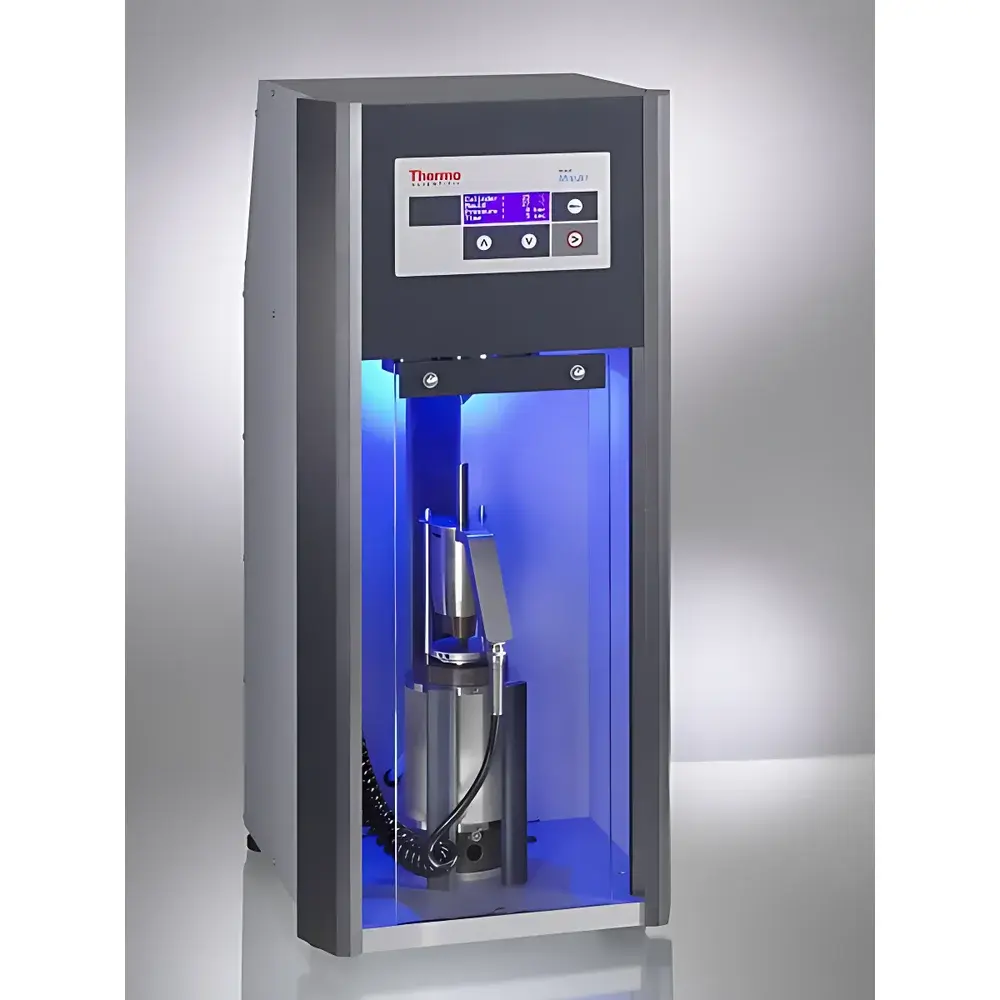
HAAKE MiniJet Pro Micro Injection Molding System
| Brand | Thermo Fisher Scientific |
|---|---|
| Origin | Germany |
| Model | HAAKE MiniJet Pro |
| Maximum Injection Pressure | 1200 bar |
| Compressed Air Supply Pressure | up to 10 bar |
| Barrel Temperature Range | up to 400 °C |
| Mold Temperature Range | up to 250 °C |
| Sample Mass Capacity | 3–5 g per shot |
| Control Interface | Digital LCD Controller with Parameter Storage |
Overview
The HAAKE MiniJet Pro Micro Injection Molding System is a precision-engineered laboratory-scale injection molding instrument developed by Thermo Fisher Scientific (Germany) for thermoplastic polymer research and development. Designed around the principles of conventional screw-assisted injection molding—but scaled to micro-dosage volumes—it enables reproducible fabrication of standardized test specimens (e.g., ASTM D638 tensile bars, ISO 179 Charpy impact samples, or ISO 527 dog-bone geometries) from as little as 3–5 g of material per cycle. Its vertical clamping and injection architecture ensures ergonomic loading, consistent melt homogenization, and minimal thermal lag—critical for evaluating heat-sensitive, high-viscosity, or filled polymers where conventional macro-scale molding introduces excessive shear history or degradation. The system operates under closed-loop temperature control across barrel zones and mold platens, supporting both single-shot and multi-cavity mold configurations with full traceability of process parameters.
Key Features
- Vertical injection unit with integrated servo-controlled plunger drive for precise volumetric dosing and repeatable pressure profiles up to 1200 bar
- Four-zone independently controlled barrel heating (max. 400 °C), calibrated to ±0.5 °C accuracy per zone
- Electrically heated mold platens with PID-controlled temperature regulation (range: ambient to 250 °C; stability ±1 °C)
- Digital LCD controller with non-volatile memory for storing ≥20 user-defined process protocols—including injection speed, hold pressure, cooling time, and temperature ramp profiles
- Modular integration capability: direct mechanical and data interface compatibility with the HAAKE MiniLab II micro-compounder and HAAKE Process 11 micro twin-screw extruder for end-to-end lab-scale formulation workflows
- Compressed air supply interface (rated for ≤10 bar) supporting pneumatic mold actuation and auxiliary venting functions
- CE-compliant safety architecture including interlocked guarding, emergency stop circuitry, and overtemperature cut-off protection
Sample Compatibility & Compliance
The HAAKE MiniJet Pro accommodates a broad spectrum of thermoplastic resins—including commodity grades (PP, PE, PS), engineering plastics (PA6/66, PBT, PC), high-performance polymers (PEEK, PEI, LCP), and filled systems (glass- or carbon-fiber reinforced, mineral-filled, conductive composites). It supports ASTM D3641, ISO 294-1, and ISO 10724-1 methodologies for small-part molding validation. All temperature and pressure logging meets GLP data integrity requirements; optional analog/digital I/O ports enable integration into FDA 21 CFR Part 11–compliant LIMS environments when paired with validated third-party acquisition software. Traceable calibration certificates are available for temperature sensors and pressure transducers per ISO/IEC 17025-accredited procedures.
Software & Data Management
While the embedded LCD controller provides standalone operation with parameter recall and real-time status feedback, the system supports RS485/Modbus RTU communication for external SCADA or custom LabVIEW-based monitoring. Process logs—including barrel zone temperatures, mold cavity pressure (when equipped with optional piezoelectric sensor), injection time, and plunger displacement—are timestamped and exportable in CSV format. For audit-ready documentation, users may configure automated report generation aligned with internal SOPs or regulatory submission templates (e.g., IMDS, REACH, or automotive PPAP Level 3). Firmware updates are delivered via USB stick with version-controlled release notes and change logs.
Applications
- Rapid screening of new polymer formulations prior to pilot-scale extrusion or industrial molding trials
- Generation of mechanically tested specimens from limited synthesis batches (e.g., novel biopolymers, lab-synthesized polyesters, or functionalized copolymers)
- Investigation of thermal degradation thresholds, shear sensitivity, and filler dispersion effects under controlled residence time conditions
- Calibration reference specimen production for DMA, DSC, and rheological master curve construction
- Teaching laboratories requiring safe, compact, and visually transparent demonstration of injection molding fundamentals
- Quality control of incoming raw materials using standardized morphology–property correlations derived from micro-molded samples
FAQ
What is the minimum recommended sample mass for reliable molding with the MiniJet Pro?
The system is optimized for 3–5 g per shot; consistent part quality is achievable down to 2.5 g with careful mold design and process tuning.
Can the MiniJet Pro be used with reactive polymers or thermosets?
No—it is designed exclusively for thermoplastic processing; no provisions exist for curing cycles, venting volatiles, or handling crosslinking chemistries.
Is mold interchangeability supported across HAAKE micro-platform instruments?
Yes—standardized mounting interfaces and platen dimensions allow shared use of molds between the MiniJet Pro, MiniLab II, and Process 11 platforms.
Does Thermo Fisher provide validation documentation for GxP environments?
IQ/OQ documentation packages are available upon request; PQ support requires site-specific protocol development in collaboration with qualified validation engineers.
What maintenance intervals are recommended for long-term operational reliability?
Barrel cleaning after every 10–15 runs with abrasive or filled compounds; annual verification of thermocouple drift and pressure transducer linearity per manufacturer service bulletin.



