
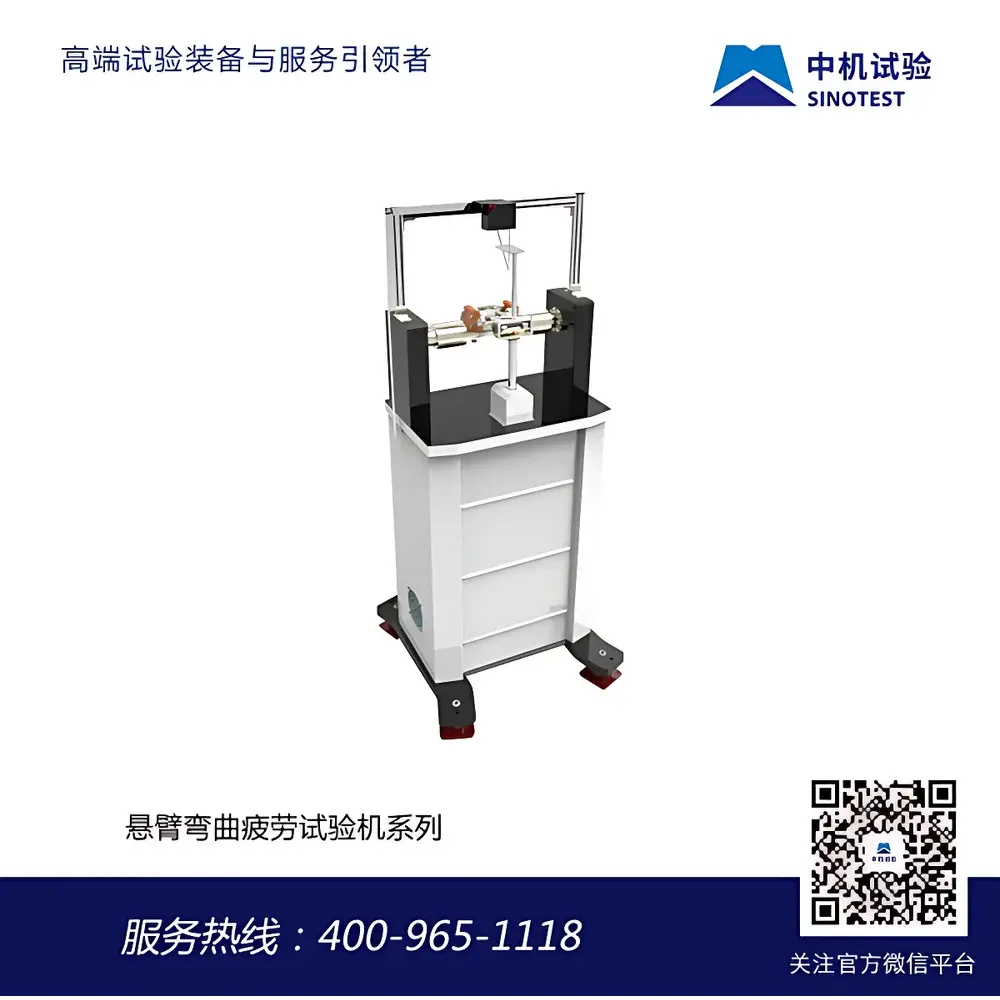
WQP Series Cantilever Bending Fatigue Testing Machine
| Brand | SINOTEST |
|---|---|
| Origin | Jilin, China |
| Manufacturer Type | Direct Manufacturer |
| Country of Origin | China |
| Model | WQP Series |
| Pricing | Available Upon Request |
| Compliance | JB/T 9371–2015 Technical Specifications for Pure Bending Fatigue Testing Machines |
Overview
The WQP Series Cantilever Bending Fatigue Testing Machine is a precision-engineered mechanical test system designed to evaluate the fatigue resistance of structural materials under controlled cantilever bending loading conditions. It operates on the principle of applying a dynamic, sinusoidal bending moment at the free end of a fixed specimen—typically rectangular plates or cylindrical rods—thereby inducing cyclic tensile and compressive stresses concentrated at the clamped root section. This stress gradient enables high-fidelity simulation of real-world service conditions where components experience repeated flexural loading without axial constraint, such as in turbine blades, dental prostheses, orthopedic implants, and printed circuit board substrates. The machine delivers repeatable, traceable fatigue data—including fatigue life (Nf), crack initiation threshold, and S–N curve generation—under fully instrumented load and displacement feedback. Its rigid frame architecture, servo-controlled actuation, and low-inertia loading train ensure minimal phase lag and high waveform fidelity across frequency ranges typical for low-cycle (1–100 Hz) and high-cycle (100–500 Hz) fatigue regimes.
Key Features
- Modular cantilever fixture system accommodating standardized specimen geometries per ISO 13584, ASTM E466, and GB/T 24171.1—supporting widths from 5 mm to 50 mm and thicknesses up to 20 mm.
- Electro-hydraulic or electromechanical servo-actuation options, with closed-loop force control accuracy ≤ ±0.5% of full scale and displacement resolution ≤ 0.1 µm.
- Integrated strain monitoring via bonded foil gauges or non-contact digital image correlation (DIC) ports for localized root-strain mapping during cycling.
- Real-time crack detection capability using acoustic emission (AE) sensor integration (optional), synchronized with load-cycle indexing for precise crack initiation timing.
- Thermally stable base frame with vibration-damping granite pedestal mounting, meeting ISO 2041 requirements for laboratory-grade mechanical testing environments.
- Compliance-ready design aligned with JB/T 9371–2015, including documented calibration procedures, traceable load cell certification (ISO/IEC 17025 accredited), and audit-trail-enabled operation logs.
Sample Compatibility & Compliance
The WQP Series accommodates metallic alloys (e.g., Ti-6Al-4V, 316L stainless steel), polymer composites (CFRP, GFRP), ceramics (alumina, zirconia), and brittle intermetallics. Specimen preparation follows ISO 14577 Part 4 (instrumented indentation) and ASTM D7771 (flexural fatigue of plastics) guidelines where applicable. All test protocols are structured to support GLP-compliant reporting and FDA 21 CFR Part 11–ready electronic records when paired with optional software modules. Calibration certificates include uncertainty budgets per ISO/IEC 17025, referencing NIST-traceable standards for force, displacement, and cycle counting.
Software & Data Management
The embedded control interface runs on a deterministic real-time OS and supports dual-mode operation: manual parameter setup and automated test sequencing via script-based protocol libraries. Data acquisition captures load, displacement, cycle count, temperature (via optional RTD inputs), and AE event timestamps at ≥10 kHz sampling. Export formats include CSV, HDF5, and MDF4 for post-processing in MATLAB, Python (SciPy/Pandas), or commercial fatigue analysis suites (nCode DesignLife, fe-safe). Audit trails record user actions, parameter changes, and calibration events with time-stamped digital signatures—fully compliant with ISO 17025 Clause 7.7 and EU Annex 11 requirements for regulated environments.
Applications
- Qualification testing of additive-manufactured lattice structures under flexural fatigue per ASTM F3302.
- Comparative evaluation of surface-treated vs. as-built metal specimens for biomedical device fatigue certification (ISO 14801).
- Development of fatigue life prediction models for thermoplastic matrix composites used in automotive under-hood applications.
- Root-stress analysis of micro-scale MEMS cantilevers subjected to resonant excitation.
- Validation of finite element models (FEM) against experimentally derived S–N curves and crack growth trajectories.
FAQ
What standards does the WQP Series comply with?
It meets JB/T 9371–2015 as a baseline requirement and supports implementation of ASTM E466, ISO 1099, and GB/T 24171.1 through configurable test templates and certified calibration documentation.
Can the system perform both constant-amplitude and variable-amplitude fatigue testing?
Yes—via programmable waveform synthesis, including block loading, spectrum loading, and user-defined time-history inputs imported from external fatigue spectra.
Is third-party calibration and validation support available?
SINOTEST provides factory calibration with ISO/IEC 17025–accredited certificates; on-site verification and IQ/OQ/PQ protocols are offered for GMP-regulated laboratories.
What specimen clamping methods are supported?
Hydraulic wedge clamps with serrated jaws (for metals) and pneumatic soft-jaw fixtures (for polymers/ceramics) ensure uniform stress transfer and eliminate edge slippage during high-cycle testing.
Does the system integrate with existing LIMS or ELN platforms?
Yes—through RESTful API endpoints and ASTM E1482-compliant data exchange interfaces, enabling bidirectional synchronization with LabWare, Thermo Fisher SampleManager, and Benchling.



