
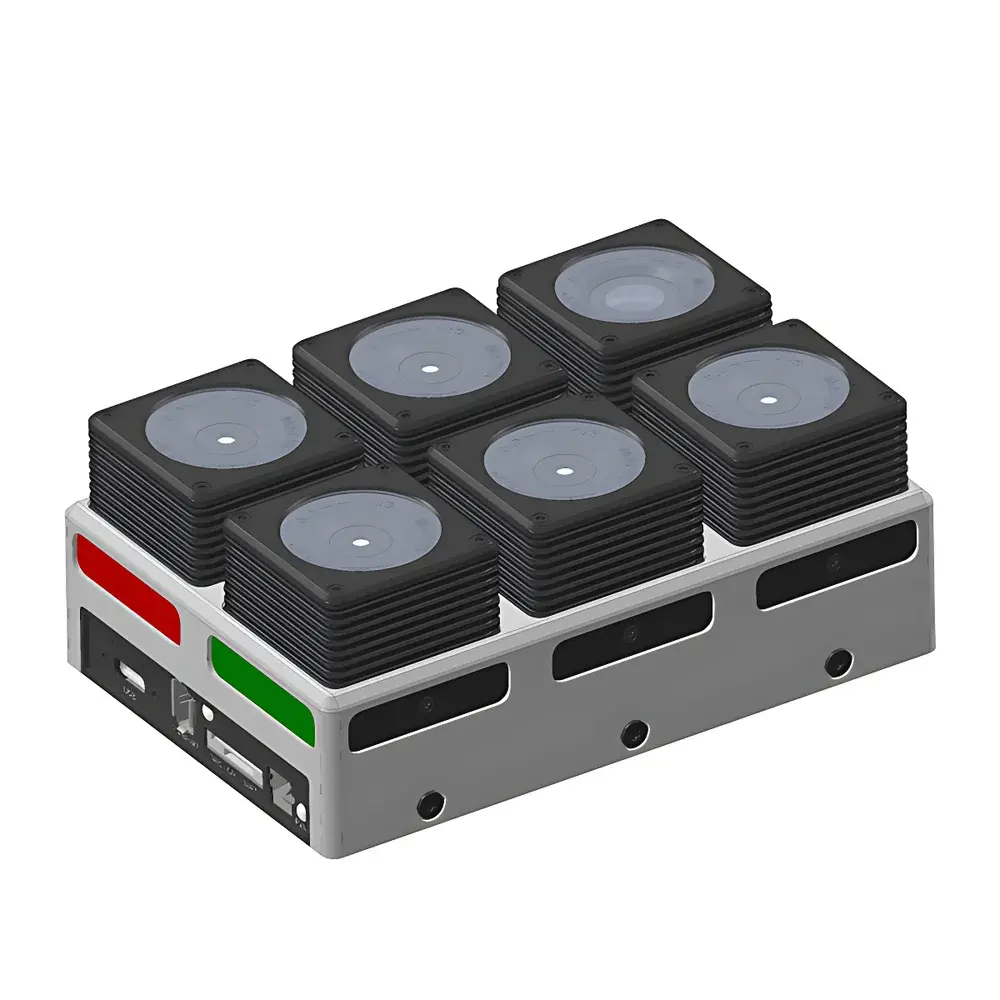
MapIR K6 Research-Grade Airborne Multispectral Imaging System
| Brand | MapIR |
|---|---|
| Origin | USA |
| Manufacturer Type | Authorized Distributor |
| Product Origin | Imported |
| Model | K6 |
| Spectral Configuration | 6-, 8-, 10-, or 11-channel modular multispectral imaging |
| Spectral Acquisition Method | Filter-wheel–free filter array (discrete bandpass filter modules) |
| Platform Integration | UAV-mounted (multirotor & fixed-wing compatible) |
| Spectral Band Options | 26 selectable narrowband filters (250–1000 nm), including monochrome (Mono) and RGB+SWIR hybrid configurations |
| Sensor 1 Resolution | 3.2 MP global shutter (mono channel), pixel size 3.45 × 3.45 µm |
| Sensor 2 Resolution | 14.4 MP Bayer color sensor (trichromatic output), pixel size 1.4 × 1.4 µm |
| Horizontal Field of View (HFOV) | 87° or 41° (lens-dependent) |
| Instantaneous Field of View (IFOV) | 4.3 cm/px (3.2 MP) or 2.0 cm/px (14.4 MP) at 120 m AGL (400 ft AGL) |
| Frame Rate | 2 fps (3.2 MP RAW), 1 fps (14.4 MP RAW) |
| Onboard Processing | Dual-core ARM Cortex-A9 @ 1.2 GHz (i.MX6 SoC) |
| Trigger Interface | PWM, relay pulse (voltage-level), UAVCAN, UART, GPIO |
| Image Format | 12-bit RAW per channel |
| Storage | Removable microSDXC card (up to 128 GB) |
| Power | 5.0 VDC, 4.0 W per module |
| Connectivity | USB 2.0, UART, UAVCAN, Ethernet, I²C, HDMI, SD video output, GPIO headers |
Overview
The MapIR K6 is a research-grade, modular airborne multispectral imaging system engineered for high-fidelity spectral data acquisition in remote sensing applications. Unlike scanning or push-broom hyperspectral systems, the K6 employs a discrete, filter-based spectral architecture—each camera module integrates a dedicated narrowband interference filter, monolithic CMOS sensor, and embedded Linux computing core. This design enables simultaneous, synchronized capture across up to 11 spectrally distinct bands without mechanical moving parts, eliminating motion-induced registration error and supporting robust operation on dynamic UAV platforms. The system operates on the principle of spectral band separation via hard-coated optical filters, with spectral response defined by center wavelength (CWL) and full-width-at-half-maximum (FWHM) specifications traceable to NIST-calibrated reference sources. Its dual-sensor architecture—comprising a global-shutter monochrome detector (3.2 MP) and a high-resolution Bayer color sensor (14.4 MP)—supports both quantitative reflectance analysis and spatially registered contextual imaging. Designed for integration into ISO/IEC 17025-aligned field measurement workflows, the K6 delivers repeatable radiometric performance suitable for vegetation index derivation (e.g., NDVI, NDRE, PRI), soil moisture estimation, precision agriculture calibration, and environmental monitoring under GLP-compliant data governance frameworks.
Key Features
- Modular architecture: Select and combine up to six independent spectral modules from a library of 26 certified narrowband filters (250–1000 nm), enabling customizable 6-, 8-, 10-, or 11-channel configurations.
- Dual-sensor imaging engine: Simultaneous acquisition using a 3.2 MP global-shutter mono sensor (3.45 µm pixels) for high-temporal-resolution spectral bands and a 14.4 MP Bayer sensor (1.4 µm pixels) for spatial context and RGB+SWIR fusion.
- Onboard real-time processing: Freescale i.MX6 Dual Core ARM Cortex-A9 processor (1.2 GHz) runs embedded Linux, enabling firmware-upgradable spectral calibration, metadata embedding (GPS, IMU, exposure), and lossless RAW compression.
- UAV-native synchronization: Hardware-level trigger support via PWM, relay pulse, UAVCAN, and UART interfaces ensures precise temporal alignment with autopilot systems (e.g., PX4, ArduPilot) and GNSS-aided PPK/RTK positioning units.
- Field-serviceable design: All modules—including lenses, filters, and sensors—are mechanically and electrically decoupled, permitting in-field replacement, recalibration, and hardware revision updates without system-level requalification.
- Regulatory-ready data pipeline: Generates timestamped, geotagged 12-bit RAW frames with embedded EXIF/XMP metadata; supports optional audit-trail logging compliant with FDA 21 CFR Part 11 requirements when deployed in GxP environments.
Sample Compatibility & Compliance
The K6 is optimized for outdoor reflective surface imaging—primarily vegetative canopies, agricultural plots, bare soil, water bodies, and constructed surfaces—under natural illumination (sunlight) or controlled active illumination (e.g., calibrated LED panels). It does not support transmission-mode or fluorescence-excitation measurements. Each spectral module is factory-calibrated against NIST-traceable standards, with spectral response curves provided in CSV format for radiometric correction. The system meets CE and FCC Class B emissions requirements for airborne electronics. While not certified as medical or aerospace safety-critical hardware, its mechanical and thermal design conforms to RTCA DO-160 Section 21 (vibration) and Section 24 (temperature) test profiles for small UAV payloads. Data outputs comply with ASTM E2937-22 (Standard Guide for Use of Multispectral Imaging in Forensic Document Examination) and ISO 19115-2:2019 metadata schema conventions.
Software & Data Management
K6 firmware and post-processing utilities are distributed via MapIR’s open-source SDK (GitHub-hosted, MIT licensed), supporting Python 3.9+ and MATLAB R2022a+. Raw data is stored in vendor-neutral 12-bit packed binary format with embedded JSON metadata headers, enabling direct ingestion into ENVI, QGIS, Agisoft Metashape, and Pix4Dmapper. The onboard microSDXC slot (up to 128 GB) implements wear-leveling and power-loss recovery protocols, ensuring data integrity during abrupt power cycles. Optional cloud sync via Ethernet or USB tethering enables automated transfer to secure SFTP endpoints. All firmware updates undergo SHA-256 signature verification, and configuration files support cryptographic signing for integrity validation in regulated deployments. Audit logs record firmware version, sensor temperature, exposure time, GPS fix status, and trigger source—retained for ≥30 days unless manually purged.
Applications
- Precision agriculture: Generation of canopy health indices (NDVI, NDRE, CIred-edge) at sub-decimeter resolution for variable-rate irrigation and nutrient application planning.
- Ecological monitoring: Long-term tracking of invasive species spread, wetland hydroperiod changes, and post-fire regeneration using time-series spectral unmixing.
- Environmental compliance: Detection of chlorophyll-a anomalies in inland waterways and quantification of suspended sediment loads aligned with EPA Method 160.1.
- Geospatial surveying: Radiometrically corrected orthomosaic generation for topographic modeling, where spectral bands serve as tie-point constraints in bundle adjustment.
- Academic remote sensing research: Validation of atmospheric correction models (e.g., DOS, 6S) and development of novel band-ratio algorithms for mineralogical discrimination.
FAQ
Is the K6 compatible with DJI Matrice 300 RTK and Autel EVO II Pro platforms?
Yes—the K6’s 5 VDC power interface, UAVCAN v1.0 protocol stack, and mechanical mounting footprint are validated for seamless integration with both platforms using standard M3 standoff brackets and CAN bus adapters.
Can spectral calibration be performed in-house without returning the unit to MapIR?
Yes—calibration coefficients (dark current, flat-field, spectral response) are user-editable via the SDK; however, NIST-traceable recalibration requires factory service due to optical bench dependency.
Does the K6 support real-time streaming or only onboard recording?
The K6 records exclusively to microSDXC; real-time streaming is not supported. However, HDMI output provides live preview of the Bayer sensor feed at 30 Hz for framing verification.
What is the maximum operational altitude above ground level (AGL) for radiometric accuracy?
For <±5% radiometric uncertainty, operation is validated up to 120 m AGL (400 ft) under clear-sky conditions with solar zenith angle <60°. Above this, atmospheric path radiance correction becomes necessary.
Are firmware updates backward-compatible with older K6 hardware revisions?
Firmware v3.2+ maintains binary compatibility with all K6 units shipped since Q3 2021; earlier units require bootloader update prior to major version upgrades.





