
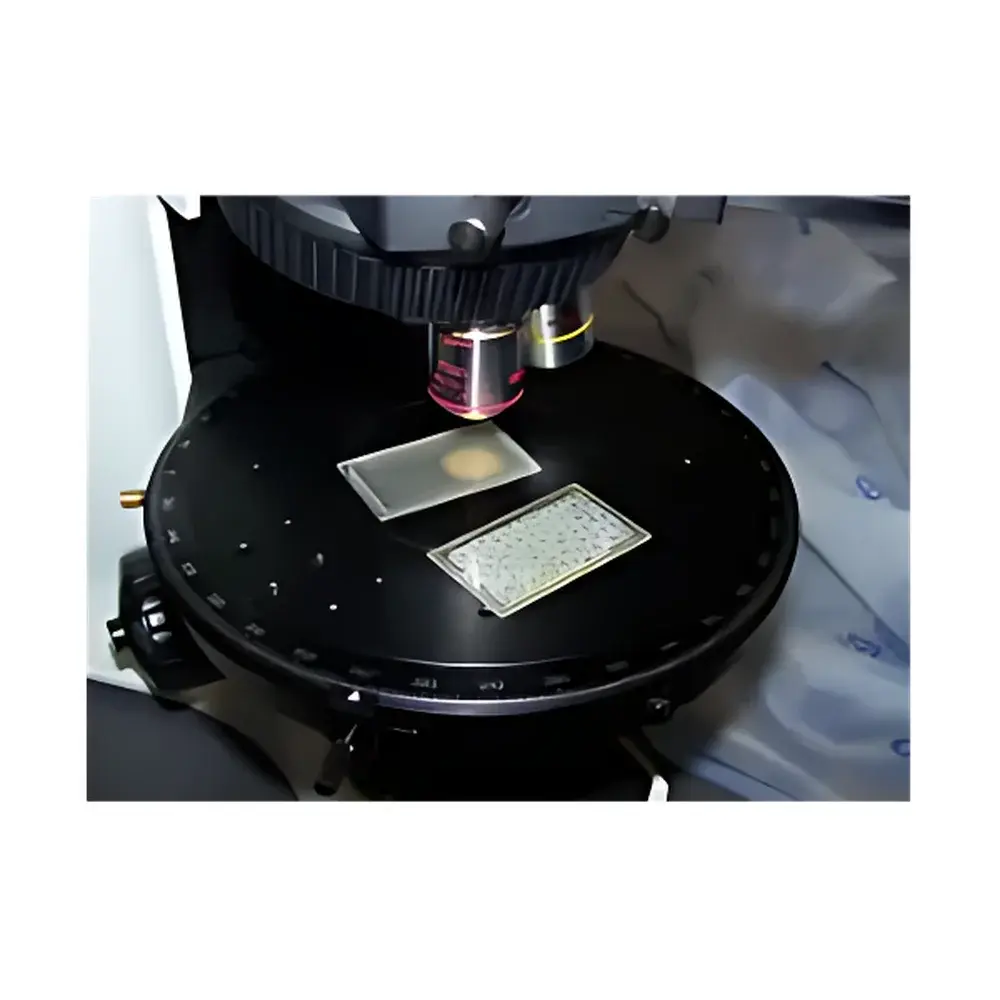
SOC SurfaceOptics SOC710M Hyperspectral Micro-Imaging System
| Brand | SOC/SurfaceOptics |
|---|---|
| Origin | USA |
| Manufacturer Type | Authorized Distributor |
| Import Status | Imported |
| Model | SOC710M |
| Pricing | Available Upon Request |
| Operating Principle | Push-broom Scanning |
| Deployment Mode | Ground-based |
| Spectral Range | 400–1000 nm (Visible–NIR) and 1000–1700 nm (SWIR), dual-band configurable |
| Spatial Resolution | Sub-micron to ~5 µm (dependent on objective lens and magnification) |
| Spectral Resolution | < 5 nm FWHM (typical) |
| Detector | Back-illuminated Si CCD (VIS–NIR) and InGaAs array (SWIR) |
| Interface | GigE Vision or Camera Link |
Overview
The SOC SurfaceOptics SOC710M Hyperspectral Micro-Imaging System is a precision-engineered, push-broom scanning instrument that integrates high-resolution optical microscopy with calibrated hyperspectral data acquisition across two complementary spectral domains: 400–1000 nm (visible to near-infrared) and 1000–1700 nm (short-wave infrared). Unlike snapshot or tunable-filter systems, the SOC710M employs line-scan spectroscopy synchronized with precise motorized stage translation—ensuring high spatial fidelity, radiometric consistency, and minimal spectral crosstalk. Its optical architecture is optimized for laboratory-grade microspectroscopic analysis, supporting quantitative reflectance, transmittance, fluorescence, and absorbance measurements at pixel-level resolution. Designed for integration into regulated research environments, the system complies with foundational metrological practices aligned with ISO/IEC 17025 traceability frameworks and supports spectral calibration via NIST-traceable reference standards.
Key Features
- Modular dual-band configuration: Independent VIS–NIR (400–1000 nm) and SWIR (1000–1700 nm) detection channels, each with dedicated optics, dispersion elements, and cooled detectors (Si CCD and thermoelectrically stabilized InGaAs array)
- Microscope-coupled imaging: Compatible with standard upright and inverted research microscopes (e.g., Nikon Eclipse, Zeiss Axio, Olympus BX series) via C-mount or fiber-optic coupling; supports objectives from 2.5× to 100×
- High-fidelity push-broom acquisition: Pixel dwell time adjustable from 1–100 ms; scan velocity programmable to maintain optimal signal-to-noise ratio (SNR > 800:1 typical at 10 ms integration)
- Onboard spectral calibration: Real-time wavelength registration using internal LED references and factory-characterized grating alignment; supports user-performed dark current and flat-field correction
- Ruggedized optomechanical housing: Aluminum alloy chassis with vibration-damped mounting interface; designed for stable operation in shared lab spaces without active isolation
- Compliance-ready metadata embedding: All acquired hypercubes include EXIF-compliant headers containing exposure parameters, stage coordinates, objective magnification, illumination source ID, and calibration timestamps
Sample Compatibility & Compliance
The SOC710M accommodates a broad range of solid, semi-transparent, and fluorescent specimens—including histological sections (frozen or FFPE), plant tissue cross-sections, mineral thin sections, polymer films, semiconductor wafers, and pharmaceutical tablet coatings. Sample mounting follows ASTM E2936-14 (Standard Practice for Microspectrophotometry) guidelines. The system supports GLP/GMP-aligned workflows through audit-trail-enabled software logging (21 CFR Part 11 compliant when used with validated acquisition modules), and spectral data files conform to HDF5-based HyperCube format (HDF5-HC v2.1), ensuring interoperability with ENVI, Python (hyperspy, scikit-image), MATLAB, and commercial chemometric platforms. All optical components meet RoHS and REACH directives; SWIR detector housing includes Class 1 laser safety certification per IEC 60825-1.
Software & Data Management
Acquisition and preprocessing are managed via SOC’s proprietary SpectraView Pro v4.x platform—a Windows-based application supporting real-time preview, region-of-interest (ROI) masking, spectral library matching (USGS, JPL, ECOSTRESS), and PCA-based endmember extraction. Raw data export supports multiple formats: BIL/BIP/BSQ (ENVI), .h5 (HDF5), and .mat (MATLAB). Batch processing pipelines integrate with Python via documented REST API and COM automation interfaces. Data integrity is enforced through SHA-256 checksum generation upon file save and optional encryption (AES-256) for sensitive datasets. Version-controlled calibration profiles are stored separately and linked to each acquisition session via UUID-based referencing.
Applications
- Biomedical Research: Chromosome karyotyping via spectral unmixing of Giemsa-stained metaphase spreads; label-free discrimination of tumor vs. stromal regions in H&E sections; quantification of collagen cross-linking states in dermal biopsies using NIR absorption ratios
- Plant Science: In vivo mapping of chlorophyll a/b, anthocyanin, and carotenoid distributions in leaf epidermis; detection of early-stage fungal infection via altered cellulose–lignin spectral signatures
- Materials Characterization: Spatially resolved identification of Si quantum dot size distribution via photoluminescence peak shift analysis (700–950 nm); phase segregation mapping in block copolymer thin films using SWIR absorbance contrast
- Petroleum Geoscience: Fluorescence lifetime-independent hydrocarbon typing on core plug surfaces; co-registered mapping of bitumen saturation and clay mineralogy (kaolinite vs. smectite) using 1400 nm and 2200 nm combination bands
- Pharmaceutical QA: Uniformity assessment of active pharmaceutical ingredient (API) distribution in coated tablets; detection of excipient crystallinity changes induced by humidity cycling
FAQ
Is the SOC710M compatible with automated microscope stages?
Yes—it supports bidirectional communication with Prior, Ludl, and Marzhauser motorized stages via RS-232 or USB HID protocols, enabling synchronized coordinate mapping and multi-position mosaic acquisition.
Can spectral libraries be customized and imported?
Yes—users may import spectral libraries in ASCII (.asc), CSV, or ENVI SPC format; SpectraView Pro includes tools for spectral averaging, noise reduction, and derivative preprocessing prior to library registration.
What is the minimum resolvable spectral feature width?
The system achieves full-width-at-half-maximum (FWHM) spectral resolution ≤ 4.8 nm in VIS–NIR and ≤ 8.2 nm in SWIR under standard operating conditions, verified with mercury–argon lamp line spectra.
Does the system support fluorescence lifetime imaging (FLIM)?
No—the SOC710M is a steady-state hyperspectral imager; time-resolved fluorescence requires external TCSPC hardware integration, which is not natively supported.
How is radiometric calibration maintained over time?
Users perform quarterly validation using NIST-traceable reflectance standards (e.g., Labsphere Spectralon® 99% white tile) and optional irradiance calibration kits; drift compensation algorithms are embedded in SpectraView Pro’s calibration module.




