
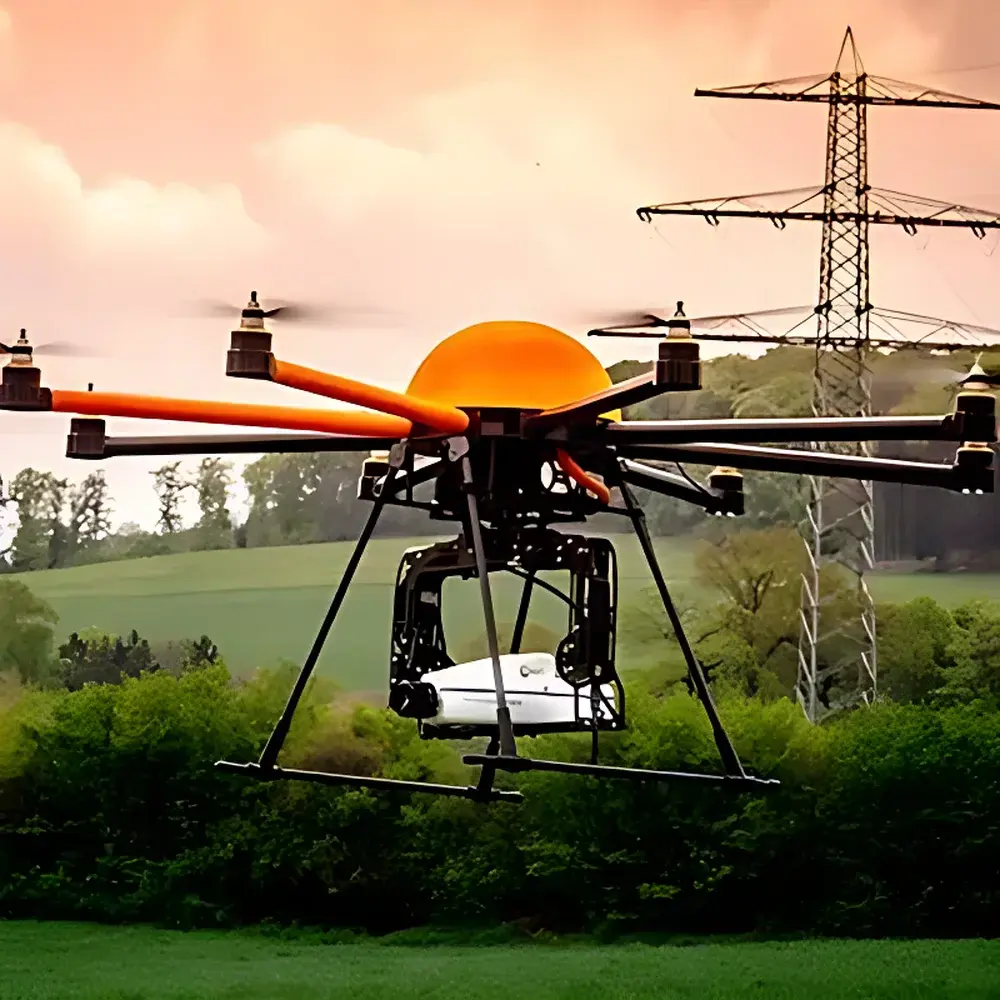
Cubert S185 Airborne Snapshot Hyperspectral Imager
| Brand | Cubert |
|---|---|
| Origin | Germany |
| Model | S185 |
| Spectral Range | 450–950 nm |
| Spectral Resolution | 8 nm @ 532 nm |
| Spatial Resolution (IFOV) | 1 mm |
| Imaging Resolution | 1.0 MP × 2 |
| Field of View Options | 10 mm, 23 mm, 35 mm (C-mount) |
| Frame Rate | 5 Hyperspectral Cubes/s |
| Detector | Dual Si CMOS/CCD Area Array |
| Bit Depth | 12-bit |
| Data Interface | Dual Gigabit Ethernet |
| Weight | 490 g |
| Operating Temperature | 0–40 °C (non-condensing) |
| Power Supply | DC 12 V, 15 W |
Overview
The Cubert S185 Airborne Snapshot Hyperspectral Imager is a compact, lightweight, and high-performance frame-based hyperspectral imaging system engineered for rigorous remote sensing applications aboard unmanned aerial vehicles (UAVs) and ground-based platforms. Unlike scanning-based (push-broom or whisk-broom) hyperspectral sensors, the S185 employs true snapshot spectral imaging—capturing the full spatial-spectral data cube (x, y, λ) in a single integration time without mechanical motion or temporal scanning. This eliminates motion-induced artifacts, spectral misregistration, and geometric distortion commonly observed in moving-platform deployments. Its optical architecture leverages dual synchronized silicon area-array detectors coupled with a patented image-splitting prism and tunable filter stack, enabling simultaneous acquisition of 125 spectral bands across the visible to near-infrared (VNIR) spectrum (450–950 nm) at 4 nm sampling interval and 8 nm full-width-at-half-maximum (FWHM) resolution centered at 532 nm. With a native acquisition speed of up to 5 hyperspectral cubes per second and sub-100 µs exposure time, the S185 delivers high temporal fidelity essential for dynamic airborne surveys, real-time vegetation monitoring, and rapid environmental change detection.
Key Features
- Snapshot acquisition architecture: No moving parts—ensures artifact-free, radiometrically stable cubes under UAV vibration and acceleration
- Ultra-lightweight design: 490 g mass optimized for Class I/II UAV integration without compromising structural rigidity or thermal stability
- Dual 1.0-megapixel silicon detector array: Enables high signal-to-noise ratio (SNR) and low readout noise in VNIR band
- Configurable field-of-view optics: Interchangeable C-mount lenses (10 mm, 23 mm, 35 mm) support flexible ground sampling distance (GSD) selection from millimeter- to meter-scale
- Real-time onboard preview: Integrated Wi-Fi module enables live spectral cube streaming and ground-based visualization during flight
- Remote parameter control: Full instrument configuration—including exposure, gain, ROI, and spectral binning—via TCP/IP over GigE or wireless interface
- Robust environmental tolerance: Operational within 0–40 °C non-condensing ambient conditions; designed for outdoor deployment without active cooling
Sample Compatibility & Compliance
The S185 is inherently platform-agnostic and validated for integration with multirotor and fixed-wing UAVs compliant with EASA SC-VIII and FAA Part 107 operational frameworks. Its mechanical and electrical interfaces adhere to standard UAV payload mounting protocols (e.g., DJI SkyPort, Gremsy T3/T4, custom gimbal brackets). While not certified to ISO/IEC 17025 for metrological traceability as a laboratory instrument, its radiometric response is characterized per ASTM E2792-21 (Standard Practice for Calibration of Hyperspectral Imaging Sensors) and supports post-acquisition correction using reflectance standards (e.g., Spectralon® panels) traceable to NIST SRM 2035. The system meets CE marking requirements for electromagnetic compatibility (EMC Directive 2014/30/EU) and low-voltage safety (LVD Directive 2014/35/EU). Firmware and software workflows are structured to support GLP-aligned documentation practices, including embedded timestamping, GPS-IMU metadata tagging (when externally synchronized), and audit-ready log export.
Software & Data Management
The S185 ships with Cubert’s proprietary HyperSpectra Studio, a cross-platform (Windows/Linux) application supporting real-time cube ingestion, radiometric calibration, georeferencing (with optional GNSS/IMU fusion), spectral library matching, and automated vegetation index computation (NDVI, EVI, NDRE, PRI, etc.). All processing modules operate natively on raw 12-bit data without lossy compression. Batch processing pipelines enable scalable analysis of large-area mosaics—fully automated orthorectification and seam-free stitching are implemented via tie-point registration and intensity-normalized blending. For advanced users, Cubert provides a documented, open-source C++/Python SDK (available under MIT License) with full API access to sensor control, memory-mapped frame buffers, and metadata structures. Integration with common scientific environments—including ENVI, QGIS (via GDAL drivers), Python (scikit-image, spectral, rasterio), and MATLAB—is supported through standardized BIL/BIP file exports conforming to HDF5 and GeoTIFF formats with embedded spectral wavelength arrays and projection metadata (WKT + RPC).
Applications
- Agricultural monitoring: High-throughput phenotyping, nitrogen status mapping, early stress detection (water, nutrient, pathogen)
- Environmental assessment: Wetland delineation, invasive species identification, soil organic carbon estimation, coastal water quality profiling
- Forestry and ecology: Canopy species classification, leaf area index (LAI) retrieval, chlorophyll-a/b ratio quantification
- Cultural heritage and archaeology: Subsurface feature detection, pigment identification, fresco degradation mapping
- Geological surveying: Mineralogical mapping (e.g., clays, iron oxides, carbonates) using diagnostic absorption features
- Industrial inspection: Coating uniformity verification, material sorting, counterfeit detection in pharmaceutical packaging
- Defense and security: Camouflage detection, concealed object identification, persistent surveillance analytics
FAQ
Does the S185 require an external IMU for georeferencing?
No—the S185 operates independently of inertial measurement units for basic geo-tagging. However, for centimeter-level orthorectification and rigorous photogrammetric processing, integration with a high-accuracy GNSS-IMU (e.g., Applanix APX-15, NovAtel PwrPak7) is recommended and fully supported via NMEA 0183/RTCM input.
Can the S185 be used for laboratory-based hyperspectral microscopy?
Yes—its snapshot architecture and C-mount lens compatibility allow adaptation to macro/micro imaging setups. Users have successfully deployed it with telecentric lenses and motorized stages for controlled sample scanning, though illumination uniformity and spectral calibration must be validated per ASTM E2792-21.
What spectral preprocessing steps are applied onboard?
None—the S185 outputs raw digital numbers (DN) only. All radiometric correction (dark current subtraction, flat-field normalization, spectral response calibration) is performed offline in HyperSpectra Studio or third-party tools to preserve maximum flexibility and reproducibility.
Is firmware update supported over-the-air?
Yes—firmware updates are delivered via secure HTTPS and installed through the web-based device management interface accessible via Wi-Fi or GigE. Each release includes version-locked checksums and rollback capability.
How is spectral calibration maintained over time and temperature?
The S185 incorporates internal thermal stabilization of optical elements and detector electronics. Factory spectral calibration is valid across the full operating temperature range (0–40 °C); users may perform field recalibration using a NIST-traceable white reference panel before critical missions.
Related Products



