
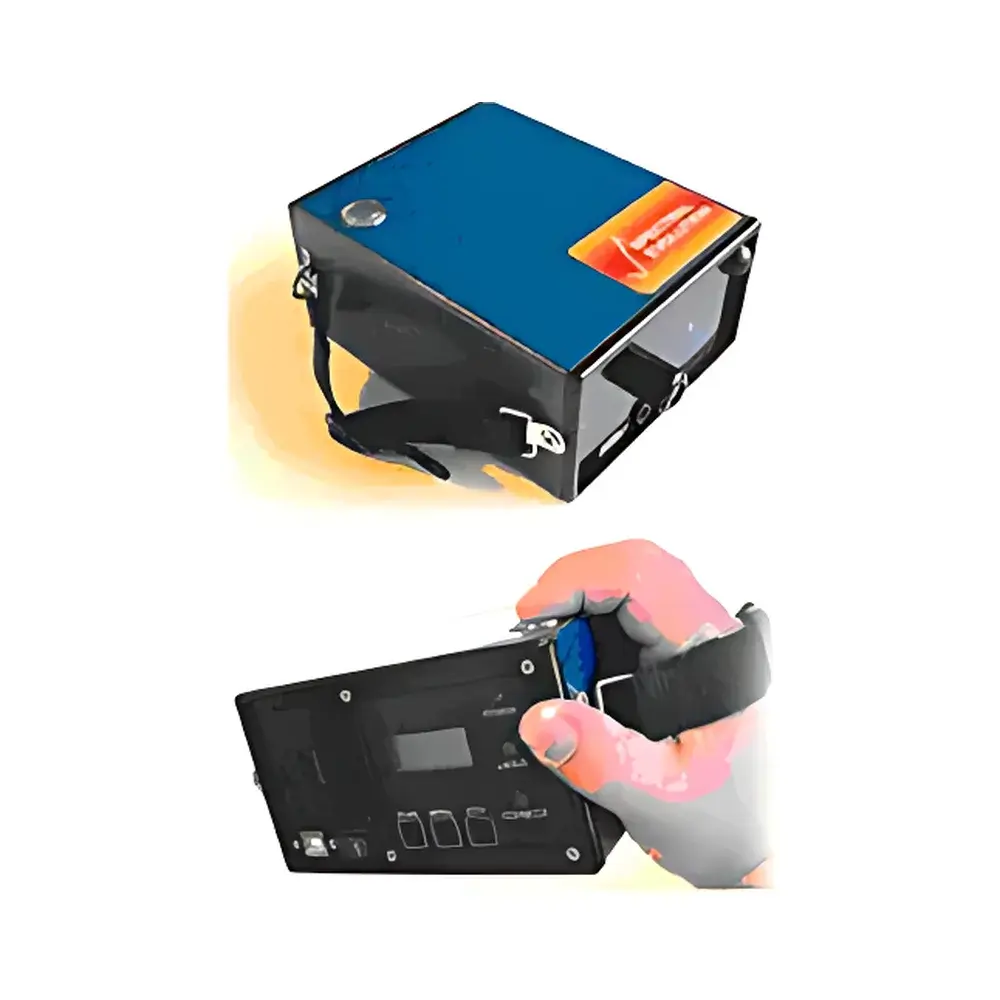
SEI PSR-1100 / PSR-1100F Handheld Field Spectroradiometer
| Brand | SEI |
|---|---|
| Origin | USA |
| Model | PSR-1100 / PSR-1100F |
| Spectral Range | 320–1100 nm |
| Spectral Resolution | 3.2 nm @ 600 nm |
| Sampling Bandwidth | 1.5 nm |
| Detector | 512-pixel Si CCD array (25 µm × 2.5 mm pixel size) |
| A/D Conversion | 16-bit |
| Wavelength Accuracy | ±0.5 nm |
| Wavelength Repeatability | ±0.1 nm |
| Integration Time | 8–2000 ms |
| FOV Options | 4° (PSR-1100), 25° fiber-coupled (PSR-1100F) |
| IFOV | 1.5 mrad |
| Frame Rate | 50 fps |
| NEΔL (1 s) | 8.0×10⁻¹⁰ W/cm²/nm/sr @ 400 nm |
| Max Radiance | 1.5×10⁻⁴ W/cm²/nm/sr @ 700 nm |
| Built-in Rechargeable Battery | 2800 mAh (≥4 h operation) |
| Data Storage | 2500 spectra (standalone mode) |
| Communication | USB 2.0, Bluetooth 4.0 |
| Dimensions | 17.8 × 8.3 × 14.6 cm |
| Weight | <1.8 kg |
Overview
The SEI PSR-1100 and PSR-1100F are handheld, field-deployable spectroradiometers engineered for high-fidelity reflectance and radiance measurements across terrestrial, aquatic, and atmospheric surfaces. Operating on a fixed-grating, filter-based optical architecture with a 512-element silicon CCD detector array, these instruments deliver calibrated spectral data from 320 to 1100 nm—covering the full UV-A, visible, and near-infrared (VNIR) spectrum critical for vegetation biophysics, soil characterization, water quality assessment, and calibration/validation of airborne and satellite remote sensing platforms. Unlike scanning or Fourier-transform systems, the PSR series employs a non-scanning, snapshot acquisition design based on optimized diffraction grating dispersion and slit-limited spectral sampling, ensuring high photometric stability and low stray light through an all-reflective optical path. Each unit is factory-calibrated traceable to NIST standards, with wavelength accuracy of ±0.5 nm and repeatability better than ±0.1 nm—enabling reliable inter-comparison across multi-temporal and multi-site field campaigns.
Key Features
- Self-contained operation: Integrated LCD display and push-button interface allow full spectral acquisition and storage of up to 2500 spectra without external computing hardware.
- Intelligent exposure control: Automatic shutter speed, gain adjustment, and dark-current subtraction executed in a single button press—optimized for variable illumination conditions including direct solar exposure.
- Dual optical configurations: PSR-1100 features a fixed 4° fore-optic lens ideal for targeted ground-level reflectance; PSR-1100F integrates a 1-m fiber optic cable with optional 25° FOV input for flexible probe-based or contact measurements.
- Onboard targeting: PSR-1100 includes a Class II infrared laser pointer for precise spatial registration during field surveys—critical for georeferenced spectral sampling.
- Robust field engineering: All-reflective optics minimize chromatic aberration and thermal drift; sealed housing rated for outdoor use; weight under 1.8 kg with ergonomic hand strap for extended one-handed operation.
- Wireless interoperability: Bluetooth 4.0 enables real-time telemetry and remote triggering from compatible PDAs or tablets running DARWin CE software—supporting concurrent GPS tagging, digital imaging, and voice annotation.
Sample Compatibility & Compliance
The PSR-1100/1100F supports non-contact and contact measurement modes across diverse natural and engineered materials—including live vegetation canopies, bare soils, mineral outcrops, painted surfaces, and submerged aquatic vegetation. When used with optional contact probes (e.g., halogen-illuminated leaf or soil probes), the system meets ASTM E275–22 requirements for reflectance measurement geometry and source uniformity. Its NIST-traceable radiometric calibration satisfies ISO 17025–accredited laboratory practices for field reference instrumentation. The instrument’s spectral output format (ASCII-encoded .sig files) complies with NASA’s SPECCHIO metadata schema and USGS Spectral Library ingestion protocols. For regulatory applications involving environmental monitoring or agricultural compliance reporting, raw data logs include timestamp, integration time, detector temperature, and dark reference status—supporting GLP audit trails when paired with DARWin SP’s secure project management environment.
Software & Data Management
DARWin SP is the proprietary cross-platform application for spectral acquisition, visualization, and quantitative analysis. It provides synchronized dual-curve plotting (e.g., reference panel vs. target surface), batch processing of spectral indices (NDVI, EVI, PRI, MCARI, etc.), and direct comparison against embedded USGS spectral libraries. All processed spectra export as ASCII text with column-aligned wavelength, radiance, and reflectance values—ensuring compatibility with ENVI, MATLAB, Python (NumPy/Pandas), R, and ArcGIS workflows. DARWin SP implements configurable data validation rules (e.g., saturation detection, SNR thresholds) and generates machine-readable XML metadata per ASTM E131–23 Annex A1. Optional DARWin CE for Windows Mobile extends functionality to PDA-based deployments, recording GPS coordinates (WGS84), elevation, compass heading, and time-synchronized JPEG thumbnails—each tagged with spectral acquisition parameters for reproducible field documentation.
Applications
- Remote Sensing Validation: Ground-truthing of Sentinel-2, Landsat-8/9, and PlanetScope Level-2 surface reflectance products via standardized vicarious calibration protocols.
- Agricultural Monitoring: In-field quantification of chlorophyll content, water stress indicators (NDWI, MSI), and nitrogen status using published spectral indices validated against lab-analyzed tissue samples.
- Ecological Assessment: Discrimination of invasive vs. native species, post-fire recovery mapping, and wetland vegetation classification using continuum-removed absorption features at 680 nm, 970 nm, and 1020 nm.
- Water Quality Analysis: Estimation of chlorophyll-a, suspended sediment concentration (SSC), and colored dissolved organic matter (CDOM) from hyperspectral reflectance signatures in lakes, rivers, and coastal zones.
- Geological Surveying: Identification of iron oxide/hydroxide minerals (hematite, goethite), clay species (kaolinite, smectite), and carbonate abundance through diagnostic absorption features between 400–1000 nm.
FAQ
What spectral calibration standards are applied during factory calibration?
Each PSR-1100/1100F undergoes absolute radiometric calibration using NIST-traceable tungsten-halogen and deuterium lamps, with wavelength calibration verified against mercury-argon emission lines. Certificate of Calibration includes uncertainty budgets per ISO/IEC 17025 Annex A.3.
Can the instrument be used under full sunlight without saturation?
Yes—the auto-exposure algorithm dynamically adjusts integration time (8–2000 ms) and electronic gain to maintain signal within the 16-bit linear range across irradiance levels from 0.1 to >100 mW/cm²/nm. NEΔL performance ensures usable SNR even under diffuse overcast conditions.
Is spectral data compliant with FAIR principles (Findable, Accessible, Interoperable, Reusable)?
DARWin SP exports spectra with embedded ISO 19115-compliant metadata headers, supports CF-NetCDF conversion via open-source plugins, and adheres to the SPECCHIO spectral data model—enabling ingestion into institutional repositories such as ESA’s Φ-Data Hub or NASA’s LP DAAC.
How is geometric alignment ensured during field deployment?
The built-in laser pointer (PSR-1100) and optional PDA-mounted digital camera provide real-time visual registration. Field-of-view tolerances are specified at ±0.2°, and angular response is characterized per ASTM E2079–20 Annex B for bidirectional reflectance distribution function (BRDF) correction.
Does the system support FDA 21 CFR Part 11 compliance for regulated environments?
While the standalone instrument does not include electronic signature or audit trail features, DARWin SP Enterprise Edition (optional license) provides role-based access control, immutable log files, and cryptographic hash verification of exported datasets—meeting baseline requirements for GxP-aligned environmental monitoring programs.





