
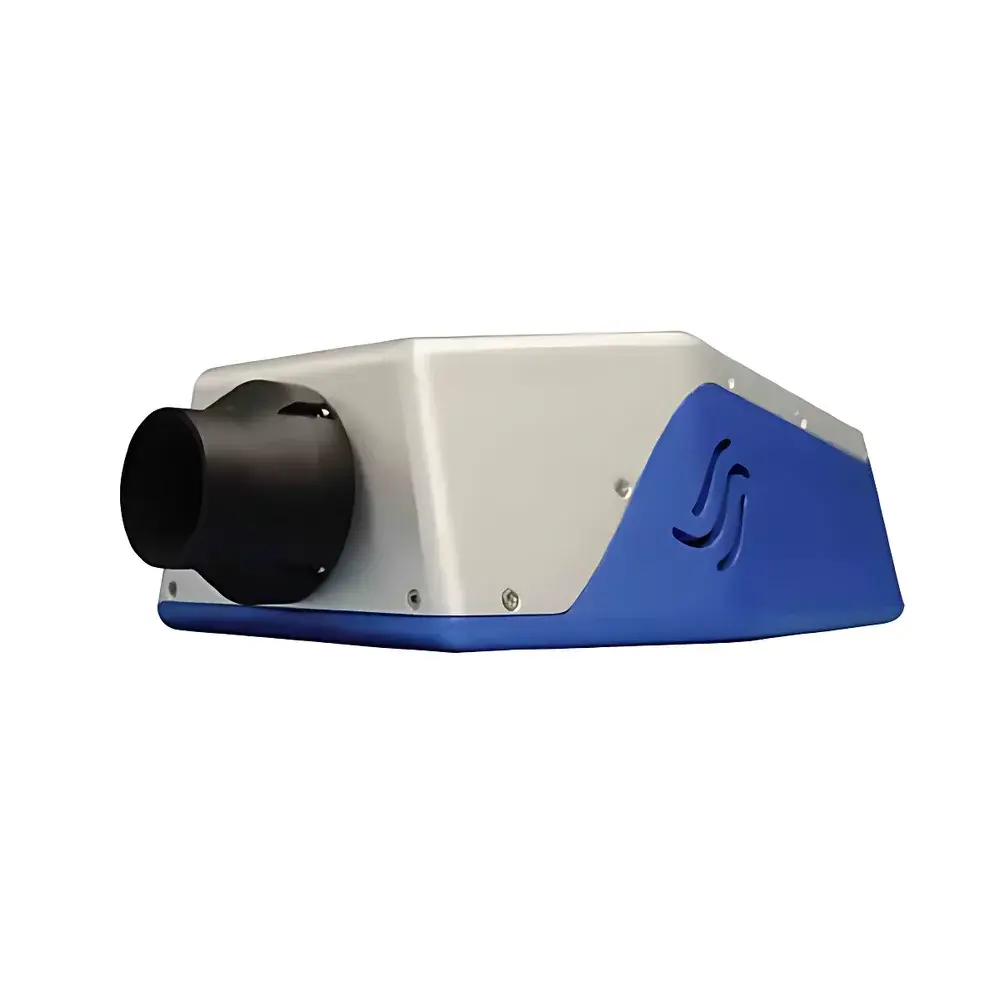
SurfaceOptics LightShift Multimodal Snapshot Spectral & Polarimetric Imager
| Brand | SurfaceOptics |
|---|---|
| Origin | USA |
| Model | LightShift |
| Spectral Range | 400–1000 nm |
| Spectral Resolution | Avg. 25 nm |
| Spatial Resolution | 512 × 512 pixels |
| Spectral Channels | 16 simultaneous channels (or 12 spectral + 4 polarimetric) |
| Data Acquisition Rate | 28 hyperspectral cubes per second |
| Detector Type | CCD |
| Dynamic Range | 12-bit |
| Pixel Pitch | 7.4 µm (spectral) × 29.6 µm (spatial) |
| Exposure Time | 1 ms |
| F-number | f/2.7 |
| Lens Focal Length | 66 mm |
| Horizontal FOV | 6.5° |
| Weight | 3.2 kg |
| Dimensions | 17.1 × 9.5 × 28.2 cm |
| Power | 12 VDC, <12 W |
| Interface | USB 3.0 |
| Minimum System Requirements | Intel Core i7 or higher, 8 GB RAM, Windows 10, NVIDIA GeForce GTX 980 / 980 Ti / 1080 or higher GPU |
Overview
The SurfaceOptics LightShift Multimodal Snapshot Spectral & Polarimetric Imager is a compact, field-deployable snapshot hyperspectral imaging system engineered for simultaneous acquisition of spectral, spatial, and polarimetric data at video frame rates. Unlike scanning-based or tunable-filter systems, LightShift employs a fixed, monolithic micro-optical channel array to encode full spectral-polarimetric information across all pixels in a single exposure—enabling true snapshot operation without mechanical movement or temporal multiplexing. Its core architecture leverages dispersive optics combined with spatially variant polarization filters, allowing concurrent measurement of intensity, wavelength-dependent reflectance/transmittance, and Stokes vector components (S₀, S₁, S₂) per pixel. Designed for ground-based operation in laboratory, industrial, and outdoor environments, LightShift delivers high temporal fidelity (up to 28 spectral cubes per second) while maintaining radiometric stability and geometric consistency—critical for dynamic scene analysis, real-time anomaly detection, and quantitative material characterization.
Key Features
- True snapshot acquisition: Captures full 512 × 512 × N spectral-polarimetric datacubes in a single integration time (as short as 1 ms), eliminating motion artifacts and enabling high-speed process monitoring.
- Configurable multimodal sensing: Supports two standard configurations—16-band spectral-only mode or 12-band spectral + 4-channel polarimetric mode—with field-replaceable 4×4 microchannel arrays for application-specific spectral band selection.
- Integrated optical design: Optimized f/2.7 lens with 66 mm focal length and 6.5° horizontal field of view ensures uniform illumination and minimal vignetting across the full spectral range (400–1000 nm).
- High-fidelity detector: Scientific-grade CCD sensor with 12-bit digitization, pixel pitch of 7.4 µm (spectral axis) × 29.6 µm (spatial axis), and calibrated quantum efficiency across visible-NIR wavelengths.
- Ruggedized packaging: Aluminum housing (17.1 × 9.5 × 28.2 cm), low-power consumption (<12 W), and USB 3.0 interface enable seamless integration into mobile platforms, UAV gimbals, or embedded inspection systems.
Sample Compatibility & Compliance
LightShift operates in reflective, transmissive, and emissive modes across solid, liquid, and particulate samples—including biological tissues, painted surfaces, agricultural canopies, mineral specimens, and industrial coatings. Its 400–1000 nm spectral coverage aligns with ASTM E308-22 (standard practice for computing photometric quantities from spectrophotometric data) and supports common vegetation indices (e.g., NDVI, EVI) per ISO 19130-2:2021. The system meets CE electromagnetic compatibility requirements and complies with IEC 61000-6-3 for industrial emission limits. While not certified for medical device use under FDA 21 CFR Part 820, its raw data output format (ENVI-compatible BSQ with wavelength metadata) facilitates traceable post-processing in GLP/GMP-aligned workflows when paired with validated analysis scripts.
Software & Data Management
LightShift PRO software provides dual operational modes: real-time streaming visualization and offline playback/reprocessing. Users may concurrently display live imaging feeds alongside multiple synchronized replay windows, each supporting independent spectral curve extraction, region-of-interest (ROI) statistics, and false-color mapping. The built-in toolbox includes standardized algorithms for spectral unmixing, histogram normalization, NDVI computation, and spectral angle mapper (SAM) classification—all implemented with deterministic numerical routines and reproducible floating-point precision. Custom Python or MATLAB functions can be integrated via documented API hooks. Export options include ENVI BSQ files (with .hdr header containing calibrated wavelength vectors), TIFF stacks, and CSV-formatted spectral profiles—ensuring interoperability with third-party platforms such as ENVI, MATLAB Image Processing Toolbox, or Python’s scikit-image and hsi libraries.
Applications
- Military & remote sensing: Target discrimination under variable illumination, camouflage detection, and terrain classification using polarimetric contrast enhancement.
- Biomedical research: Label-free tissue characterization, burn depth assessment, and retinal oximetry via spectral absorption modeling.
- Environmental monitoring: Detection of hydrocarbon spills on water surfaces, chlorophyll-a quantification in algal blooms, and soil organic matter mapping.
- Industrial quality control: Real-time sorting of recycled plastics by polymer type, coating thickness verification, and defect detection in solar cell wafers.
- Robotics & autonomous systems: Onboard spectral-polarimetric perception for navigation in degraded visual environments (e.g., fog, dust, smoke).
- Materials science: Anisotropy mapping of thin-film stress, crystallinity evaluation of polymers, and plasmonic resonance tracking in nanostructured surfaces.
FAQ
What spectral calibration standards are supported?
LightShift ships with NIST-traceable factory calibration using tungsten-halogen and deuterium lamps; users may perform optional field recalibration using provided reference tiles (reflectance >99% and <3% in 400–1000 nm).
Can the system operate in outdoor daylight conditions?
Yes—its high dynamic range, adjustable exposure (1–1000 ms), and narrowband microchannel design mitigate solar glare; optional neutral density filters are available for direct sun imaging.
Is raw data accessible for custom algorithm development?
All acquired cubes are stored in open-format binary (BSQ) with human-readable ENVI headers; no proprietary compression or obfuscation is applied.
Does LightShift support synchronization with external triggers or other sensors?
USB 3.0 timing signals allow hardware-level trigger input (TTL-compatible); precise timestamp alignment with GPS or inertial measurement units (IMUs) is achievable via software-defined synchronization protocols.
What is the typical radiometric accuracy across the spectral range?
Calibrated radiance uncertainty is ±3.5% (k=2) from 450–950 nm under controlled lab conditions; performance varies with scene reflectivity and ambient irradiance—detailed uncertainty budgets are provided in the calibration certificate.
Related Products





