
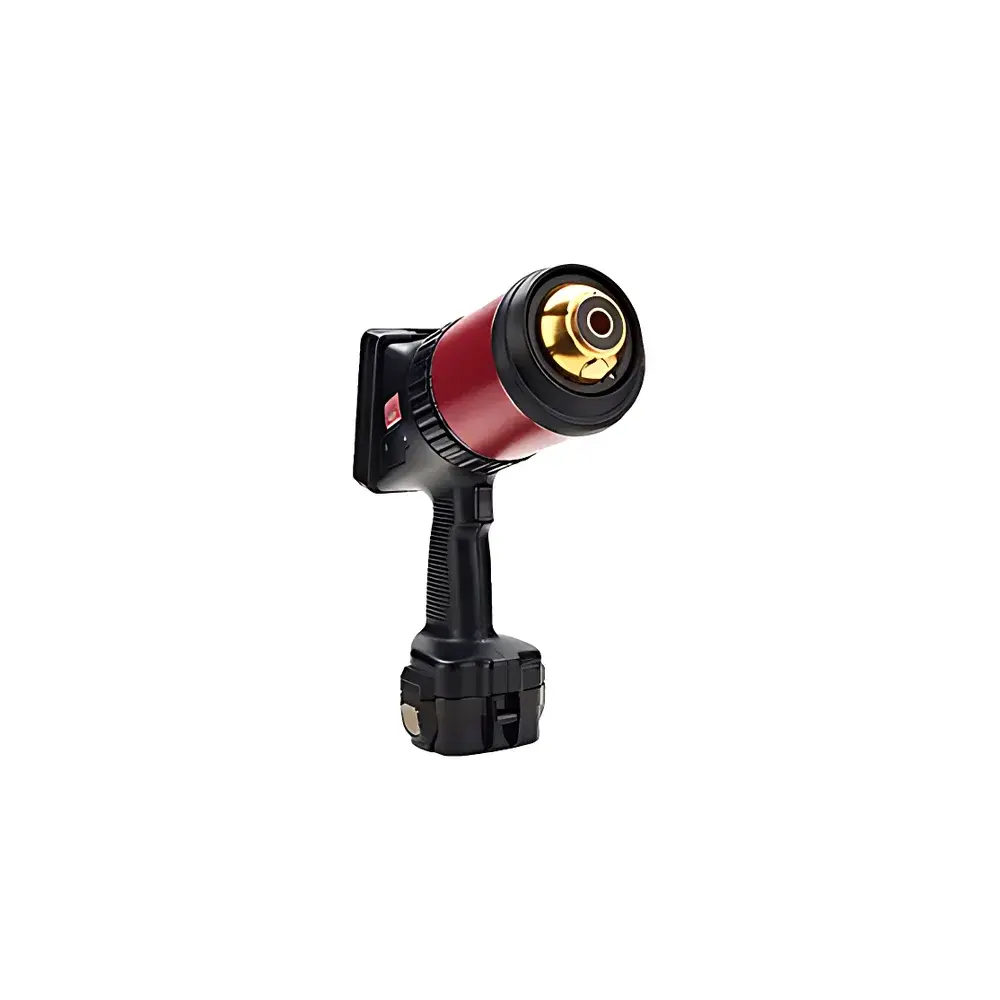
ET100 Portable Infrared Emissivity Meter by SOC/SurfaceOptics
| Brand | SOC/SurfaceOptics |
|---|---|
| Origin | USA |
| Model | ET100 |
| Measurement Principle | Integrating Sphere-Based Reflectance Method |
| Imaging Mode | 3D Surface-Referenced Optical Sampling |
| Operating State | Ground-Based Field & Lab Use |
| Spectral Bands | 6 Non-Contiguous IR Bands (1.5–2, 2–3.5, 3–4, 4–5, 5–10.5, 10.5–21 µm) |
| Incidence Angles | 20° and 60° (relative to surface normal) |
| Measurement Type | Directional-Hemispherical Reflectance (DHR), converted to spectral and broadband emissivity |
| Measurement Time | ≤7 s per acquisition (after 90 s IR source stabilization) |
| Sample Geometry Support | Flat, convex (≥6″ radius), concave (≥12″ radius) surfaces |
| Power Supply | Dual Rechargeable NiMH Batteries |
| Operating Temperature | 0–40 °C (non-condensing) |
| Storage Temperature | −25–70 °C |
| Weight | 2.1 kg (inclusive of batteries) |
| Compliance | ASTM E408-22, NIST-Traceable Calibration Available |
| Data Storage | Internal SD card with timestamped reflectance/emissivity records |
Overview
The ET100 Portable Infrared Emissivity Meter, engineered by SOC/SurfaceOptics (USA), is a field-deployable, battery-operated optical metrology instrument designed for quantitative, in-situ measurement of directional-hemispherical reflectance (DHR) across six discrete mid- to long-wave infrared (MWIR–LWIR) spectral bands. Based on the ASTM E408-22 standard methodology, the ET100 implements an integrated integrating sphere architecture with a stabilized Cr–Al–Co alloy infrared source, enabling high-fidelity DHR acquisition at two user-selectable incidence angles—20° and 60°—relative to surface normal. These reflectance measurements are rigorously converted to spectral and total hemispherical emissivity (εh) using Kirchhoff’s law of thermal radiation under local thermodynamic equilibrium assumptions. Unlike scanning or imaging spectrometers, the ET100 employs a fixed-optic, single-point sampling approach optimized for material-level surface characterization—not spatial mapping—making it especially suited for rapid, repeatable validation of thermal optical properties in non-laboratory environments.
Key Features
- Field-portable design with integrated rechargeable NiMH battery system (2.1 kg total mass), enabling >4 hours of continuous operation without external power
- Dual-angle capability (20° and 60° incidence) supporting compliance with ASTM E408’s recommended angular configurations for emissivity inference
- Six discrete, factory-aligned IR spectral bands spanning 1.5–21 µm—covering critical atmospheric windows and thermal emission regions relevant to aerospace thermal control, solar absorber evaluation, and building envelope analysis
- Onboard microprocessor-controlled acquisition sequence: automatic source stabilization (90 s), reflectance capture (≤7 s), real-time DHR-to-emissivity conversion, and timestamped storage to removable SD card
- Modular probe head architecture permitting future calibration updates or spectral band reconfiguration without full-system replacement
- Integrated touchscreen LCD interface with intuitive menu navigation, eliminating dependency on external PCs during field deployment
- NIST-traceable calibration delivered with each unit, including certified gold mirror reference standard (mirror reflectance ≥98.5% across all bands)
Sample Compatibility & Compliance
The ET100 accommodates a broad range of solid material geometries without requiring sample extraction or vacuum conditions: flat surfaces, convex surfaces with curvature radius ≥6 inches, and concave surfaces with radius ≥12 inches. Its non-contact, low-flux IR illumination ensures no thermal perturbation or surface degradation during measurement. The instrument conforms to ASTM E408-22 “Standard Test Methods for Total Normal Emittance of Surfaces Using Inspection-Meter Techniques,” and its optical path design satisfies the geometric constraints specified for directional-hemispherical reflectance determination. All firmware and data logging routines support audit-ready metadata tagging—including operator ID, GPS coordinates (optional external module), ambient temperature/humidity (via optional sensor input), and calibration certificate ID—facilitating GLP-compliant documentation workflows. While not FDA-regulated, its traceability framework aligns with ISO/IEC 17025 requirements for calibration laboratories performing emissivity verification.
Software & Data Management
Raw reflectance values (unitless DHR), computed spectral emissivities (dimensionless, 0–1), and derived total hemispherical emissivity (εh) are stored in CSV format on the internal SD card, with filenames incorporating acquisition timestamp (YYYYMMDD_HHMMSS) and measurement mode identifier. No proprietary binary formats are used; data files are directly importable into MATLAB, Python (NumPy/Pandas), Excel, or third-party thermal modeling platforms (e.g., ThermCalc, THERM). Optional PC-based post-processing software (ET100 Analyst Suite) provides batch statistical analysis, spectral band comparison overlays, emissivity uncertainty propagation (based on ASTM E408 repeatability limits), and report generation compliant with ISO 9001 documentation standards. Firmware updates are delivered via SD card and include version-locked cryptographic signatures to ensure integrity.
Applications
- Aerospace thermal management: Qualification of spacecraft radiator coatings, thermal control paints, and MLI outer layer emissivity stability under UV/thermal cycling
- High-performance coating development: In-field verification of low-emissivity (low-ε) architectural glazing, selective solar absorbers, and corrosion-resistant thermal barrier coatings
- Building energy modeling: On-site emissivity validation for cool roof membranes, insulated cladding systems, and fenestration components per ASHRAE 140 and ISO 13789 protocols
- Optical materials R&D: Benchmarking of IR-transmissive ceramics (e.g., ZnSe, Ge), chalcogenide glasses, and metamaterial surfaces for directed energy and sensing applications
- Quality assurance in manufacturing: Final inspection of vacuum-deposited thin films, anodized aluminum finishes, and ceramic matrix composites prior to shipment
FAQ
Does the ET100 measure emissivity directly, or is it derived from reflectance?
The ET100 measures directional-hemispherical reflectance (DHR) at defined incidence angles and spectral bands; total and spectral emissivity values are computed in real time using Kirchhoff’s law (ε = 1 − ρ) under the assumption of opaque, diffuse-dominant surfaces at thermal equilibrium.
Can the ET100 be used on curved or textured surfaces?
Yes—it supports convex surfaces with radius ≥6 inches and concave surfaces with radius ≥12 inches. Surface roughness up to Ra ≈ 5 µm does not significantly affect measurement fidelity due to the integrating sphere’s spatial averaging effect.
Is spectral radiance or temperature measurement capability included?
No. The ET100 is strictly a reflectance/emissivity metrology tool. It does not incorporate radiometric calibration for absolute radiance or surface temperature retrieval.
How often must the instrument be recalibrated?
Annual NIST-traceable recalibration is recommended. The onboard gold reference standard enables daily verification checks; deviation >0.5% from certified reflectance triggers a full recalibration protocol.
Does the ET100 comply with FDA 21 CFR Part 11 requirements?
While not a regulated medical device, the data logging architecture supports electronic signature implementation and audit trail configuration upon customer request—enabling alignment with Part 11 for GxP environments where emissivity data informs process validation.





