
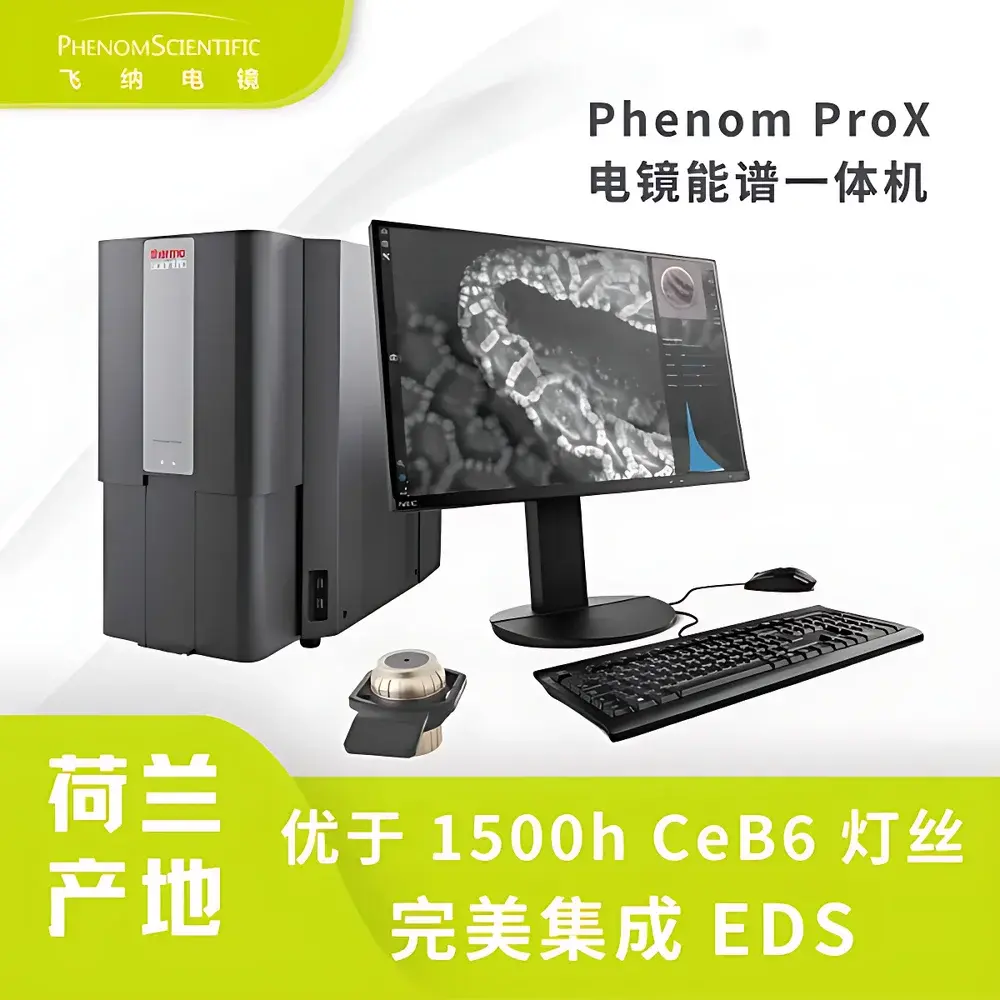
Phenom ProX Desktop SEM-EDS Integrated System
| Brand | Phenom |
|---|---|
| Origin | Netherlands |
| Model | ProX Desktop Scanning Electron Microscope |
| Instrument Type | Desktop SEM-EDS Integrated System |
| Electron Source | Cerium Hexaboride (CeB6) |
| Secondary Electron Image Resolution | 6 nm |
| Maximum Magnification | 350,000× |
| Accelerating Voltage | Basic Mode: 2 / 5 / 10 / 15 / 20 kV |
| Advanced Mode | 4.8–20.5 kV (continuous, for simultaneous imaging & EDS analysis) |
| Backscattered Electron Image Resolution | 6 nm |
| Standard Detectors | Backscattered Electron Detector (BSD), Energy-Dispersive X-ray Spectrometer (EDS) |
| Optional Detector | Secondary Electron Detector (SED) |
| Vacuum Modes | High Vacuum / Low Vacuum (for charge mitigation) |
| Optical Navigation Camera | Integrated Full-Color CCD Camera |
Overview
The Phenom ProX Desktop SEM-EDS Integrated System is a compact, high-performance scanning electron microscope engineered for rapid, quantitative microstructural and elemental characterization in academic research laboratories, materials development centers, and industrial quality control environments. Unlike conventional floor-standing SEMs requiring dedicated rooms and extensive infrastructure, the ProX leverages a robust desktop architecture without compromising analytical capability. Its core operation relies on electron-sample interaction physics: primary electrons from a CeB6 thermionic source strike the specimen surface, generating secondary electrons (SE), backscattered electrons (BSE), and characteristic X-rays. The integrated BSE detector delivers topographic and atomic-number contrast at ≤6 nm resolution, while the co-aligned EDS spectrometer collects X-ray spectra in real time—enabling simultaneous morphological imaging and elemental identification across the full periodic table (Be to U). This dual-modal acquisition is performed under fully automated vacuum and beam control, eliminating manual alignment or external controller dependencies.
Key Features
- True hardware-level SEM-EDS integration: EDS detector physically mounted within the chamber with fixed geometry, ensuring consistent take-off angle and optimal solid-angle collection efficiency for reproducible quantification.
- CeB6 electron source: Offers 5× longer operational lifetime versus tungsten filaments and superior brightness stability—critical for long-duration mapping and routine QC workflows.
- Two-voltage operation modes: Discrete kV selection (2/5/10/15/20 kV) for standardized protocol compliance; continuously adjustable 4.8–20.5 kV mode optimized for combined high-resolution imaging and low-overlap EDS peak acquisition.
- Optical navigation system: Integrated color CCD camera provides real-time macro-to-micro correlation—users locate regions of interest at low magnification before seamless transition to SEM imaging.
- Low-vacuum mode: Enables direct imaging of non-conductive or hydrated samples (e.g., polymers, biological tissues, battery cathodes) without metal coating, minimizing preparation artifacts and preserving native structure.
- Sub-30-second system startup: Cold-cathode vacuum pumping and automated gun alignment reduce downtime between analyses—ideal for high-throughput lab environments.
Sample Compatibility & Compliance
The Phenom ProX accommodates standard 36 mm pin-mount stubs and accepts specimens up to 25 mm in diameter and 30 mm in height. Its dual-mode vacuum architecture supports both conductive (metals, ceramics) and semi-conductive/non-conductive materials (polymers, composites, geological sections, pharmaceutical powders). For regulated industries, the system supports audit-ready data handling: all EDS spectra, maps, and reports include embedded metadata (operator ID, timestamp, instrument parameters, calibration status) compliant with GLP documentation requirements. While not FDA 21 CFR Part 11-certified out-of-the-box, raw spectral files (.eds, .map) are exportable in vendor-neutral formats (e.g., .csv, .tif) for integration into validated LIMS or ELN platforms. Routine performance verification aligns with ISO 16700 (EDS quantification) and ASTM E1508 (SEM image resolution assessment).
Software & Data Management
Control and analysis are unified within the Phenom EID (Element Identification) software suite—a Windows-based application designed for intuitive, step-driven workflows. Key modules include: Real-time EDS spectrum acquisition with automatic peak deconvolution (based on NIST Standard Reference Database); Quantitative ZAF matrix correction for bulk composition; Point-and-click elemental mapping (line scan and area scan) with false-color overlay on BSE/SE images; Batch processing for multi-sample reports; Export options include PDF, PNG, TIFF, and CSV for traceable archival. All measurement parameters—including kV, probe current, dwell time, live time, and detector geometry—are automatically logged per acquisition. Software updates follow a documented release cycle with version-controlled change logs, supporting laboratory validation protocols.
Applications
- Materials Science: Grain boundary analysis in sintered metals; porosity quantification in additive manufacturing powders; interfacial reaction layer thickness in brazed joints.
- Semiconductor & Electronics: Failure analysis of solder joint voiding; contamination identification on wafer surfaces; cross-sectional metrology of thin-film stacks.
- Battery R&D: Cathode particle cracking assessment (LFP, NMC); SEI layer morphology on anodes; separator pore distribution analysis.
- Geosciences & Catalysis: Mineral phase identification in rock thin sections; active site dispersion mapping on supported catalysts (e.g., Pt/Al2O3).
- Quality Assurance: Coating thickness verification; inclusion analysis in steel; counterfeit component authentication via elemental fingerprinting.
FAQ
Is the Phenom ProX suitable for uncoated insulating samples?
Yes—the integrated low-vacuum mode (10–100 Pa range) mitigates surface charging on polymers, ceramics, and biological specimens without requiring sputter coating.
Can EDS quantification be performed without standards?
The system supports standardless quantification using fundamental parameter (FP) algorithms; however, for highest accuracy (<5% relative error), certified reference materials are recommended for calibration.
What maintenance is required beyond lamp replacement?
No routine optical alignment or pump oil changes are needed—the turbomolecular pump uses magnetic levitation bearings, and the CeB6 source requires replacement only every ~5 years under typical usage.
Does the software support automated report generation for ISO/IEC 17025 accreditation?
Yes—customizable report templates include operator signature fields, instrument calibration certificates, and raw spectral attachments, fulfilling key documentation requirements for accredited testing labs.
How does the ProX compare to field-emission SEMs in resolution?
While FE-SEMs achieve sub-nanometer resolution under ultra-high vacuum, the ProX’s 6 nm BSE/SE resolution is sufficient for >90% of industrial QA tasks—including particle sizing, defect review, and elemental homogeneity assessment—within a fraction of the footprint and cost.





