
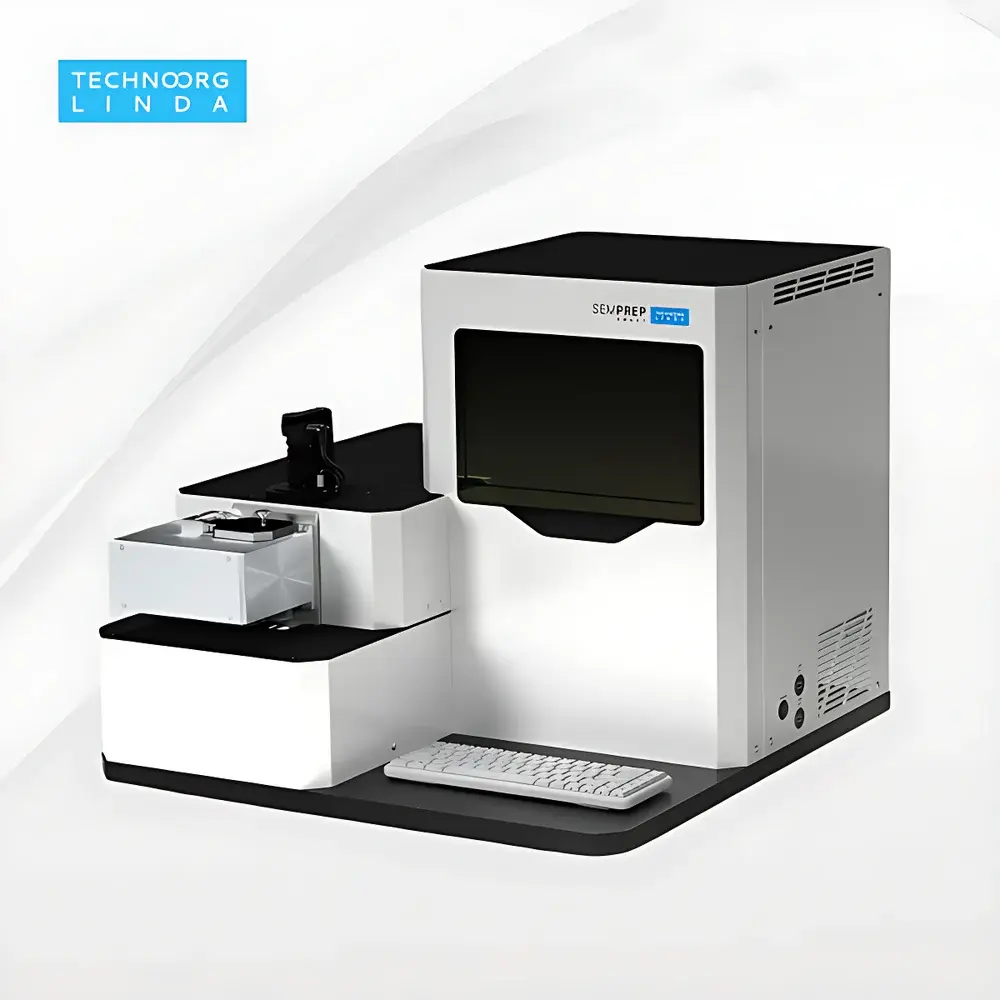
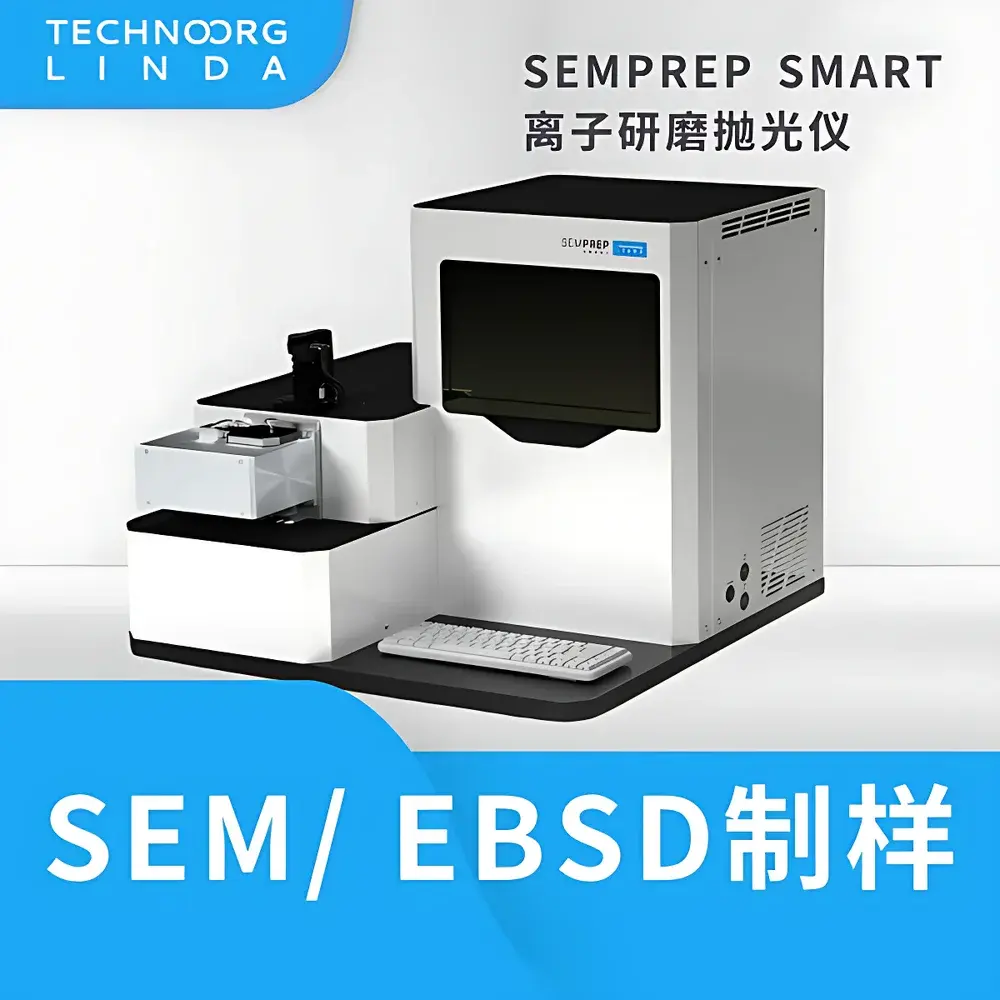
Technoorg Linda SEMPREP SMART Ion Milling System for SEM/EBSD Sample Preparation
| Brand | Technoorg Linda |
|---|---|
| Origin | Hungary |
| Model | SEMPREP SMART |
| Ion Gun Energy | Up to 16 keV |
| Sample Stage Options | Cross-section (30°/90°), Planar (Flat/Standard/Hollow Heads) |
| Sample Dimensions | Up to 50 mm Ø × 4 mm (flat) |
| Tilt Range | 0–30°, adjustable in 0.1° increments |
| Rotation | 360° continuous, variable speed |
| Swing Angle | ±10° to ±120°, adjustable in 5° steps |
| Cooling Options | LN₂ or Peltier |
| Vacuum System | Oil-free diaphragm pump + HiPace 80 Neo turbomolecular pump |
| Imaging | 5 MP CMOS camera with on-image measurement |
| Gas Supply | 99.999% pure Ar, precision needle-valve flow control |
| Software | Automated gun operation, stage calibration, beam-assisted positioning |
Overview
The Technoorg Linda SEMPREP SMART Ion Milling System is a high-precision, ultra-low-damage sample preparation instrument engineered specifically for demanding applications in scanning electron microscopy (SEM) and electron backscatter diffraction (EBSD). It employs broad-beam argon ion milling based on physical sputtering—where energetic Ar⁺ ions bombard the sample surface at controlled incidence angles, removing material atom-by-atom with minimal subsurface damage, amorphization, or thermal artifact. Unlike mechanical polishing or FIB-based methods, ion milling delivers atomically flat, crystallographically undisturbed surfaces essential for high-fidelity EBSD pattern indexing, orientation mapping, and phase identification. The system integrates dual-energy ion gun capability (standard high-energy mode up to 16 keV; optional Low-Energy Gun [LEG] for delicate or beam-sensitive materials), enabling optimization across diverse material classes—from brittle ceramics and intermetallics to layered battery electrodes and polymer composites.
Key Features
- High-energy ion gun (up to 16 keV) with optional Low-Energy Gun (LEG) for sub-keV precision milling of soft or radiation-sensitive specimens
- Modular, motorized sample stage with independent tilt (0–30°, 0.1° resolution), rotation (360°, variable speed), and swing motion (±10° to ±120°, 5° increments) for optimized beam incidence geometry
- Dedicated cross-section stages (30° and 90° configurations) and planar EBSD stages with three interchangeable head types: flat (50 mm Ø), standard (32 mm Ø), and hollow (25 mm Ø)
- Cryogenic cooling options—including liquid nitrogen (LN₂) and thermoelectric (Peltier)—to suppress beam-induced diffusion, charging, or decomposition during milling of temperature-sensitive materials
- Oil-free vacuum architecture featuring a diaphragm roughing pump and HiPace 80 Neo turbomolecular pump, achieving base pressures <5×10⁻⁷ mbar for stable, contamination-free milling environments
- Integrated 5-megapixel CMOS imaging system with real-time on-screen measurement tools, enabling precise visual alignment and process monitoring without breaking vacuum
- Graphical user interface with automated sequence programming, beam-assisted stage calibration, and reproducible recipe storage for GLP-compliant workflow documentation
Sample Compatibility & Compliance
The SEMPREP SMART accommodates a wide range of conductive and non-conductive materials—including metals, alloys, oxides, nitrides, semiconductor wafers, Li-ion battery separators and electrodes, geological thin sections, and composite laminates. Its low-angle, low-energy milling modes meet ASTM E1558–22 requirements for EBSD specimen preparation, while its vacuum transfer unit (VTU) option supports seamless integration into inert-atmosphere gloveboxes or multi-chamber UHV systems—critical for air-sensitive battery or catalyst samples. The system’s design conforms to ISO 14644-1 Class 5 cleanroom compatibility standards when installed with appropriate exhaust filtration. All software operations support audit-trail logging per FDA 21 CFR Part 11 requirements, ensuring traceability for regulated QC/QA laboratories operating under GMP or GLP frameworks.
Software & Data Management
The SEMPREP SMART is controlled via a Windows-based graphical interface featuring intuitive drag-and-drop protocol building, real-time parameter visualization, and synchronized video overlay from the integrated CMOS camera. Users define milling sequences—including voltage, current, angle, duration, and oscillation profile—with full repeatability across sessions. Each run generates timestamped metadata logs containing vacuum pressure history, gas flow rates, beam parameters, and stage coordinates. Export formats include CSV and XML for integration with LIMS or ELN platforms. Optional remote diagnostics and firmware update capability enable proactive maintenance planning without on-site service visits.
Applications
- Preparation of artifact-free cross-sections for failure analysis in semiconductor packaging and advanced interconnect structures
- Surface planarization of multiphase alloys and additive-manufactured components for quantitative EBSD grain boundary and texture analysis
- Interface-specific milling of solid-state battery cathodes/anodes to reveal interphase reaction layers without delamination
- Routine preparation of geological thin sections for microstructural characterization of metamorphic textures and deformation fabrics
- Final polishing of TEM lamellae prior to lift-out—particularly where FIB-induced Ga implantation must be avoided
- Removal of polishing-induced smearing or redeposition on metallographic samples prior to high-resolution SEM imaging
FAQ
What is the primary advantage of ion milling over mechanical polishing for EBSD?
Ion milling eliminates plastic deformation, embedded abrasives, and surface relief associated with mechanical methods—delivering near-perfect crystallinity required for high-confidence EBSD pattern indexing.
Can the SEMPREP SMART prepare insulating samples without conductive coating?
Yes—low-energy ion milling combined with cryogenic cooling significantly reduces charging effects, enabling direct analysis of oxides, polymers, and ceramics without carbon or gold sputtering.
Is vacuum transfer supported between the SEMPREP SMART and other instruments?
An optional Vacuum Transfer Unit (VTU) enables direct, air-free sample transfer to SEM, FIB-SEM, or XPS systems equipped with compatible load-lock interfaces.
How does the system ensure long-term operational stability?
The oil-free pumping architecture prevents hydrocarbon contamination; the high-stability ion gun power supply and closed-loop stage encoders maintain positional accuracy over thousands of hours of cumulative operation.
Are software updates and technical support available globally?
Technoorg Linda provides lifetime software maintenance and remote engineering support through authorized regional distributors, with documentation available in English, German, Japanese, and Chinese.



