
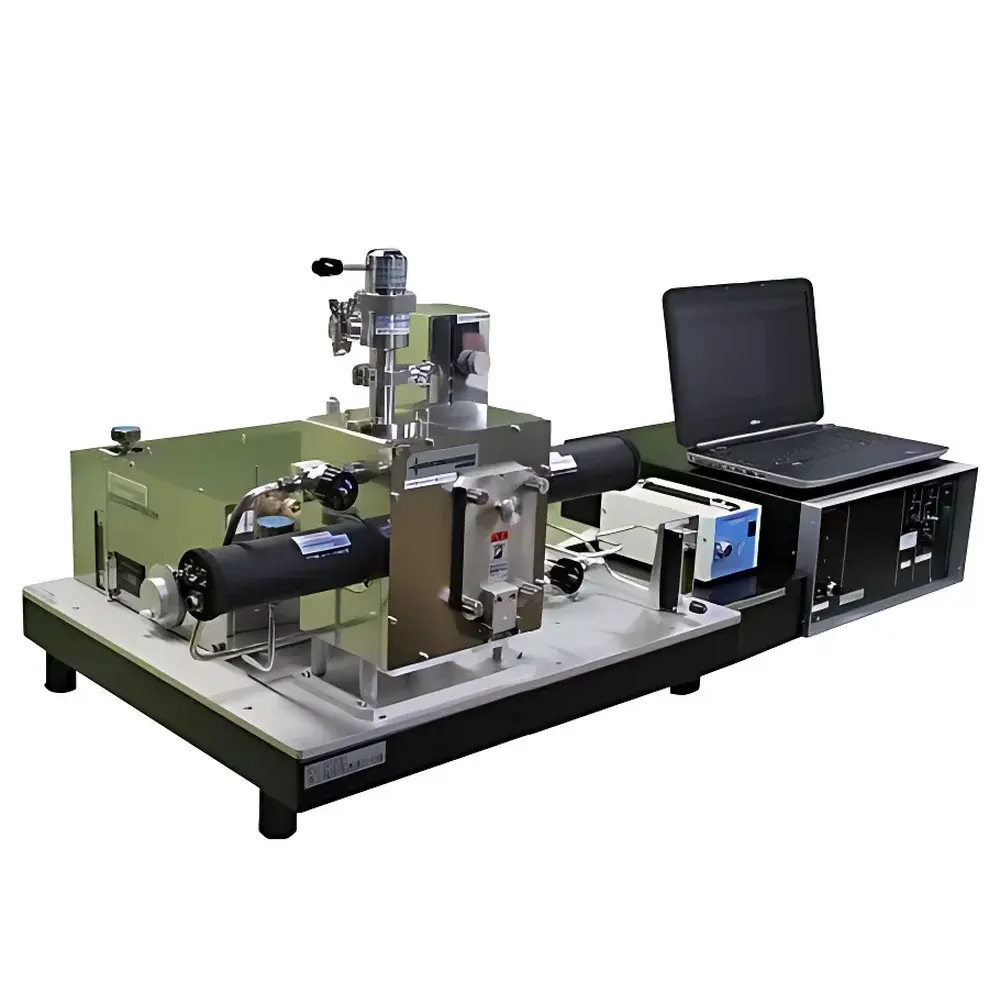
Bunkoukeiki KV-202 Desktop Vacuum Ultraviolet Transmittance Spectrometer
| Brand | Bunkoukeiki |
|---|---|
| Origin | Japan |
| Model | KV-202 |
| Instrument Architecture | Dual-wavelength |
| Detector Type | CCD (Charge-Coupled Device) |
| Wavelength Range | 120–400 nm |
| Automation Level | Automatic Wavelength Scanning |
| Spectral Bandwidth | 4 nm |
| Wavelength Accuracy | ±0.1 nm |
| Wavelength Repeatability | ±0.1 nm |
| Stray Light (S.L.) | ≤0.001% T |
| Light Source | 30 W Deuterium Lamp |
| Sample Format | Rectangular, 3×3 mm to 12×12 mm (min–max), Thickness: 0.1–0.3 mm |
| Measurement Repeatability | ±0.3% T |
| Optical Configuration | Dual-beam with Reference Channel Compensation |
| Monochromator | KV-200 Purgeable/High-Stability Vacuum UV Monochromator |
Overview
The Bunkoukeiki KV-202 Desktop Vacuum Ultraviolet Transmittance Spectrometer is a precision-engineered optical instrument designed for quantitative spectral transmittance measurements in the vacuum ultraviolet (VUV) region—specifically from 120 nm to 400 nm. Unlike conventional UV-Vis spectrophotometers limited by atmospheric oxygen absorption below ~190 nm, the KV-202 operates under nitrogen-purged or vacuum-compatible optical pathways, enabling reliable acquisition of transmission spectra in the critical 120–130 nm range where many advanced optical coatings, wide-bandgap semiconductors, and thin-film dielectrics exhibit characteristic absorption edges. Its core optical architecture employs a high-stability KV-200 monochromator with optimized grating dispersion and thermal drift compensation, coupled with a dual-beam optical layout: one beam interrogates the sample while the second simultaneously monitors source intensity fluctuations via a reference channel. This configuration ensures high photometric stability and minimizes baseline drift during extended acquisitions—essential for reproducible VUV characterization in R&D and quality control environments.
Key Features
- Extended VUV spectral coverage from 120 nm to 400 nm, enabled by nitrogen-purged optical path and high-transmission fused silica/quartz optics
- Dual-beam optical design with real-time reference-channel compensation for enhanced photometric stability and reduced source-intensity artifacts
- KV-200 monochromator engineered for high wavelength repeatability (±0.1 nm) and narrow spectral bandwidth (4 nm FWHM)
- High-sensitivity CCD detector optimized for low-photon-flux VUV conditions; supports rapid spectral acquisition with minimal integration time variability
- Automated wavelength scanning with programmable step resolution and dwell time, compatible with standardized method protocols
- Robust mechanical construction with vibration-damped optical bench and temperature-stabilized housing to maintain alignment integrity over multi-hour runs
Sample Compatibility & Compliance
The KV-202 accommodates planar solid samples with dimensions ranging from 3 × 3 mm to 12 × 12 mm and thicknesses between 0.1 mm and 0.3 mm—ideal for evaluating optical thin films, transparent conductive oxides (e.g., ITO, AZO), UV-grade quartz substrates, and polymer-based barrier layers. Its sample compartment is configured for easy insertion and alignment using precision kinematic mounts, minimizing operator-induced positioning errors. The system meets fundamental requirements for traceable optical metrology: wavelength calibration is traceable to NIST-standard spectral emission lines (e.g., Hg and Ne lamps), and photometric linearity is verified per ISO 6581 and ASTM E275. While not inherently 21 CFR Part 11 compliant out-of-the-box, the instrument’s data export architecture supports integration into validated LIMS or ELN platforms with audit-trail-enabled software extensions for GLP/GMP-regulated laboratories.
Software & Data Management
The KV-202 is operated via a dedicated Windows-based control suite supporting full instrument parameterization—including slit width, scan speed, averaging cycles, and background subtraction routines. Raw spectral data are stored in ASCII-compatible .csv format with embedded metadata (timestamp, lamp status, purge gas pressure, calibration ID). Onboard processing includes Savitzky-Golay smoothing (1st–3rd order), numerical differentiation (1st–3rd derivative), peak detection (height/area/integration limits), and overlay comparison across up to eight spectra. Export options include PNG/SVG graphics and direct linkage to MATLAB, Python (via NumPy/Pandas), or LabVIEW for custom algorithm development. All user actions—including method loading, calibration updates, and data deletion—are logged with timestamped entries, forming an auditable operational record suitable for internal QA review.
Applications
- Characterization of deep-UV antireflection and high-reflection coatings for excimer laser optics (e.g., ArF at 193 nm, F₂ at 157 nm)
- Bandgap determination of wide-bandgap materials such as AlN, GaN, and diamond-like carbon (DLC) films
- Quality assurance of VUV-transparent window materials (MgF₂, LiF, CaF₂) used in synchrotron beamlines and space-based sensors
- Thickness and uniformity assessment of ultra-thin (<5 nm) metal-oxide gate dielectrics via interference fringe analysis in transmission mode
- Stability testing of photoresists and EUV resist candidates under controlled VUV exposure conditions
- Development and validation of optical models for thin-film stacks using reverse-engineering algorithms (e.g., Swanepoel method)
FAQ
What purge gas is required for optimal operation below 190 nm?
Nitrogen (≥99.999% purity) is recommended for routine operation down to ~130 nm; for measurements below 125 nm, vacuum evacuation (<10⁻² Pa) is necessary and requires optional vacuum interface hardware.
Can the KV-202 measure reflectance or absorbance directly?
No—the instrument is configured exclusively for transmittance measurement. Reflectance and absorbance must be derived indirectly using calibrated reference standards (e.g., certified VUV-reflectance mirrors) and Beer-Lambert modeling.
Is the deuterium lamp user-replaceable, and what is its typical lifetime?
Yes—the 30 W deuterium lamp is field-replaceable with standard alignment tools; rated lifetime is ≥1,000 hours at nominal current, with output stability monitored via built-in reference photodiode feedback.
Does the system support automated mapping of non-uniform samples?
Not natively—the KV-202 is a point-measurement spectrometer. For spatial mapping, it must be integrated with motorized XYZ translation stages and external motion-control software.
How is wavelength accuracy maintained over time?
Through periodic recalibration using mercury or neon emission line standards; the monochromator’s stepper-motor drive includes encoder feedback for positional verification, ensuring long-term repeatability without manual intervention.






