
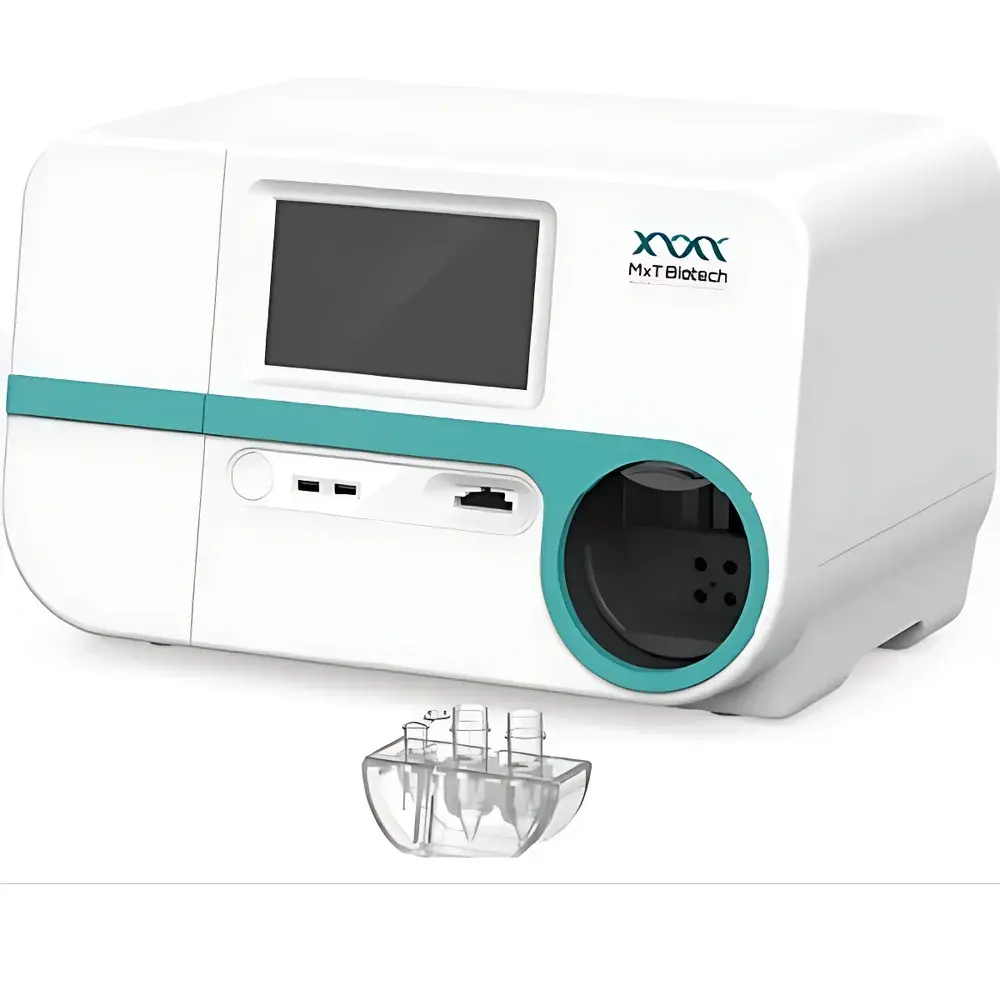
MxT Biotech Hyctoporaltor Hydrodynamic Cell Transfection System
| Brand | MxT Biotech |
|---|---|
| Origin | South Korea |
| Manufacturer Type | Authorized Distributor |
| Origin Category | Imported Instrument |
| Model | Hyctoporaltor |
| High-Voltage Range | 100 V |
| Low-Voltage Range | 10 V |
Overview
The MxT Biotech Hyctoporaltor Hydrodynamic Cell Transfection System is a non-viral, microfluidic-based platform engineered for high-efficiency, low-stress delivery of nucleic acids and proteins into primary, sensitive, and hard-to-transfect mammalian cells. Unlike conventional electroporation or lipid-mediated methods, the Hyctoporaltor leverages precisely controlled hydrodynamic shear forces—generated via transient, laminar fluid acceleration—to induce transient membrane perturbations without chemical reagents or electrical pulses. This physical mechanism enables rapid, uniform intracellular delivery while preserving native cell physiology, viability, and functional integrity. Designed for research-grade reproducibility and scalability, the system operates under fully enclosed, sterile conditions and is validated for use with adherent and suspension cells—including human T cells, iPSCs, neurons, and primary hepatocytes—making it particularly suitable for applications demanding high post-transfection viability and phenotypic fidelity.
Key Features
- Hydrodynamic transfection principle: Shear-mediated membrane permeabilization eliminates dependence on cationic lipids, polymers, or electric field exposure.
- Automated, walk-away operation with pre-validated protocols for over 20 cell types—including primary immune cells and stem cells—reducing inter-operator variability.
- Microfluidic precision engineering ensures uniform exposure of all cells to identical hydrodynamic stress profiles, enabling batch-to-batch consistency in transfection efficiency and expression kinetics.
- Multi-modal cargo compatibility: Validated for plasmid DNA, mRNA, siRNA, recombinant proteins, CRISPR-Cas9 ribonucleoprotein (RNP) complexes, and polymeric/lipid nanoparticles.
- Integrated real-time pressure and flow monitoring with closed-loop feedback control maintains optimal transfection dynamics across varying cell densities and viscosities.
- Compact benchtop footprint (32 × 45 × 38 cm) and intuitive touchscreen interface support seamless integration into GLP-compliant workflows and automated cell processing suites.
Sample Compatibility & Compliance
The Hyctoporaltor demonstrates robust performance across diverse biological samples, including human peripheral blood mononuclear cells (PBMCs), CD3+ T lymphocytes, CD34+ hematopoietic progenitors, induced pluripotent stem cells (iPSCs), primary hepatocytes, and neuronal cultures. It supports both single-use and reusable microfluidic cartridges certified to ISO 10993-5 (cytotoxicity) and ISO 13485-compliant manufacturing standards. While intended for Research Use Only (RUO), the system’s architecture aligns with foundational requirements for future regulatory pathway development—including traceable parameter logging, user-accessible audit trails, and protocol versioning—facilitating alignment with FDA 21 CFR Part 11 readiness frameworks during translational process development.
Software & Data Management
The Hyctoporaltor Control Suite (v3.2+) provides role-based access control, encrypted local data storage, and export options compliant with FAIR (Findable, Accessible, Interoperable, Reusable) principles. Each run generates timestamped metadata logs—including flow rate, pressure differential, total volume processed, and real-time impedance deviation—exportable as CSV or HDF5 for downstream analysis in Python/R environments. Software updates are delivered via secure OTA channels with SHA-256 signature verification. All user-defined protocols are digitally signed and version-controlled, supporting retrospective analysis and method transfer across laboratory sites.
Applications
- CRISPR genome editing: High-efficiency RNP delivery into primary T cells for multiplexed knockout of TCR, PD-1, or HLA loci with >85% editing rates and >90% viability retention.
- mRNA-engineered cell therapies: Production of transient CAR-T cells with preserved metabolic fitness and cytokine secretion profiles, avoiding genomic integration risks.
- Stem cell reprogramming & differentiation: Delivery of transcription factor mRNAs into iPSCs without compromising pluripotency marker expression or karyotypic stability.
- Functional genomics screening: Scalable transfection of pooled sgRNA libraries into primary macrophages or dendritic cells for phenotype-resolved immune response mapping.
- Viral-free gene therapy vector development: Optimization of non-integrating episomal DNA constructs for sustained transgene expression in quiescent cell populations.
- Cell line engineering: Rapid generation of stable CHO or HEK293 pools with minimal clonal selection bias and enhanced monoclonality assurance.
FAQ
Is the Hyctoporaltor compatible with GMP manufacturing environments?
The system is RUO-labeled and not certified for clinical production; however, its design incorporates features supporting future process validation—including material traceability, calibration certificate management, and electronic record retention per ALCOA+ principles.
Can I use my own microfluidic chips with this instrument?
Only MxT Biotech–certified disposable cartridges are supported to ensure pressure integrity, sterility, and protocol reproducibility. Third-party chips void warranty and invalidate regulatory compliance pathways.
What is the maximum recommended cell concentration for optimal transfection?
The system supports densities from 1 × 10⁵ to 2 × 10⁷ cells/mL depending on cell type and cargo; optimal ranges are provided in the Application Note Library for each validated cell line.
Does the Hyctoporaltor require external cooling or gas supply?
No external utilities are required. Integrated Peltier-based thermal regulation maintains sample temperature within ±0.5°C of setpoint (4–37°C) throughout the run.
How is transfection efficiency quantified post-run?
The system does not include integrated detection; users perform downstream assessment via flow cytometry, qRT-PCR, or functional assays—consistent with standard industry practice for physical transfection platforms.



