
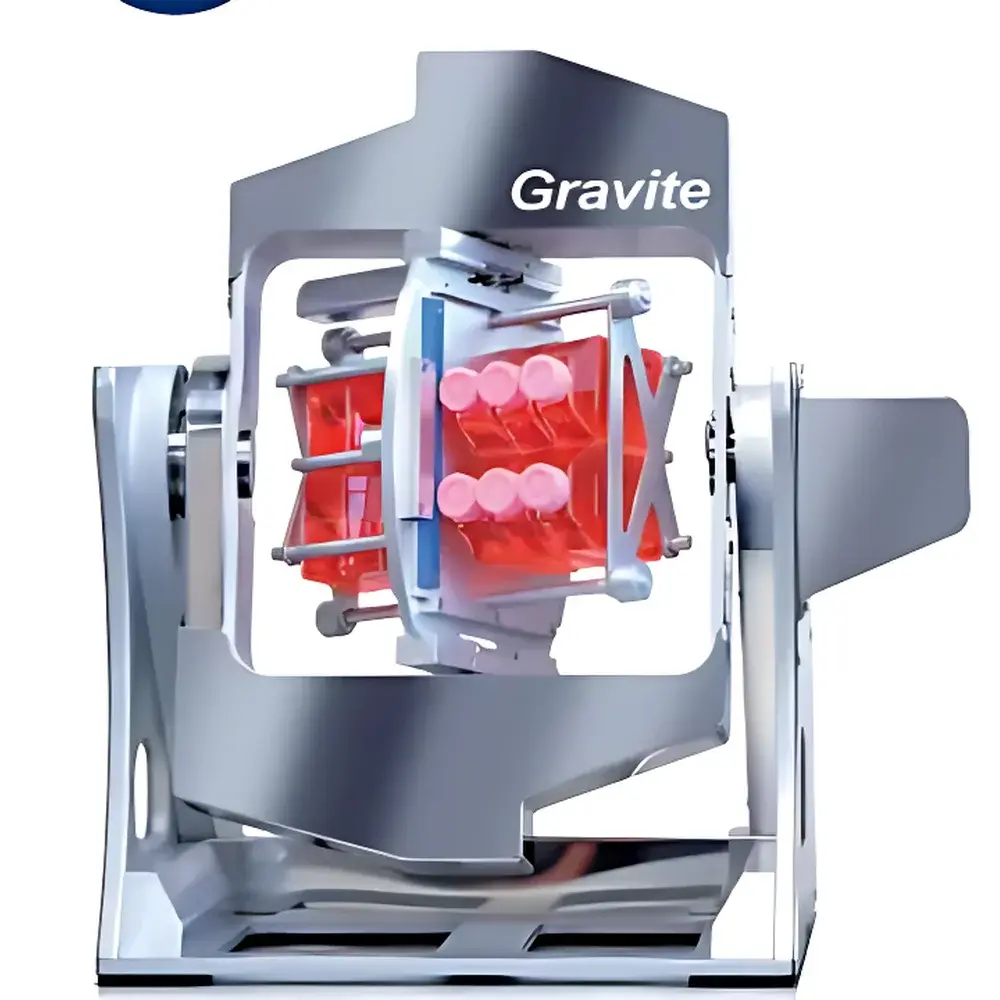
Gravite® Microgravity & Hypergravity 3D Cell Culture System
| Origin | Japan |
|---|---|
| Manufacturer Type | Authorized Distributor |
| Origin Category | Imported |
| Model | Gravite® |
| Price | Upon Request |
Overview
The Gravite® Microgravity & Hypergravity 3D Cell Culture System is a precision-engineered, dual-axis rotating bioreactor designed to simulate physiologically relevant gravitational environments for advanced in vitro cell culture. Unlike conventional static or orbital shaker-based systems, Gravite® employs controlled orthogonal rotation to dynamically cancel the net gravitational vector at its central sample chamber—achieving a time-averaged residual acceleration of ≤10−3 g, closely approximating microgravity conditions experienced aboard the International Space Station (ISS). Simultaneously, single-axis centrifugal operation enables hypergravity exposure at 2–3 g, facilitating comparative mechanobiological studies. This system operates on the principle of vector cancellation via synchronized angular momentum, not fluid suspension or magnetic levitation, ensuring mechanical stability, minimal shear stress, and high reproducibility across biological replicates. It is engineered for integration into standard CO2 incubators (37 °C, 5% CO2, ≥95% RH), enabling real-time physiological relevance without compromising sterility or environmental control.
Key Features
- Dual-Axis Vector Cancellation Architecture: Independent, programmable control of two perpendicular rotational axes enables precise modulation of net gravitational load at the sample center—delivering stable, long-term microgravity (≤10−3 g) or switchable hypergravity (2–3 g) within the same platform.
- Real-Time Gravitational Monitoring: Integrated triaxial MEMS accelerometers provide continuous, calibrated acceleration data (±0.001 g resolution) with timestamped output, supporting GLP-compliant experimental documentation and validation.
- Incubator-Compatible Design: Compact, stainless-steel housing with sealed electronics and low-heat-generation motors allows uninterrupted operation inside standard humidified CO2 incubators—eliminating external environmental interference.
- Standardized Cell Culture Integration: Accommodates standard tissue culture vessels (e.g., 6-/12-/24-well plates, T25/T75 flasks, custom bioreactor cartridges) with secure mounting fixtures and vibration-dampened sample holders.
- Programmable Operation Profiles: Predefined and user-defined gravity profiles—including ramped transitions, intermittent gravity cycling, and sustained exposure modes—are executable via USB-connected control software with audit-trail logging.
Sample Compatibility & Compliance
The Gravite® system supports adherent and suspension mammalian cell lines, primary human cells, stem cells (ES/iPS), organoids, and co-culture models. Its non-invasive, low-shear environment preserves native extracellular matrix deposition and intercellular signaling—critical for 3D spheroid and organoid maturation. The device complies with ISO 13485 design controls for medical device-related research instrumentation and meets electromagnetic compatibility (EMC) requirements per IEC 61326-1. While not a diagnostic device, its operational parameters align with FDA-recommended practices for preclinical model validation under 21 CFR Part 11 when paired with compliant data acquisition software. All materials in contact with samples are USP Class VI-certified and autoclavable (excluding motor assembly).
Software & Data Management
GraviteControl™ software (Windows-based) provides intuitive profile setup, real-time acceleration visualization, and automated CSV export of sensor logs with metadata tagging (user ID, experiment ID, vessel ID, timestamp). Audit trails record all parameter changes, start/stop events, and calibration actions—supporting 21 CFR Part 11 compliance when deployed with institutional IT security protocols. Raw acceleration data is exportable for third-party analysis (e.g., MATLAB, Python SciPy) and integrates with LIMS via RESTful API for enterprise-scale data governance. Firmware updates are digitally signed and version-locked to ensure traceability.
Applications
- Cancer Biology: Modeling tumor spheroid formation, hypoxia gradients, and chemoresistance mechanisms under microgravity-induced cytoskeletal reorganization.
- Stem Cell Differentiation Studies: Investigating gravity-dependent regulation of pluripotency markers (e.g., Oct4, Nanog) and lineage commitment pathways during embryoid body development.
- Tissue Engineering: Enhancing extracellular matrix synthesis and mechanical integrity in bioengineered cartilage, bone, and vascular constructs.
- Drug Discovery & Toxicology: Improving predictive accuracy of compound efficacy and off-target effects using 3D models that better recapitulate in vivo pharmacokinetic barriers.
- Astrobiology & Space Medicine: Ground-based simulation of spaceflight physiological stressors for astronaut health risk assessment and countermeasure development.
- Musculoskeletal Mechanobiology: Quantifying myoblast fusion inhibition and sarcomere disassembly kinetics under chronic microgravity exposure.
FAQ
What gravitational accuracy does Gravite® achieve in microgravity mode?
Gravite® delivers a time-averaged residual acceleration of ≤10−3 g at the geometric center of the sample chamber, validated using NIST-traceable inertial measurement units under ISO/IEC 17025-accredited calibration protocols.
Can Gravite® be used inside a standard CO2 incubator?
Yes—the system is specifically engineered for continuous operation inside humidified, 37 °C, 5% CO2 incubators; no external cooling or venting is required.
Is real-time gravity data exportable for regulatory submissions?
Yes—acceleration logs include ISO 8601 timestamps, device serial number, and operator ID; export formats comply with ALCOA+ principles for GxP environments.
Does Gravite® support sterile, closed-system operation?
All sample interfaces use ISO 5 cleanroom-compatible materials; vessels remain sealed during rotation, and the system has been validated for sterility maintenance over 14-day culture periods.
How is hypergravity generated, and what is its uniformity across the sample volume?
Hypergravity (2–3 g) is generated via single-axis centrifugation; radial uniformity is ±2.5% across standard well-plate dimensions (per ASTM E2500-18 Annex A3 verification).



