
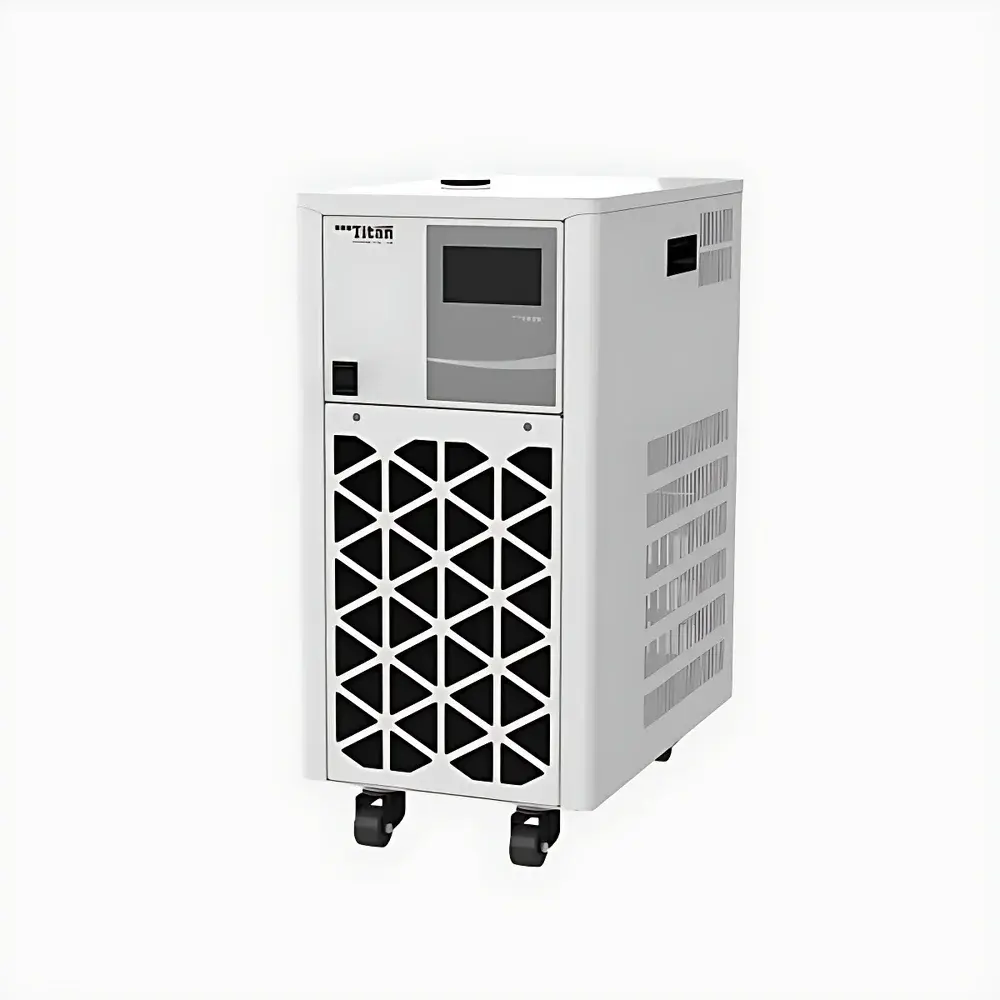
Titan HLT-0940 Integrated High-Low Temperature Circulating Chiller
| Brand | Titan |
|---|---|
| Origin | Shanghai, China |
| Manufacturer Type | Direct Manufacturer |
| Product Category | Domestic |
| Model | HLT-0940 |
| Instrument Type | Integrated Unit |
| Cooling Method | Water-Cooled |
| Temperature Range | −40 °C to +100 °C |
| Cooling Capacity | 1500 W (Heating Capacity: 2000 W) |
| Temperature Stability | ±0.05 °C |
| Circulation Pump Pressure | 1.0 bar |
| Circulation Flow Rate | 22 L/min |
| Reservoir Volume | 9 L |
| Operation Mode | Continuous |
Overview
The Titan HLT-0940 is an integrated high-low temperature circulating chiller engineered for precision thermal control in demanding laboratory and industrial R&D environments. It operates on a dual-mode thermodynamic principle—employing a hermetically sealed, environmentally optimized refrigeration circuit combined with a high-efficiency resistive heating system—to deliver stable, programmable temperature regulation across a wide operational span of −40 °C to +100 °C. Unlike modular or external-coil systems, the HLT-0940 integrates compressor, condenser, expansion valve, evaporator, heater, reservoir, and circulation pump into a single compact chassis, minimizing footprint while maximizing thermal response consistency and long-term reliability. Its water-cooled condenser design ensures stable performance under ambient conditions where air-cooled units may experience capacity derating—particularly critical in controlled laboratories with limited ventilation or elevated ambient temperatures. The unit is designed for continuous-duty operation, supporting applications requiring uninterrupted thermal management over extended cycles, including reaction calorimetry, material testing, spectrometer cooling, and chromatographic column conditioning.
Key Features
- Wide temperature range: −40 °C to +100 °C, enabled by a cascade refrigeration architecture with R-404A/R-23 dual-refrigerant staging for low-temperature stability and rapid recovery
- High thermal output: 1500 W nominal cooling capacity at 20 °C ambient, paired with 2000 W electric heating for precise ramp-and-soak profiles
- Exceptional temperature stability: ±0.05 °C (at setpoint, load ≤ 70% of max capacity), achieved via PID-controlled dual-stage temperature feedback using platinum RTD sensors (Pt100, Class A) mounted directly in the reservoir and outlet stream
- Robust circulation system: 22 L/min flow rate at 1.0 bar pressure, driven by a magnetically coupled, brushless DC pump with adjustable speed control to match system backpressure and minimize cavitation risk
- 9-liter stainless-steel reservoir with level sensor, overflow protection, and integrated filtration (5 µm particulate trap) to safeguard connected instrumentation
- Front-panel touchscreen interface with real-time trend logging, alarm history, and user-configurable safety limits (high/low temperature, low flow, low level)
Sample Compatibility & Compliance
The HLT-0940 is compatible with standard laboratory fluid loops using aqueous glycol/water mixtures (up to 40% ethylene or propylene glycol) and non-corrosive heat transfer fluids (e.g., silicone oils within viscosity limits). It interfaces seamlessly with external equipment via standard 1/2″ NPT or G1/2″ BSP inlet/outlet ports. All wetted components—including reservoir, pump head, and internal tubing—are constructed from 316 stainless steel and EPDM/FKM elastomers, ensuring chemical compatibility and resistance to thermal cycling fatigue. The unit complies with IEC 61000-6-3 (EMC emission standards) and IEC 61000-6-2 (immunity), carries CE marking per the EU Machinery Directive 2006/42/EC, and meets RoHS 2011/65/EU material restrictions. For GLP/GMP-regulated labs, optional audit-trail-enabled firmware supports 21 CFR Part 11-compliant electronic records when used with Titan’s validated LabLink software suite.
Software & Data Management
Titan LabLink™ software (v3.2+) provides remote monitoring and control via Ethernet or USB connection. It enables multi-parameter logging (temperature, flow, pressure, power draw), script-based temperature programming (ramp-hold-ramp sequences), and export of timestamped CSV data compliant with ISO/IEC 17025 documentation requirements. The software supports user role-based access control (administrator/operator), configurable alarm notifications (email/SNMP), and integration with LabArchives or Electronic Lab Notebook (ELN) platforms via RESTful API. Internal memory retains ≥30 days of 1-second-interval data even during network outages, with automatic overwrite protection for critical alarm events.
Applications
- Stabilization of laser sources, CCD detectors, and interferometers requiring sub-0.1 °C thermal drift control
- Cooling of rotary evaporators, jacketed reactors, and synthesis blocks in organic and pharmaceutical process development
- Thermal conditioning of DSC, TGA, and DMA sample stages under ISO 11357 and ASTM E1356 protocols
- Support of HPLC/UHPLC column ovens and detector cells per USP and ICH Q2(R2) method validation guidelines
- Environmental stress screening of electronic components and polymer composites per MIL-STD-810 and ASTM D696
FAQ
What is the recommended heat transfer fluid for operation below −20 °C?
For temperatures down to −40 °C, Titan recommends a 35% propylene glycol / 65% deionized water mixture (viscosity ≤ 12 cP at −40 °C); avoid ethylene glycol below −30 °C due to increased viscosity and crystallization risk.
Can the HLT-0940 be integrated into a building management system (BMS)?
Yes—via Modbus TCP (standard) or optional BACnet/IP gateway, enabling status monitoring, setpoint adjustment, and fault reporting within enterprise-level HVAC or lab infrastructure networks.
Is external water cooling required for the condenser?
Yes—the unit requires a continuous supply of clean, deionized or softened water (5–30 °C inlet, ≤ 3 bar pressure, flow ≥ 3 L/min) to the water-cooled condenser; failure to maintain adequate coolant flow triggers immediate shutdown to protect compressor integrity.
Does the unit support external temperature sensing for process-coupled control?
Yes—via optional PT100 input port (IEC 60751), enabling cascade control where the chiller regulates based on a remote sensor placed at the application point rather than reservoir temperature.
What maintenance intervals are specified for long-term reliability?
Compressor oil and refrigerant charge require verification every 24 months; circulation filter replacement every 6 months; and full system leak test and calibration every 12 months—documented in accordance with ISO/IEC 17025 traceable procedures.



