
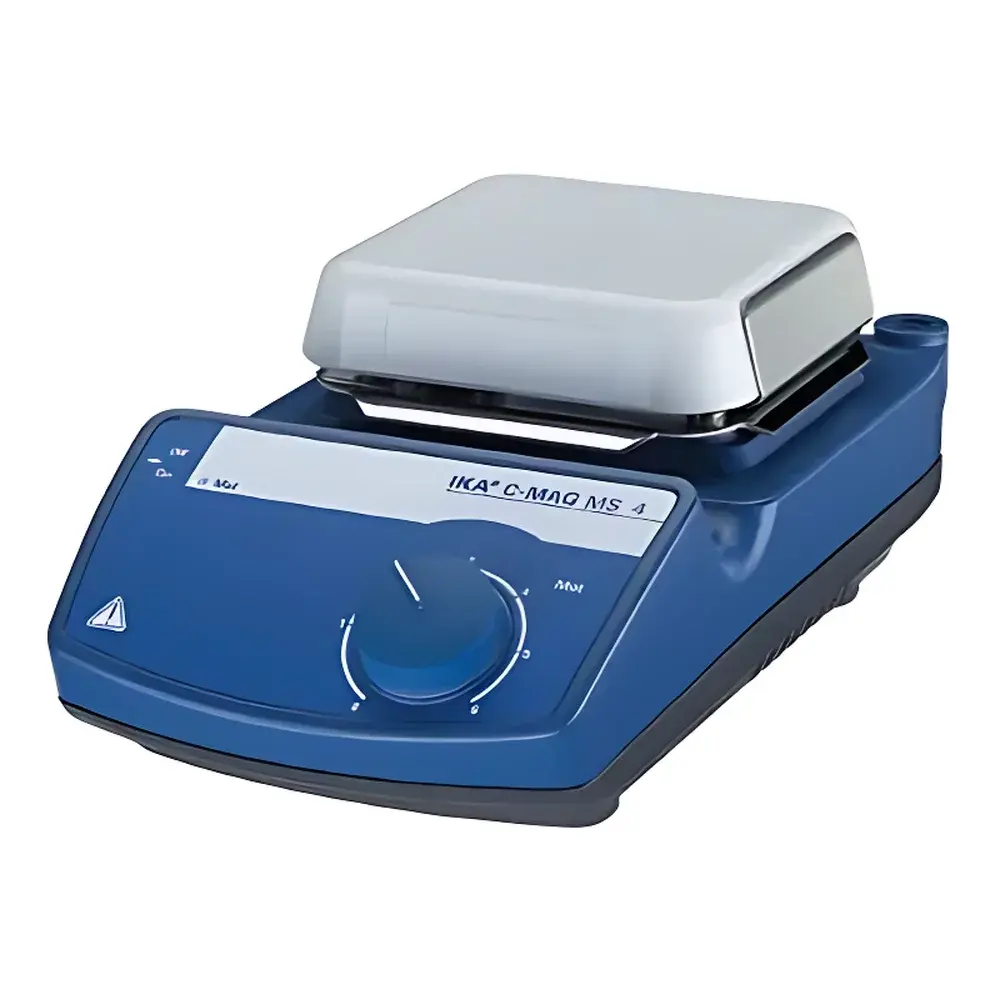
IKA C-MAG MS4 IKAMAG® Magnetic Stirrer
| Brand | IKA |
|---|---|
| Origin | Germany |
| Model | C-MAG MS4 |
| Instrument Type | Magnetic Stirrer |
| Maximum Stirring Volume (H₂O) | 5 L |
| Speed Range | 100–1500 rpm |
| Temperature Control Range | 5–40 °C |
| Working Plate Material | Ceramic |
| Plate Dimensions | 100 × 100 mm |
| Input Power | 30 W |
| Protection Rating | IP21 |
| Operating Ambient Temperature | 5–40 °C |
| Relative Humidity Limit | 80 % |
| Voltage | 230 V, 50/60 Hz |
Overview
The IKA C-MAG MS4 IKAMAG® Magnetic Stirrer is a compact, single-position benchtop instrument engineered for precision and reliability in routine laboratory mixing applications. Designed around the principle of magnetic coupling—where a rotating permanent magnet beneath a non-magnetic plate induces rotation of a magnetic stir bar immersed in the sample—the C-MAG MS4 delivers consistent torque transmission without mechanical drive shafts or seals. Its ceramic-coated aluminum plate provides uniform thermal distribution and excellent chemical resistance, making it suitable for aqueous, organic, and mildly aggressive reagent environments. Unlike gear-driven or overhead stirrers, this device operates with minimal vibration and zero risk of contamination from moving parts, aligning with GLP-compliant workflows where sample integrity and operator safety are paramount.
Key Features
- High-Performance Ceramic Heating Plate: Seamless, one-piece ceramic surface resists corrosion from acids, bases, and solvents; withstands thermal shock and maintains dimensional stability across repeated heating/cooling cycles.
- Precise Analog Speed Control: Calibrated rotary dial (0–6 scale) enables reproducible speed selection within the 100–1500 rpm range; internal tachometric feedback ensures stable rotational output even under variable load conditions.
- Integrated Temperature Regulation: Built-in PTC heating element supports temperature control between 5 °C and 40 °C—ideal for low-temperature crystallization studies, enzyme assays, or ambient-sensitive dissolution protocols.
- Ergonomic Elevated Control Panel: Raised interface minimizes splashing onto controls during active stirring; large-scale analog speed indication improves readability without requiring digital displays or software dependency.
- Robust Mechanical Architecture: Compact footprint (150 × 105 × 260 mm), lightweight design (3 kg), and IP21-rated enclosure ensure safe operation in shared lab spaces subject to incidental liquid exposure or dust accumulation.
- Energy-Efficient Operation: Total input power consumption remains at 30 W, with motor output optimized at 1.5 W—reducing thermal load on sensitive samples while maintaining sufficient torque for viscous media up to 5 L (water-equivalent).
Sample Compatibility & Compliance
The C-MAG MS4 accommodates standard laboratory glassware including beakers (up to 1000 mL), Erlenmeyer flasks, and round-bottom vessels placed directly on its 100 × 100 mm ceramic plate. It supports stir bars ranging from 20 mm to 40 mm in length and is compatible with polytetrafluoroethylene (PTFE)-coated, PTFE-glass composite, and encapsulated samarium-cobalt stir elements. The unit conforms to DIN EN 60529 (IP21 ingress protection), EN 61010-1 (safety requirements for electrical equipment for measurement, control, and laboratory use), and carries CE marking for compliance with EU electromagnetic compatibility (EMC) and low-voltage directives. While not equipped with audit-trail functionality or electronic data capture, its analog architecture meets basic ISO/IEC 17025 documentation requirements when used within validated SOPs for preparatory steps in analytical chemistry or quality control testing.
Software & Data Management
The C-MAG MS4 operates as a standalone analog instrument with no embedded firmware, USB connectivity, or software interface. All operational parameters—including speed setting and plate temperature—are manually adjusted and visually monitored via the front-panel dial and ambient indicators. This design eliminates cybersecurity vulnerabilities, firmware update dependencies, and validation overhead associated with digital controllers—making it particularly suited for regulated environments where simplicity, traceability, and long-term operational consistency are prioritized over automated logging. Users may document settings manually in lab notebooks or integrate the device into broader workflow systems using external environmental monitoring tools compliant with FDA 21 CFR Part 11 if electronic records are required.
Applications
This stirrer serves core functions across pharmaceutical development (buffer preparation, excipient dispersion), academic research (kinetic reaction mixing, nanoparticle suspension stabilization), clinical diagnostics (reagent homogenization prior to spectrophotometric analysis), and industrial QC labs (viscosity pre-conditioning, titrant equilibration). Its controlled low-speed capability (100 rpm minimum) supports gentle agitation of cell cultures or fragile precipitates, while the upper limit enables efficient dispersion of fine powders in polymer solutions or catalyst slurries. The absence of moving external components also facilitates cleanroom-compatible usage when paired with sterile stir bars and disposable vessel liners.
FAQ
Does the C-MAG MS4 support external temperature probe feedback for precise bath temperature regulation?
No—it features only a fixed-range resistive heating system without external sensor input or PID tuning capability.
Can it be used with metal containers or aluminum foil-covered vessels?
No—ferromagnetic or conductive materials above the plate will disrupt magnetic coupling and impair stir bar rotation.
Is the ceramic plate resistant to hydrofluoric acid (HF)?
No—while highly resistant to most common lab chemicals, HF attacks silica-based ceramics and must be avoided.
What is the maximum viscosity this stirrer can handle at full speed?
It is rated for water-equivalent volumes up to 5 L; performance with high-viscosity fluids (e.g., >500 mPa·s) depends on stir bar geometry, vessel shape, and thermal loading—but typical use remains below 1000 mPa·s.
Does IKA provide calibration certificates or metrological traceability for this model?
As an analog device without digital sensors, formal calibration is not applicable; however, speed verification may be performed using an external tachometer per internal QA procedures.
Related Products



