
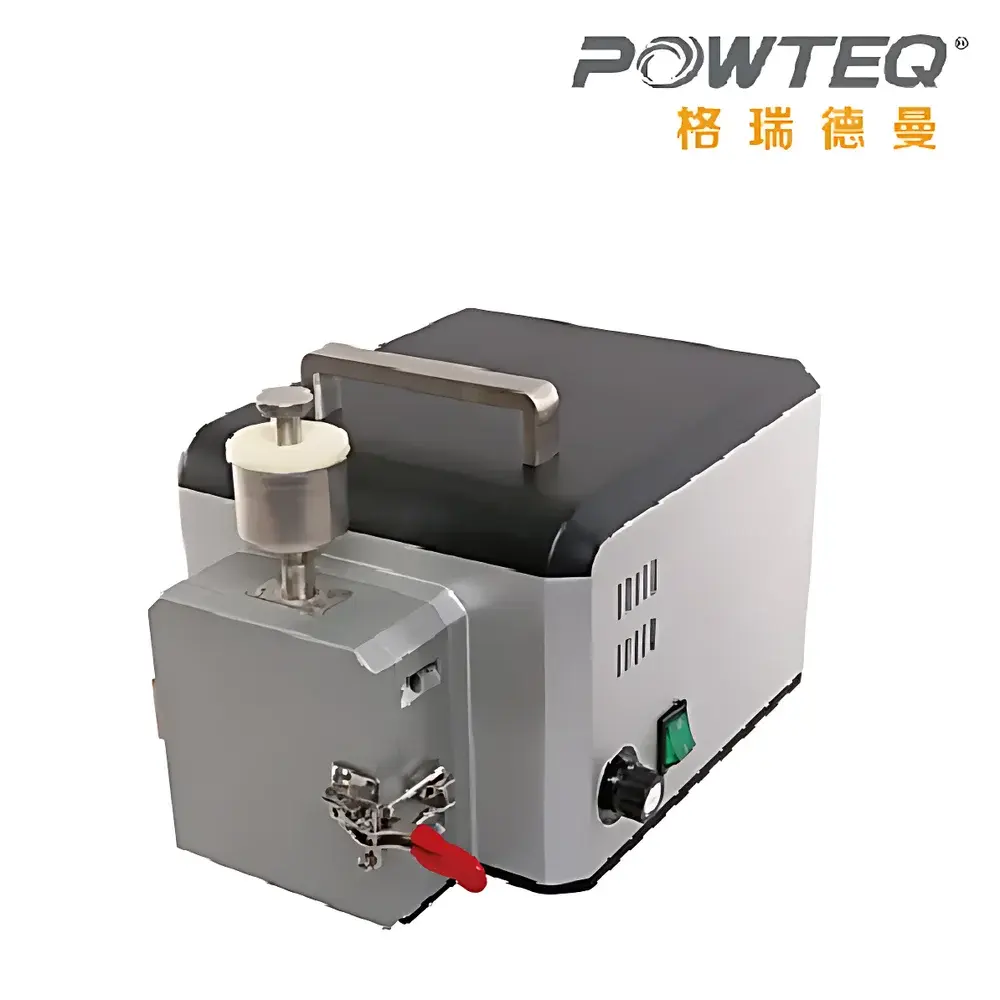
Grindemann CM50 Portable Cutting Mill
| Brand | Grindemann |
|---|---|
| Model | CM50 |
| Type | Cutting Mill |
| Origin | Beijing, China |
| Manufacturer | Grindemann Instruments Co., Ltd. |
| Power | 400 W |
| Voltage | 220 V, 50 Hz |
| Max. Feed Size | 25 mm |
| Output Particle Size Range | 0.01–0.5 mm (via interchangeable bottom sieves) |
| Adjustable Sieve Apertures | 0.3, 0.5, 1.0, 2.0 mm |
| Batch Capacity | 60 g |
| Rotational Speed | 400–6000 rpm |
| Dimensions (W×H×D) | 270 × 467 × 355 mm |
| Weight | 23 kg |
| Sample Compatibility | Hard, brittle, fibrous, and tough materials including plastics, rubber, PCBs, wood, grains, and plant tissues |
Overview
The Grindemann CM50 Portable Cutting Mill is an engineered benchtop sample preparation instrument designed for rapid, reproducible size reduction of heterogeneous solid samples prior to elemental analysis—particularly in compliance-driven workflows such as RoHS and WEEE testing. It operates on the principle of high-speed rotary cutting using a four-blade rotor with sharp, hardened steel edges rotating within a precisely aligned grinding chamber. Unlike impact or ball-milling mechanisms, the CM50 employs controlled shearing and cutting forces, minimizing thermal degradation and preserving sample integrity—critical for temperature-sensitive polymers, composites, and organic matrices. Its compact footprint and self-contained design support deployment in field labs, mobile analytical units, and quality control environments where space, portability, and operational flexibility are prioritized without compromising mechanical robustness or process repeatability.
Key Features
- Four-edge hardened steel rotor operating at variable speeds from 400 to 6000 rpm, enabling precise control over particle size distribution and energy input.
- Interchangeable stainless-steel bottom sieves (0.3, 0.5, 1.0, and 2.0 mm apertures) allow deterministic output sizing between 0.01 mm and 0.5 mm—verified by laser diffraction or sieve analysis per ISO 13320 and ASTM E11.
- Optimized grinding chamber geometry (60 g nominal batch capacity) ensures uniform material flow, reduced retention, and minimal dead volume—critical for trace-metal analysis where cross-contamination must be mitigated.
- Tool-free rotor and sieve mounting system enables rapid disassembly, cleaning, and component replacement; all contact surfaces are accessible for residue inspection and validation per GLP cleaning protocols.
- Low-heat generation profile (< 8 °C temperature rise under standard operation) maintains thermal stability of thermolabile matrices such as PVC, ABS, and biopolymers during comminution.
- CE-compliant electrical architecture with integrated overload protection, emergency stop switch, and IP20-rated enclosure suitable for ISO 17025-accredited laboratory environments.
Sample Compatibility & Compliance
The CM50 is validated for processing hard, brittle, fibrous, and moderately tough materials—including polymeric resins, elastomers, printed circuit boards (PCBs), lignocellulosic biomass, cereal grains, and synthetic textiles. Its cutting mechanism avoids pulverization-induced amorphization or elemental redistribution common in high-energy mills, making it ideal for XRF, ICP-OES, and AAS sample prep where representative sub-sampling and matrix homogeneity are prerequisites. The instrument supports regulatory workflows aligned with IEC 62321-3-2 (RoHS), EN 50581 (WEEE), and EPA Method 3050B. Optional heavy-metal-free components—including tungsten carbide-coated rotors and PTFE-sealed sieve holders—are available for ultra-trace metal analysis requiring <10 ppb background contamination limits.
Software & Data Management
While the CM50 operates as a stand-alone mechanical unit without embedded firmware or digital interface, its operational parameters (speed, duration, sieve configuration, batch ID) are fully documentable within LIMS or ELN systems via standardized SOP templates. Each unit ships with a calibration certificate traceable to NIST standards for rotational speed verification (±1.5% accuracy), and includes a maintenance logbook compliant with ISO/IEC 17025 clause 6.4.1. For regulated environments, users may integrate the CM50 into 21 CFR Part 11–compliant workflows by pairing it with electronic batch records that capture operator ID, timestamp, sieve lot number, and post-cleaning verification data.
Applications
- Routine homogenization of polymer and composite samples prior to Pb, Cd, Hg, Cr(VI), and Br screening by X-ray fluorescence spectroscopy.
- Preparation of electronic waste fractions (e.g., shredded PCBs) for leaching tests per EN 12457-2 and TCLP.
- Size reduction of botanical and agricultural commodities for mycotoxin or pesticide residue analysis where enzymatic activity must remain intact.
- Fragmentation of rubber and tire-derived materials for carbon black content determination and polymer identification via FTIR.
- Field-deployable sample conditioning in environmental monitoring programs requiring on-site comminution prior to transport to central labs.
FAQ
What safety certifications does the CM50 hold?
The CM50 complies with CE marking requirements under the Machinery Directive 2006/42/EC and Low Voltage Directive 2014/35/EU, including EN 61000-6-2 (EMC immunity) and EN 61000-6-4 (EMC emissions).
Can the CM50 be used for food-grade or pharmaceutical applications?
Yes—when equipped with FDA-compliant stainless-steel components and validated cleaning procedures, it meets GMP Annex 15 criteria for equipment qualification in non-sterile manufacturing support labs.
Is rotor balance verification required after blade replacement?
Yes; Grindemann provides a dynamic balancing template and torque specification sheet. Unbalanced rotors above 3000 rpm may induce vibration exceeding ISO 10816-3 Class A thresholds.
How is cross-contamination minimized between batches?
Through full disassembly capability, solvent-compatible chamber materials, and optional dedicated rotors/sieves assigned to high-risk analyte categories (e.g., Pb vs. As workflows).
Does Grindemann offer IQ/OQ documentation packages?
Yes—customizable installation and operational qualification protocols are available upon request, aligned with ISO/IEC 17025 and ASTM E2500-07 guidelines.



