Drick DRK101 Cork Pull-Out Tester for Wine Bottle Stopper Force Measurement
| Brand | Drick |
|---|---|
| Origin | Shandong, China |
| Manufacturer Type | Direct Manufacturer |
| Region Classification | Domestic (China) |
| Model | DRK101 |
| Price | USD 14,000 (approx.) |
| Load Capacity Options | 100 N / 500 N / 1000 N / 5000 N |
| Force Accuracy | Better than Class 0.5 |
| Force Resolution | 0.1 N |
| Displacement Resolution | 0.001 mm |
| Test Speed Range | 1–500 mm/min (infinitely variable) |
| Specimen Count per Test | 1 |
| Maximum Travel | 700 mm (customizable) |
| Dimensions (L×W×H) | 500 × 300 × 1500 mm |
| Form Factor | Benchtop Universal Testing System |
Overview
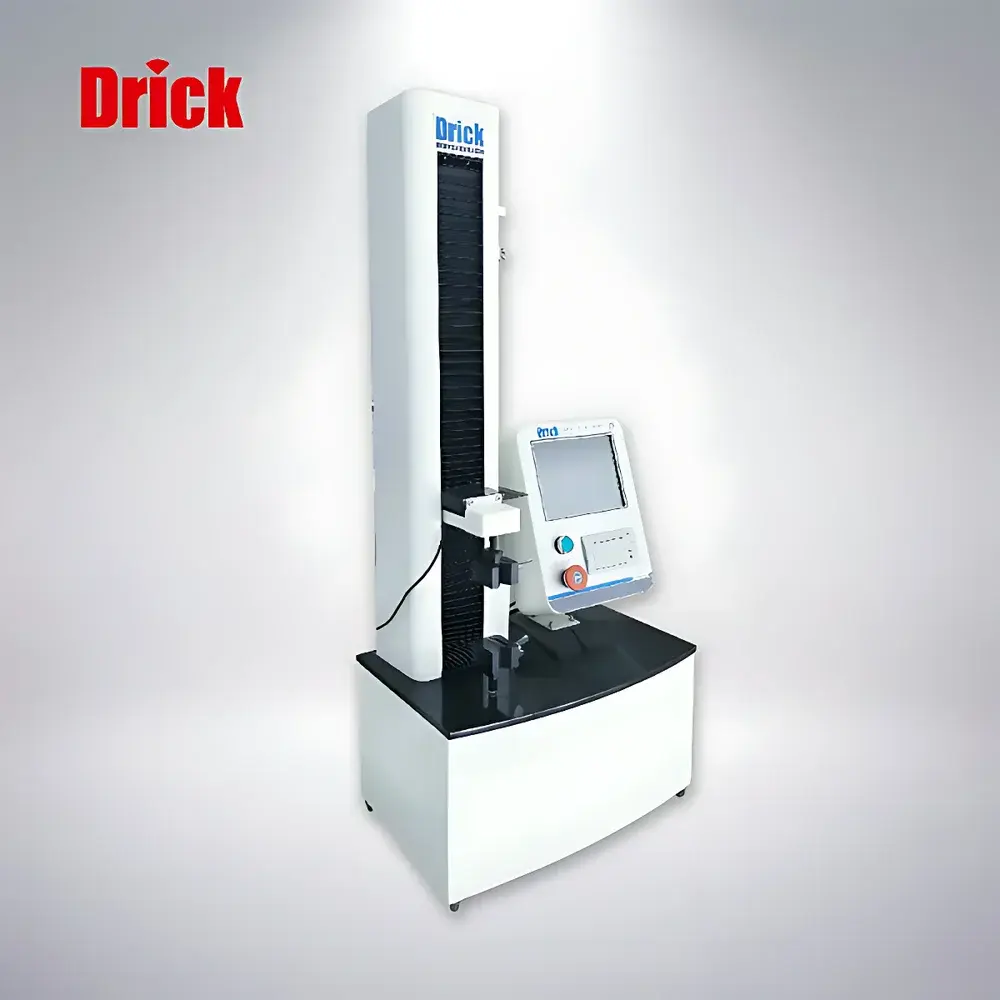
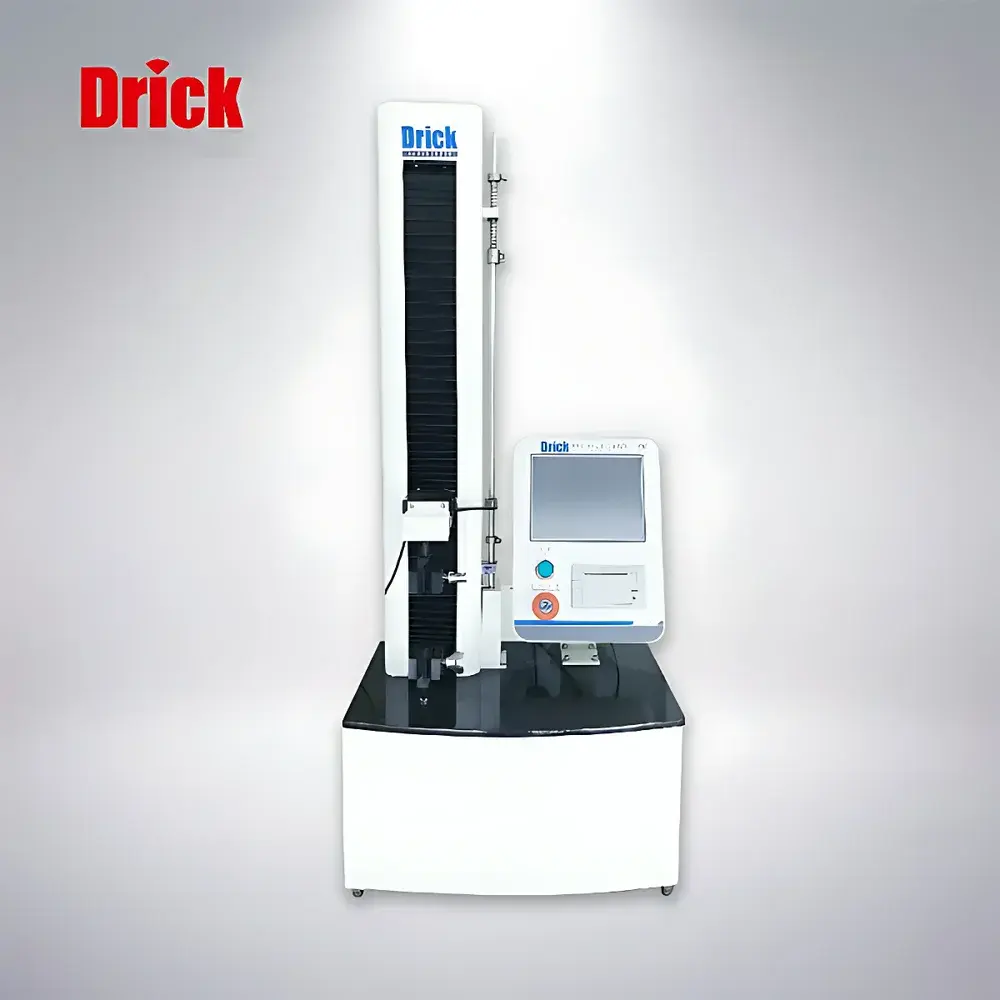
The Drick DRK101 Cork Pull-Out Tester is a dedicated benchtop universal testing instrument engineered for the precise quantification of axial extraction force required to remove natural or agglomerated cork stoppers from standard wine bottles. It operates on the fundamental principle of uniaxial tensile force measurement under controlled displacement rate, conforming to mechanical test methodologies defined in ISO 9001–compliant quality systems and aligned with ASTM F1578 (Standard Specification for Natural Cork Stoppers) and OIV-OENO 439-2015 (International Organisation of Vine and Wine guidelines for cork stopper performance). The system integrates a high-stiffness load frame, precision ball-screw actuation, and a microprocessor-controlled servo drive to ensure repeatable, traceable, and auditable force–displacement data acquisition—critical for QC laboratories in cork manufacturing, bottling facilities, and third-party certification bodies.
Key Features
- Benchtop modular architecture with rigid aluminum alloy frame and anti-vibration base plate for stable operation in shared laboratory environments
- Infinitely variable crosshead speed control (1–500 mm/min) via digital encoder feedback, enabling compliance with both slow-speed regulatory pull tests (e.g., 10 mm/min per ISO 22332) and accelerated validation protocols
- Four selectable load cell ranges (100 N, 500 N, 1000 N, 5000 N), each calibrated to better than Class 0.5 accuracy per ISO 376, with automatic range recognition and zero drift compensation
- 0.1 N force resolution and 0.001 mm displacement resolution support statistical process control (SPC) analysis of batch-to-batch cork consistency
- Manual clamping system with ergonomic lever mechanism ensures rapid specimen loading without tooling; standardized bottle-holding fixture accommodates 750 mL Bordeaux- and Burgundy-style bottles (neck OD: 18–22 mm)
- Onboard LCD interface with real-time force–time and force–displacement curve display; USB export of raw .csv data compatible with LIMS integration
Sample Compatibility & Compliance
The DRK101 is validated for use with natural cork, colmated cork, micro-agglomerated cork, and technical stoppers meeting EN 14156:2003 specifications. Its mechanical design satisfies the physical constraints outlined in ISO 22332 (Wine corks — Determination of pull-out force) and supports pre-conditioning requirements per ASTM D618 (standard conditioning at 23 °C ± 2 °C and 50 % RH ± 5 %). While primarily intended for cork stopper evaluation, the instrument’s configurable fixtures and programmable test profiles allow adaptation for auxiliary applications—including peel strength (90° and 180°), tensile strength of thin films (e.g., PVDC-coated closures), and elongation-at-break testing of elastomeric sealing gaskets—without hardware modification. All firmware and calibration records are retained internally for GLP/GMP audit readiness.
Software & Data Management
The DRK101 operates with embedded firmware supporting up to 10 user-defined test methods, each storing independent speed, preload, break detection threshold, and hold-time parameters. Raw data output includes timestamped force (N), displacement (mm), and elapsed time (s) columns, formatted for direct import into Excel, Minitab, or LabWare LIMS. Optional PC-based software (DRK-TestSuite v3.2) adds statistical reporting (mean, SD, CV%, max force, yield point, energy-to-pull), PDF certificate generation with digital signature fields, and 21 CFR Part 11–compliant audit trail functionality—including operator ID logging, method change history, and electronic signature capture for release documentation.
Applications
- Quantitative verification of cork stopper retention performance prior to bottling line deployment
- Root-cause analysis of premature cork ejection or excessive insertion force in winery QA workflows
- Comparative evaluation of cork sourcing batches across suppliers using standardized pull-out metrics
- Supporting ISO/IEC 17025 accreditation for testing laboratories offering third-party cork certification
- Adapted use in packaging R&D for measuring peel adhesion of pressure-sensitive labels, seal integrity of foil-laminated closures, and tensile behavior of biodegradable stopper alternatives (e.g., mushroom mycelium composites)
FAQ
Does the DRK101 comply with OIV or ISO cork testing standards?
Yes—the instrument implements the core mechanical parameters specified in ISO 22332 and OIV-OENO 439-2015, including defined bottle geometry, axial alignment tolerance (< ±1.5°), and force ramp rate control.
Can the travel distance be extended beyond 700 mm?
Yes—custom stroke lengths up to 1000 mm are available upon request, with corresponding recalibration and structural reinforcement.
Is calibration traceable to national metrology institutes?
All load cells ship with UKAS-accredited calibration certificates (traceable to NPL), and field recalibration kits with certified reference weights are available.
What maintenance is required for long-term accuracy?
Annual verification of force transducer linearity and displacement encoder accuracy is recommended; no lubrication or consumable parts are required in normal operation.
Can test data be exported to ERP or SAP systems?
Yes—via ASCII .csv export or optional OPC UA server module for real-time MES integration.