
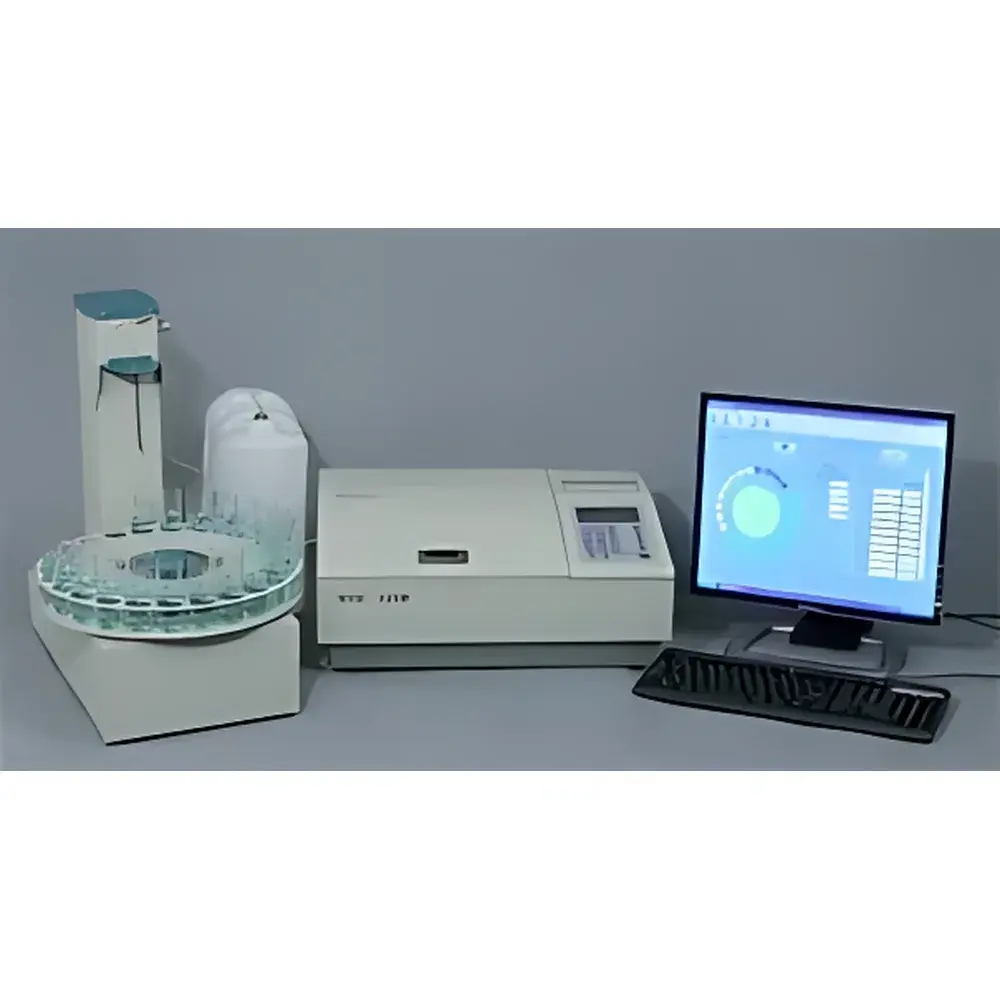
Sipo Environment BOD-220B Biochemical Oxygen Demand Analyzer
| Brand | Sipo Environment |
|---|---|
| Origin | Tianjin, China |
| Model | BOD-220B |
| Instrument Type | Laboratory BOD Analyzer |
| Measurement Principle | Microbial Membrane Electrode Method |
| Measurement Range | 2–4000 mg/L |
| Detection Limit | 2 mg/L |
| Accuracy | ≤3% |
| Single-Sample Analysis Time | 8 min |
| Repeatability | ±2% |
| Sensor Configuration | Integrated Three-Electrode Sensor with Reference Electrode (Patent No.: ZL 00 257536.1) |
| Signal Output | 0–20 µA |
| Flow-Through Cell Design | Combined Flow Cell and Measurement Chamber |
| Microbial Strain | EPA-certified InterBio BOD₅-specific strain |
| Membrane Format | Dry-layer sandwich membrane, non-toxic and biocompatible |
| Membrane Shelf Life | >12 months under ambient dry storage |
| Sample Introduction | Fully automated via optional 24-position autosampler |
| Control System | PC-based microprocessor control |
| Software Platform | Windows 95/98/2000/XP (localized Chinese GUI) |
| Operation Modes | Manual or fully automated sequential/jump sampling |
| Data Handling | Automatic archival to internal database |
| Positioning System | Triple-redundant mechanical, electromagnetic, and optical sample positioning |
| Sample Vial Capacity | 24 × 50 mL standard cups |
| Power Management | Scheduled auto-shutdown and electrode sleep mode for membrane preservation |
Overview
The Sipo Environment BOD-220B Biochemical Oxygen Demand Analyzer is a laboratory-grade instrument engineered for rapid, reliable quantification of biochemical oxygen demand in water and wastewater samples. It operates on the microbial membrane electrode principle—compliant with HJ/T 86–2002 (Chinese Environmental Protection Standard)—where immobilized, EPA-certified InterBio BOD₅-specific microorganisms consume dissolved oxygen in proportion to organic biodegradable content. This consumption is detected in real time by an integrated amperometric sensor comprising working, counter, and reference electrodes housed within a single flow-through cell. Unlike traditional 5-day dilution methods (e.g., ISO 5815-1:2012 or ASTM D5210), the BOD-220B delivers results in just 8 minutes per sample, enabling high-throughput monitoring without compromising analytical rigor. Its design emphasizes operational stability, low maintenance, and long-term sensor reproducibility—critical for environmental labs performing routine compliance testing, effluent monitoring, or process control in municipal and industrial wastewater treatment facilities.
Key Features
- Integrated three-electrode sensor with embedded reference electrode (Patent ZL 00 257536.1), ensuring stable baseline and minimized drift during extended operation.
- Flow-through measurement chamber combining sample introduction, reaction, and detection into a single optimized zone—reducing carryover and simplifying cleaning protocols.
- Dry-layer sandwich-type microbial membrane using EPA-validated InterBio BOD₅ strain; non-toxic, shelf-stable (>12 months at room temperature), and activated for ≥30 days of continuous use.
- Electrode sleep mode preserves microbial viability during idle periods, extending functional membrane lifetime and reducing recalibration frequency.
- Optional 24-position autosampler with triple-redundant positioning (mechanical, electromagnetic, optical) and intelligent vial recognition—including automatic skip of empty positions and programmable sequence/jump sampling.
- PC-based control with localized Windows-compatible software supporting both manual intervention and unattended batch analysis; all data logged with timestamp, operator ID, and method parameters.
Sample Compatibility & Compliance
The BOD-220B accommodates raw influent, secondary effluent, surface water, groundwater, and treated industrial discharge—provided samples are free of heavy metals, biocides, or extreme pH (10) that could inhibit microbial activity. Turbid or particulate-rich samples require filtration (≤0.45 µm) prior to analysis. The instrument meets performance criteria outlined in HJ/T 86–2002 and aligns with fundamental principles of ISO 5815-1:2012 and US EPA Method 405.1 for BOD assessment. While not certified for GLP/GMP environments out-of-the-box, its audit-ready data logging (with user-accessible history database and Excel-export capability) supports implementation of 21 CFR Part 11-compliant workflows when paired with validated IT infrastructure and procedural controls.
Software & Data Management
The BOD-220B runs on a dedicated Windows application offering bilingual interface support (Chinese primary, English optional). All measurements are automatically timestamped and archived with metadata including sample ID, operator, calibration status, and sensor response curve. Raw current signals (0–20 µA) are digitized at 10 Hz resolution and converted to BOD concentration using a pre-established calibration curve stored in non-volatile memory. Data exports as CSV or native Excel files (.xls) for further statistical analysis or regulatory reporting. The software permits method parameter modification (e.g., incubation duration override, threshold sensitivity adjustment), but retains immutable records of all changes for traceability.
Applications
- Routine compliance monitoring of municipal wastewater treatment plant effluents against national discharge limits (e.g., GB 18918–2002).
- Process optimization in activated sludge, MBR, or biofilm-based systems through rapid feedback on biodegradability shifts.
- Environmental impact assessments requiring high-frequency BOD profiling across seasonal or diurnal cycles.
- Quality assurance in drinking water source protection programs where early detection of organic loading is critical.
- Educational laboratories conducting comparative studies between conventional 5-day BOD and rapid electrochemical methods.
FAQ
What is the minimum detectable BOD concentration?
The instrument has a defined detection limit of 2 mg/L, verified per HJ/T 86–2002 protocol using glucose-glutamic acid standard solutions.
Can the microbial membrane be reused across multiple analyses?
Yes—the dry-layer membrane remains active for ≥30 days under normal operating conditions (20–25°C, pH 6.5–8.0); membrane replacement is only required upon signal decay exceeding ±5% RSD over consecutive calibrations.
Is external calibration required before each run?
No—factory-calibrated sensor response is retained in memory; daily verification with a 100 mg/L GGA standard is recommended for QC, but full recalibration is needed only after membrane replacement or significant drift.
Does the system support remote data access or LIMS integration?
The analyzer outputs ASCII-formatted data files compatible with common LIMS platforms; direct network connectivity or OPC UA integration requires third-party middleware configuration.
How is sensor fouling mitigated during high-solids analysis?
The flow-through cell design incorporates a self-flushing cycle between samples, and optional inline filtration (0.45 µm) is advised for samples with suspended solids >30 mg/L.
Related Products







