
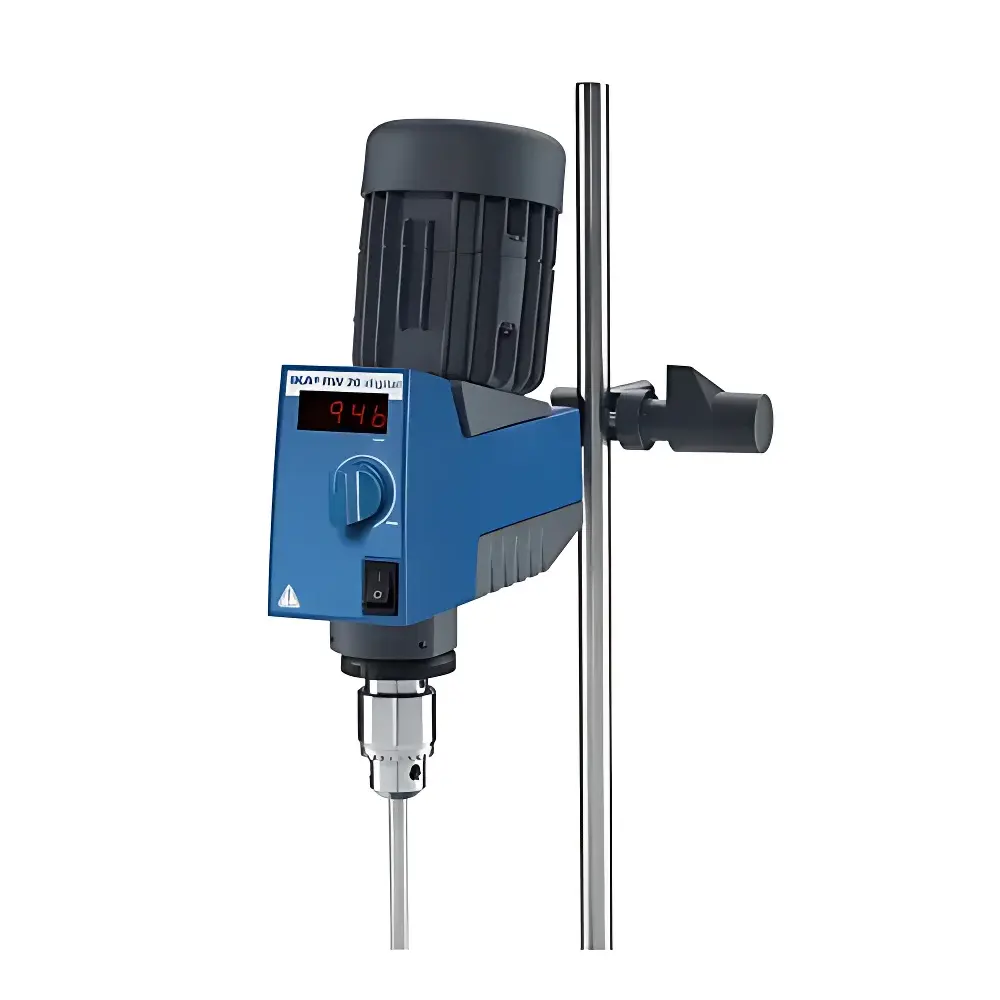
IKA RW20 Digital Overhead Stirrer
| Brand | IKA |
|---|---|
| Origin | Germany |
| Model | RW20 |
| Stirrer Type | Electric Overhead Stirrer |
| Max. Mixing Volume (Water) | 20 L |
| Speed Range | 60–2000 rpm |
| Input Power | 70 W |
| Output Power | 35 W |
| Max. Viscosity | 10,000 mPa·s |
| Torque (at 60 rpm, overload) | 300 N·cm |
| Shaft Max. Torque | 150 N·cm |
| Chuck Range | 0.5–10 mm |
| Hollow Shaft ID | 10.5 mm |
| Dimensions (W×H×D) | 88 × 294 × 212 mm |
| Weight | 3.1 kg |
| IP Rating | IP20 |
| Ambient Temp. | 5–40 °C |
| Relative Humidity | ≤80 % |
| Continuous Duty Cycle | 100 % |
Overview
The IKA RW20 Digital Overhead Stirrer is an engineered solution for precise, reproducible mechanical agitation in laboratory-scale mixing and dispersion applications. Designed around a robust brushless motor architecture and optimized gear train, the RW20 operates on the principle of direct-drive torque transmission to the stirring shaft—enabling consistent rotational force delivery across its full speed range. Unlike magnetic stirrers limited by coupling efficiency and heat generation, this overhead system maintains stable performance with high-viscosity media (up to 10,000 mPa·s) and large-volume vessels (up to 20 L of water-equivalent density). Its vertical column design minimizes footprint while maximizing clearance above reaction vessels, supporting compatibility with jacketed reactors, tall cylindrical beakers, and custom glassware. The device meets essential electrical safety requirements per DIN EN 60529 (IP20) and is constructed for long-term reliability under continuous operation at rated load.
Key Features
- Dual-range, continuously variable speed control (60–500 rpm and 240–2000 rpm at 50 Hz; corresponding ranges scale with line frequency) enables fine-tuned adjustment for both low-shear homogenization and high-torque viscous blending.
- LED digital display provides real-time feedback of actual rotational speed—critical for method transfer, SOP adherence, and audit-ready documentation.
- Hollow stainless-steel shaft (10.5 mm internal diameter) permits insertion of temperature probes, pH electrodes, or sampling tubes while the unit is stationary—supporting in-process monitoring without interrupting agitation setup.
- Integrated quick-release chuck accepts standard stirring elements from 0.5 mm to 10 mm diameter, accommodating propeller, paddle, anchor, and helical impellers commonly used in R&D and QC workflows.
- Thermally stable motor housing and dynamic torque compensation ensure consistent output even during extended runs at elevated loads—validated for 100% duty cycle under nominal conditions.
- Ergonomic upright form factor (294 mm height) combined with a 160 mm telescoping support arm facilitates rapid repositioning over varied vessel geometries without recalibration.
Sample Compatibility & Compliance
The RW20 accommodates a broad spectrum of sample types—from aqueous buffers and polymer solutions to non-Newtonian suspensions and shear-thinning gels—provided viscosity remains within the specified 10,000 mPa·s limit. Its mechanical drive architecture eliminates limitations associated with magnetic coupling slippage, making it suitable for applications involving ferromagnetic-inert media or opaque vessels where magnetic stir bars are ineffective. The unit complies with IEC/EN 61010-1 for electrical safety in laboratory environments and conforms to electromagnetic compatibility standards per EN 61326-1. While not intrinsically rated for hazardous area use, its IP20 enclosure is appropriate for general-purpose labs operating under ISO/IEC 17025 or GLP-compliant conditions. No integrated temperature control is provided; external heating/cooling must be managed via separate circulators or jacketed vessels.
Software & Data Management
The RW20 operates as a standalone instrument with local digital control—no proprietary software or drivers required for basic functionality. However, its analog tachometer output (0–10 V DC proportional to speed) allows integration into third-party data acquisition systems (e.g., LabVIEW, SCADA, or PLC-based platforms) for time-stamped speed logging and process correlation. When deployed in regulated environments subject to FDA 21 CFR Part 11 or EU Annex 11 requirements, users may implement external audit-trail solutions to capture operator actions, setpoint changes, and runtime events. Firmware updates are not field-upgradable; calibration verification is performed using traceable optical tachometry per ISO 17025-accredited procedures.
Applications
- Preparation of homogeneous polymer blends and suspension formulations in pharmaceutical excipient development.
- Mixing of catalyst slurries and heterogeneous reaction mixtures in fine chemical synthesis.
- Dispersion of nanoparticles and carbon nanotubes in solvent-based matrices for materials science characterization.
- Standardized dissolution testing per USP where mechanical consistency between runs is mandatory.
- QC batch verification of viscosity-sensitive products including adhesives, coatings, and food emulsions.
- Scale-down studies supporting transfer from lab to pilot-scale stirred tank reactors (STRs).
FAQ
Can the RW20 be used with corrosive or abrasive media?
Yes—provided the selected stirrer shaft and impeller are chemically compatible (e.g., Hastelloy, PTFE-coated, or glass-coated components); the RW20’s motor head itself is not exposed to process media.
Is the hollow shaft compatible with rotating temperature probes?
No—the hollow shaft is only accessible when the motor is fully stopped and locked; it does not rotate with the shaft, so dynamic probe insertion during operation is not supported.
Does the RW20 meet GMP documentation requirements?
It supports GMP-aligned workflows through analog output logging and mechanical traceability, but lacks built-in electronic records or user access control—these must be implemented externally.
What maintenance is required for long-term reliability?
Annual inspection of chuck integrity, shaft runout, and motor ventilation pathways is recommended; no scheduled lubrication is needed due to sealed bearing construction.
Can multiple RW20 units be synchronized for parallel experiments?
Not natively—the device has no master/slave communication interface; synchronization requires external timing hardware or manual setpoint alignment.



