
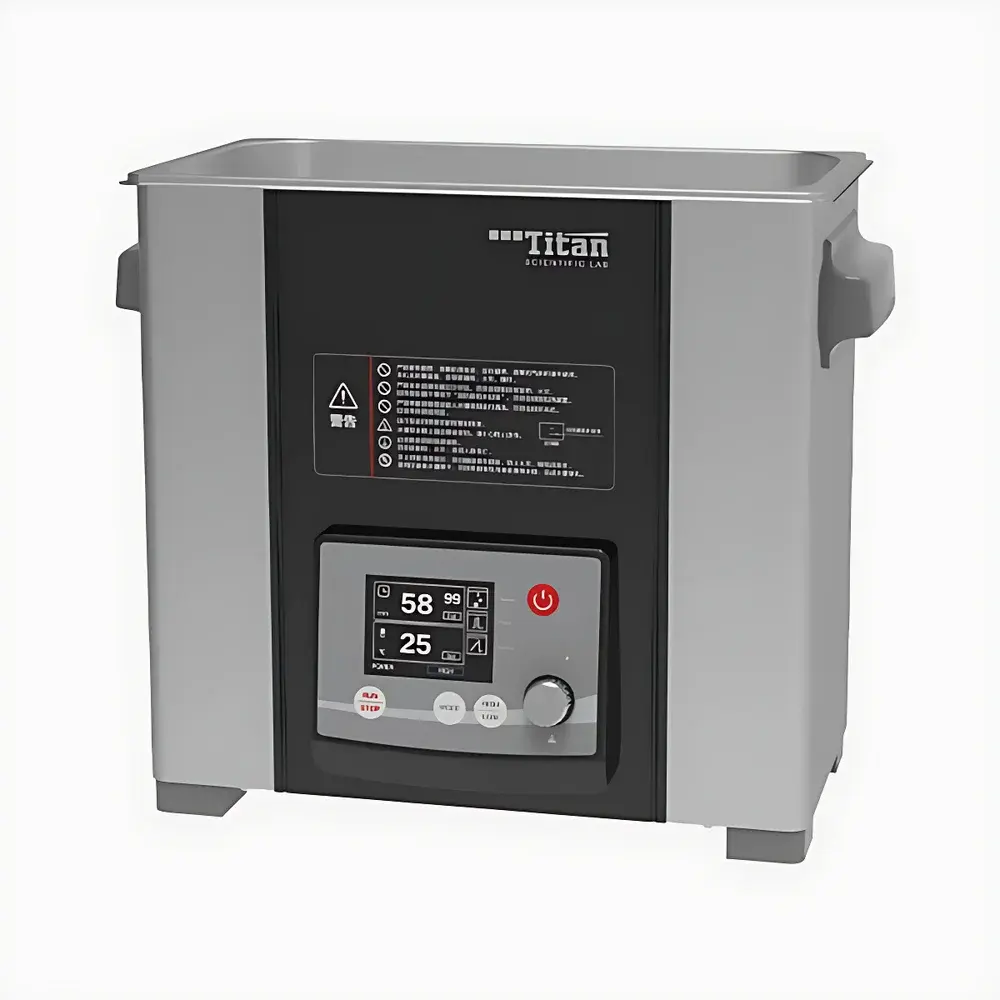
Titan SUC-6 Benchtop Ultrasonic Cleaner
| Brand | Titan |
|---|---|
| Origin | Shanghai, China |
| Manufacturer Type | Manufacturer |
| Product Category | Domestic |
| Model | SUC-6 |
| Instrument Type | General-Purpose |
| Capacity | 6 L |
| Ultrasonic Frequency | 37 kHz |
| Ultrasonic Power Output | 144 W |
| Adjustable Power | No |
| Adjustable Temperature | No |
| Timer Range | 1–99 min |
| Sound-Dampening Lid | Not Included |
| Drain & Fill Port | Not Provided |
Overview
The Titan SUC-6 is a compact, general-purpose benchtop ultrasonic cleaner engineered for routine laboratory cleaning tasks where consistent cavitation energy delivery and operational reliability are essential. It operates on the principle of piezoelectric transduction at a fixed frequency of 37 kHz—optimized to balance penetration depth and micro-cavitation intensity for effective removal of particulate contaminants, organic residues, and light oxides from delicate instrumentation, glassware, metal parts, and ceramic substrates. Unlike high-frequency cleaners (>80 kHz) designed for fine-feature cleaning (e.g., microfluidic channels), or low-frequency systems (<25 kHz) used for heavy-duty industrial degreasing, the 37 kHz frequency provides a robust compromise suitable for standard labware including pipette tips, crucibles, filters, and analytical sample holders. The unit features a stainless steel tank (304 grade) with a nominal capacity of 6 liters, enabling batch processing of moderate-volume loads without requiring continuous refilling. Its fixed-power architecture (144 W total output) ensures stable acoustic field generation across the tank volume, supporting reproducible cleaning cycles under GLP-aligned workflows.
Key Features
- Stainless steel 304 tank (L × W × H: approx. 290 × 150 × 150 mm) with corrosion-resistant epoxy-coated housing
- Fixed-frequency ultrasonic generator (37 kHz) with integrated piezoceramic transducers bonded to tank bottom
- Digital timer with precise 1-minute resolution, programmable from 1 to 99 minutes—supports repeatable cycle definition
- No external cooling or heating circuitry; ambient-temperature operation only (recommended operating range: 10–35 °C)
- Front-panel LED display with clear status indicators for power-on, timer countdown, and cycle completion
- Overheat protection circuitry automatically deactivates transducers if internal temperature exceeds safe thresholds
- CE-compliant electrical design meeting IEC 61010-1 safety requirements for laboratory equipment
Sample Compatibility & Compliance
The SUC-6 is validated for use with common laboratory materials including borosilicate glass, fused silica, stainless steel (304/316), aluminum alloys, and PTFE-coated fixtures. It is not recommended for use with soft metals (e.g., copper, brass), thin-walled plastic vials, or optics-grade lenses unless prequalified via user-specific validation protocols. Cleaning efficacy aligns with ASTM D4299–21 (“Standard Guide for Ultrasonic Cleaning of Laboratory Glassware”) for non-critical residue removal. While the unit itself does not carry ISO 13485 or FDA 21 CFR Part 11 certification (as it lacks data logging or electronic signature capability), its mechanical design and timer-based operation support traceability when integrated into documented SOPs. Users performing cleaning validation per USP or ISO 15883-1 may employ the SUC-6 as a controlled step within broader reprocessing workflows—provided temperature and time parameters are manually recorded and archived.
Software & Data Management
The SUC-6 operates as a standalone hardware device with no embedded microcontroller-based firmware, network interface, or software connectivity. All controls are implemented via discrete logic circuits and electromechanical components. Consequently, no proprietary software, driver installation, or cloud synchronization is required—or supported. Cycle parameters (duration only) are set manually and retained only during active operation; no audit trail, event logging, or timestamped data export is available. This architecture prioritizes electromagnetic compatibility (EMC), long-term stability, and minimal maintenance—making it suitable for environments where IT infrastructure constraints, cybersecurity policies, or regulatory simplicity dictate non-networked instrumentation. For laboratories requiring electronic record retention, external time-stamped video documentation or manual logbook entries (per ALCOA+ principles) are recommended.
Applications
- Routine cleaning of volumetric flasks, burettes, graduated cylinders, and NMR tubes prior to calibration or analysis
- Preparation of filtration assemblies (e.g., syringe filters, membrane holders) to eliminate fiber shedding or extractables
- Removal of dried protein films or salt crystals from electrophoresis combs and gel casting trays
- Decontamination of reusable sampling probes, spatulas, and weighing boats between batches
- Supporting ASTM E1613–22 procedures for trace metal analysis by reducing procedural blanks through thorough vessel cleaning
- Complementing autoclave or dry-heat sterilization steps in QC/QA labs handling non-sterile but residue-sensitive samples
FAQ
Is the SUC-6 suitable for cleaning delicate optical components such as microscope slides or cuvettes?
Yes—when used with low-surfactant aqueous solutions and cycle durations ≤10 min, it effectively removes fingerprints and dust without surface pitting. However, avoid prolonged exposure or high-detergent concentrations that may etch fused silica.
Does the unit include a heater or temperature control function?
No. The SUC-6 operates exclusively at ambient temperature. External water baths or thermostatic circulators must be used if elevated cleaning temperatures are required.
Can the ultrasonic power output be adjusted during operation?
No. The transducer drive level is fixed at 144 W nominal output. Power modulation is not supported.
What maintenance is required for long-term reliability?
Routine tank rinsing after each use, periodic descaling with 5% citric acid solution (if hard water is used), and visual inspection of transducer bonding integrity every 6 months.
Is a drain valve or fill port included for automated fluid handling?
No. The tank requires manual filling and emptying using standard lab-grade containers or funnels.



