
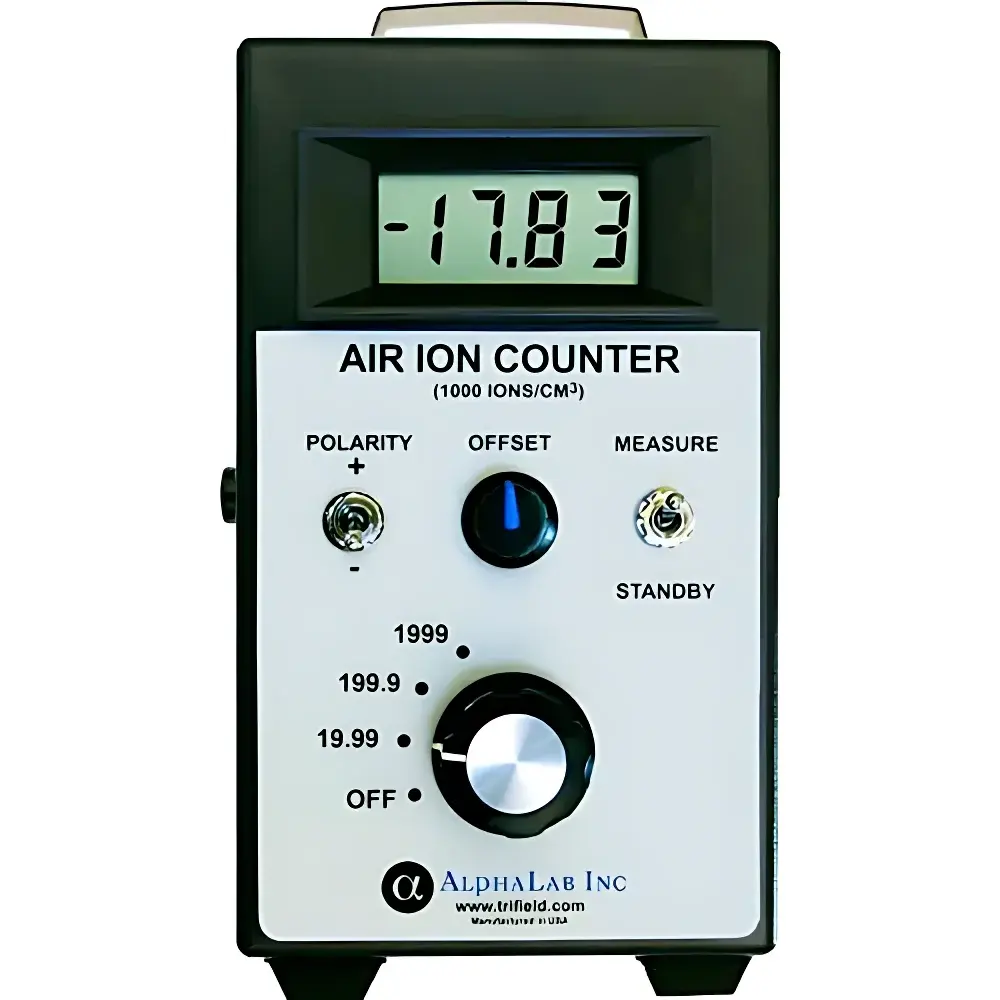
AIC2MJ Air Negative Ion Detector
| Origin | USA |
|---|---|
| Manufacturer Type | Distributor |
| Origin Category | Imported |
| Model | AIC2MJ |
| Price Range | USD 700 – 1,400 |
| Airflow Rate | 200 cm³/s |
| Measurable Ion Polarity | Positive and Negative |
| Linear Drift Velocity | 40 cm/s |
| Display | Digital LCD |
| Measurement Range | 10 to 2 × 10⁶ ions/cm³ (extended range up to 2 × 10⁷ ions/cm³) |
| Response Time | ~10 s |
| Measurement Modes | Low / Medium / High Concentration |
| Minimum Detectable Concentration | 10 ions/cm³ (100 ions/cm³ in extended low-noise mode) |
| Operating Temperature | −20 °C to +60 °C |
| Relative Humidity Limit | ≤99 % RH (non-condensing) |
| Power Supply | 9 V alkaline battery |
| Dimensions | 165.1 × 93.98 × 76.2 mm |
| Weight | 420 g |
Overview
The AIC2MJ Air Negative Ion Detector is a portable, field-deployable electrometer-based instrument engineered for quantitative measurement of unipolar and bipolar air ion concentrations in ambient and controlled environments. It operates on the principle of parallel-plate corona-assisted ion collection: sampled air is drawn at a calibrated flow rate of 200 cm³/s through a precisely defined 4 mm aperture into a polarization chamber where outer electrodes maintain a fixed electric field gradient of 1,000 V/m. Charged species—both positive and negative ions—are directionally driven toward oppositely biased collector plates; the central linear detector plate measures the resulting current, which is converted in real time to ion concentration (ions/cm³) via factory-calibrated gain factors traceable to NIST-standardized ion generation sources. Unlike passive diffusion sensors, the AIC2MJ employs active aspiration and field-controlled drift velocity (40 cm/s), ensuring high reproducibility across variable humidity and temperature conditions. Its design complies with fundamental requirements outlined in ISO 16000-30 (Indoor air — Part 30: Determination of airborne ion concentrations) for sampling geometry, flow control, and electrostatic shielding.
Key Features
- Simultaneous dual-polarity detection: measures both positive and negative ion concentrations without hardware reconfiguration
- Three selectable sensitivity ranges (Low/Medium/High) optimized for diverse environments—from pristine mountain air (<1,000 ions/cm³) to urban indoor spaces or near waterfalls (>1 million ions/cm³)
- Digital LCD display with auto-ranging and unit confirmation (ions/cm³), eliminating manual scaling errors
- Robust thermal design validated for continuous operation from −20 °C to +60 °C, including outdoor winter deployments and industrial HVAC duct monitoring
- Non-condensing humidity tolerance up to 99 % RH ensures reliability in tropical climates and humidified cleanrooms
- Integrated 9 V battery power system enables >8 hours of continuous field use; no external power supply required
- Compact ergonomic housing (165.1 × 93.98 × 76.2 mm, 420 g) with IP54-rated ingress protection against dust and incidental water splashes
Sample Compatibility & Compliance
The AIC2MJ is validated for direct measurement of gaseous ion populations in ambient air, ventilated enclosures, and near ion-emitting surfaces (e.g., mineral specimens, textiles, ceramic tiles). It does not require sample conditioning or chemical derivatization. While primarily intended for atmospheric ion analysis, its collector geometry permits qualitative assessment of surface-emitted ions when positioned within 5–10 cm of non-conductive materials under static conditions—provided ambient airflow is minimized. The instrument meets mechanical and electrical safety requirements per UL 61010-1 and IEC 61326-1 (EMC for laboratory equipment). Data output adheres to GLP documentation standards: each reading includes timestamp, polarity flag, range setting, and battery status. Though not FDA 21 CFR Part 11 compliant out-of-the-box, audit-ready CSV logs can be generated via optional serial interface for regulated environmental QA/QC workflows.
Software & Data Management
The AIC2MJ operates as a standalone instrument with no embedded firmware updates or cloud connectivity. All configuration and readout occur locally via front-panel controls and LCD. For data archival, an RS-232 serial port (DB9 female) supports ASCII-formatted real-time streaming at 9600 baud. Compatible terminal software (e.g., Tera Term, PuTTY) captures timestamped records in comma-delimited format suitable for import into Excel, MATLAB, or LIMS platforms. Each line includes: UTC timestamp (YYYY-MM-DD HH:MM:SS), polarity (+/−), concentration value (ions/cm³), active range code (L/M/H), and battery voltage. No proprietary drivers or OS-specific applications are required. Calibration verification reports—generated using certified radioactive ²¹⁰Po ion sources—are stored externally and referenced during annual metrological review per ISO/IEC 17025 guidelines.
Applications
- Environmental health studies assessing natural ion variability across forests, coastlines, caves, and alpine zones
- Indoor air quality (IAQ) audits in hospitals, schools, and office buildings—correlating ion levels with ventilation rates and particulate load
- Validation of commercial ionizer performance (e.g., needle-point, corona discharge, or radioactive source types) per ASTM D8197-20 test protocols
- Material science research evaluating ion emission from tourmaline-infused fabrics, basalt stones, or ceramic coatings
- Occupational hygiene monitoring near high-voltage equipment, laser printers, or electrostatic discharge (ESD) workstations
- Educational laboratories demonstrating gas-phase charge transport, atmospheric electrodynamics, and sensor physics principles
FAQ
Does the AIC2MJ require annual recalibration?
Yes. Due to long-term drift in electrometer amplifier offset and electrode surface contamination, NIST-traceable recalibration is recommended every 12 months using certified ion generators. Certificate of calibration includes uncertainty budget per ISO/IEC 17025.
Can it measure ions in compressed air or nitrogen purge lines?
No. The instrument is calibrated exclusively for ambient air composition (78 % N₂, 21 % O₂, 1 % Ar). Non-standard gas matrices alter ion mobility and recombination kinetics, invalidating concentration calculations.
Is the 4 mm inlet compatible with standard PM2.5 or aerosol samplers?
Not directly. The aperture is optimized for laminar ion transport—not particle filtration. Integration with size-selective inlets requires custom flow-matching manifolds and independent validation of aspiration efficiency.
What is the impact of strong electromagnetic fields on readings?
Operation within 1 m of MRI units, induction heaters, or RF transmitters may induce spurious currents in the collector circuit. Shielding is provided, but measurements should be conducted outside such zones per IEC 61000-4-3 immunity limits.
Does it comply with Chinese GB/T 18809–2002 or Japanese JIS B 9929 standards?
It satisfies core technical clauses of both standards (e.g., flow control, polarity discrimination, range coverage), though formal certification requires local third-party testing under national accreditation bodies.
Related Products







