
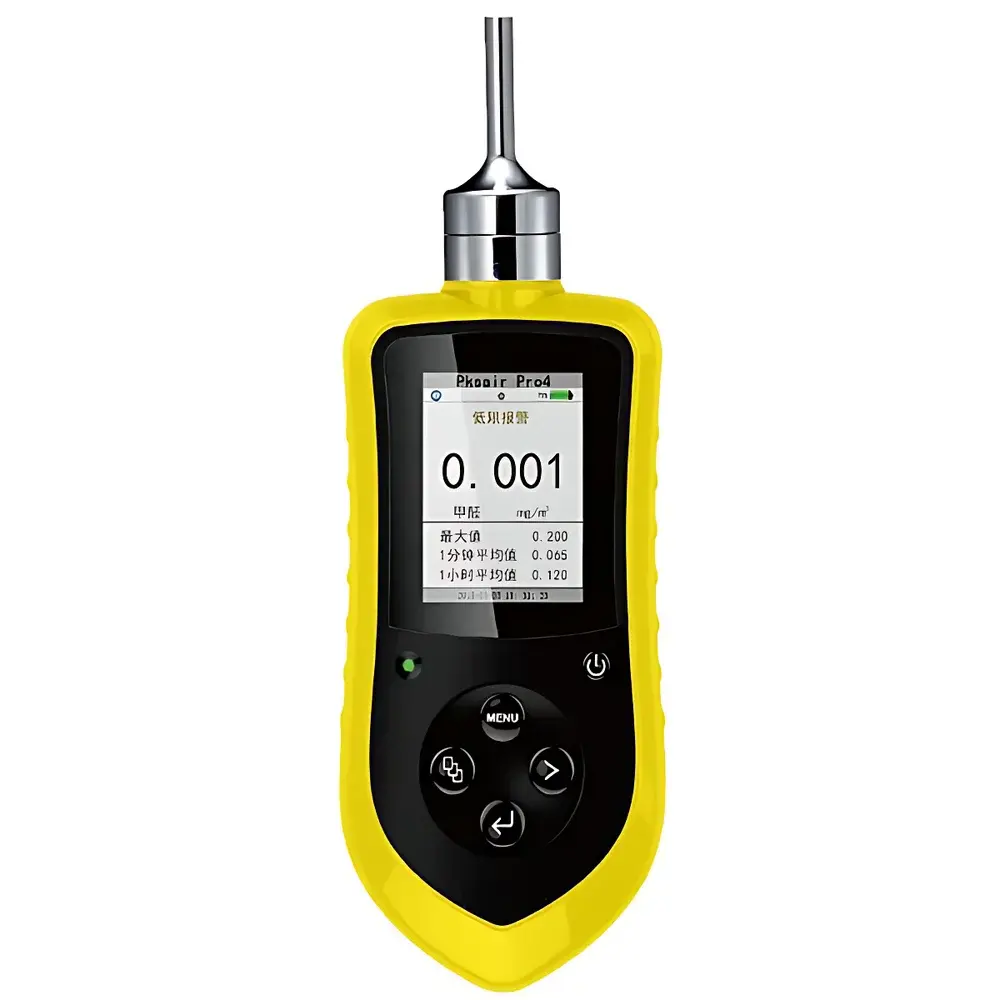
PKSAIR Pro4 Portable Formaldehyde Gas Detector
| Origin | Beijing, China |
|---|---|
| Manufacturer Type | Authorized Distributor |
| Origin Category | Domestic |
| Model | Pro4 |
| Price Range | USD 1,400–2,800 (FOB) |
| Detection Principle | Electrochemical Sensor |
| Measurement Range | 0.001–10.000 ppm (equivalent to 0.001–12.3 mg/m³ at 25°C/1 atm) |
| Resolution | 0.001 ppm |
| Repeatability | ≤ ±2% of reading |
| Sampling Method | Built-in active pump suction (300–500 mL/min) |
| Response Time | ≤ 30 s (T90) |
| Operating Temperature | −20 °C to +50 °C |
| Operating Humidity | ≤ 95% RH (non-condensing) |
| Ingress Protection | IP65 |
| Explosion Protection | Ex ib IIC T4 Gb |
| Data Storage Capacity | 100,000 records (timestamped, auto-stored with user-defined intervals) |
| Display | 2.4″ TFT color LCD (320 × 240 pixels) |
| Power Supply | Rechargeable 2800 mAh Li-polymer battery (≥20 h continuous operation) |
| Processor | 32-bit nanoscale microcontroller + 24-bit high-precision ADC |
| Calibration | Zero and span calibration supported via menu-driven interface |
| Compliance | GB 50493–2009, GB 12358–2006, GBZ 2.1–2007, GB 3836.1–2010, GB 3836.4–2010, Q/SGA 01–2015 |
Overview
The PKSAIR Pro4 Portable Formaldehyde Gas Detector is a field-deployable, electrochemical-based analytical instrument engineered for accurate, real-time quantification of formaldehyde (HCHO) in ambient air across occupational, environmental, and industrial hygiene applications. It operates on the principle of selective electrochemical oxidation: formaldehyde molecules diffuse through a permeable membrane into an aqueous electrolyte cell, where they undergo catalytic oxidation at a working electrode, generating a current linearly proportional to gas concentration. This analog signal is digitized by a 24-bit analog-to-digital converter and processed by a 32-bit nanoscale microcontroller to deliver calibrated readings in ppm or mg/m³—units freely interchangeable on-device. Designed to meet stringent Chinese national standards—including GB 50493–2009 (petrochemical toxic gas detection), GBZ 2.1–2007 (occupational exposure limits), and GB 3836.4–2010 (intrinsic safety)—the Pro4 integrates full-range temperature and humidity compensation algorithms, ensuring measurement integrity under variable field conditions without manual correction.
Key Features
- High-fidelity electrochemical sensor sourced from a Tier-1 European manufacturer, featuring low cross-sensitivity to common interferents (e.g., CO, NO₂, VOCs), ≤±2% repeatability, and ≤±2% linearity error over full scale.
- Integrated Thomas (Germany) miniature vacuum pump delivering stable 300–500 mL/min airflow, enabling rapid sample acquisition and consistent T90 response ≤30 seconds.
- Real-time dual averaging: automatic calculation and display of 1-minute and 1-hour time-weighted average (TWA) concentrations—directly aligned with OEL compliance reporting per GBZ 2.1–2007.
- Ruggedized housing constructed from ABS+PC polymer blend: impact-resistant, flame-retardant (UL94 V-0), and chemically inert to acids, alkalis, and organic solvents; certified IP65 for dust/water ingress protection.
- Intrinsically safe circuit architecture compliant with Ex ib IIC T4 Gb (GB 3836.4–2010), permitting safe use in Zone 1 hazardous locations including chemical plants, wastewater facilities, and confined-space entry operations.
- Onboard data logging: 100,000 timestamped records stored automatically with configurable intervals (1 s to 24 h); includes measurement values, alarm events, power cycles, and fault logs.
- 2.4″ high-resolution TFT color display (320 × 240 px) with adjustable brightness and ambient light sensing; supports both English and Chinese UI languages.
- Intelligent power management: 2800 mAh Li-polymer battery enables ≥20 h continuous operation; Micro-USB charging compatible with standard 5 V/2 A adapters.
Sample Compatibility & Compliance
The PKSAIR Pro4 is validated for formaldehyde detection in complex gaseous matrices, including indoor air, industrial exhaust streams, bioreactor off-gas, and post-disinfection environments. Its sensor exhibits minimal interference from aldehydes (acetaldehyde, propionaldehyde), alcohols, and low-molecular-weight hydrocarbons when operated within specified humidity (≤95% RH, non-condensing) and temperature (−20 °C to +50 °C) ranges. Device firmware implements dynamic humidity and temperature compensation using onboard thermistor and capacitive RH sensors, correcting raw electrochemical output per NIST-traceable algorithms. Regulatory alignment includes conformance to GB 12358–2006 (general technical requirements for workplace gas detectors), GB 3836.1–2010 (explosion-proof electrical equipment), and enterprise standard Q/SGA 01–2015. While not FDA 21 CFR Part 11–certified out-of-box, audit-ready data export (CSV/Excel) and immutable timestamping support GLP/GMP-aligned recordkeeping when deployed with documented SOPs.
Software & Data Management
Data retrieval is performed via USB connection to Windows/Linux/macOS systems using vendor-provided PC software (no drivers required). Exported files contain ISO 8601 timestamps, measurement units, TWA flags, alarm status codes, and device serial number—enabling traceability and third-party statistical analysis. The software permits batch filtering, graphical trend visualization (line/bar charts), and PDF report generation with customizable headers. All stored data are write-protected during transfer; no modification or deletion is possible via USB interface. Internal memory retains records across power cycles and firmware updates. Optional Bluetooth module (sold separately) enables wireless telemetry to mobile devices running PKSAIR FieldLink™ app for remote monitoring and geotagged logging.
Applications
- Occupational health monitoring: verification of compliance with 8-hr TWA limits (0.5 ppm / 0.62 mg/m³ per GBZ 2.1–2007) in furniture manufacturing, textile finishing, and resin production facilities.
- Indoor air quality (IAQ) assessment: post-renovation verification, school/daycare inspections, and HVAC system commissioning per JGJ/T 461–2019 guidelines.
- Hazardous location surveillance: continuous leak detection in formaldehyde storage areas, fumigation chambers, and sterilization tunnels classified as Zone 1.
- Environmental field studies: ambient monitoring near landfill leachate treatment units, composting facilities, and biomass combustion sites.
- Academic research: kinetic studies of formaldehyde emission from building materials, catalyst testing, and sensor validation protocols.
- Regulatory enforcement: portable reference instrumentation for municipal environmental protection bureaus conducting unannounced site audits.
FAQ
What formaldehyde concentration units does the Pro4 support?
The device displays readings in both parts per million (ppm) and milligrams per cubic meter (mg/m³), with automatic conversion based on temperature and pressure inputs per ISO 8573-1:2010 conventions.
Is calibration required before each use?
Zero calibration is recommended before critical measurements; span calibration is advised every 30 days or after exposure to concentrations >5 ppm. Both procedures are guided step-by-step on the device screen.
Can the Pro4 operate in high-humidity environments such as greenhouses or wastewater plants?
Yes—provided relative humidity remains ≤95% RH without condensation. The integrated humidity sensor triggers automatic compensation, and the IP65-rated enclosure prevents moisture ingress during routine operation.
How is data integrity ensured during export?
All logged entries include immutable UTC timestamps, device ID, and CRC-32 checksums. Exported CSV files retain original binary precision without rounding or interpolation.
Does the Pro4 meet international explosion protection standards beyond GB 3836?
The intrinsic safety design satisfies IEC 60079-0 and IEC 60079-11 equivalency per GB 3836.1–2010 and GB 3836.4–2010; CE marking is pending EU-type examination under ATEX 2014/34/EU Directive.







