
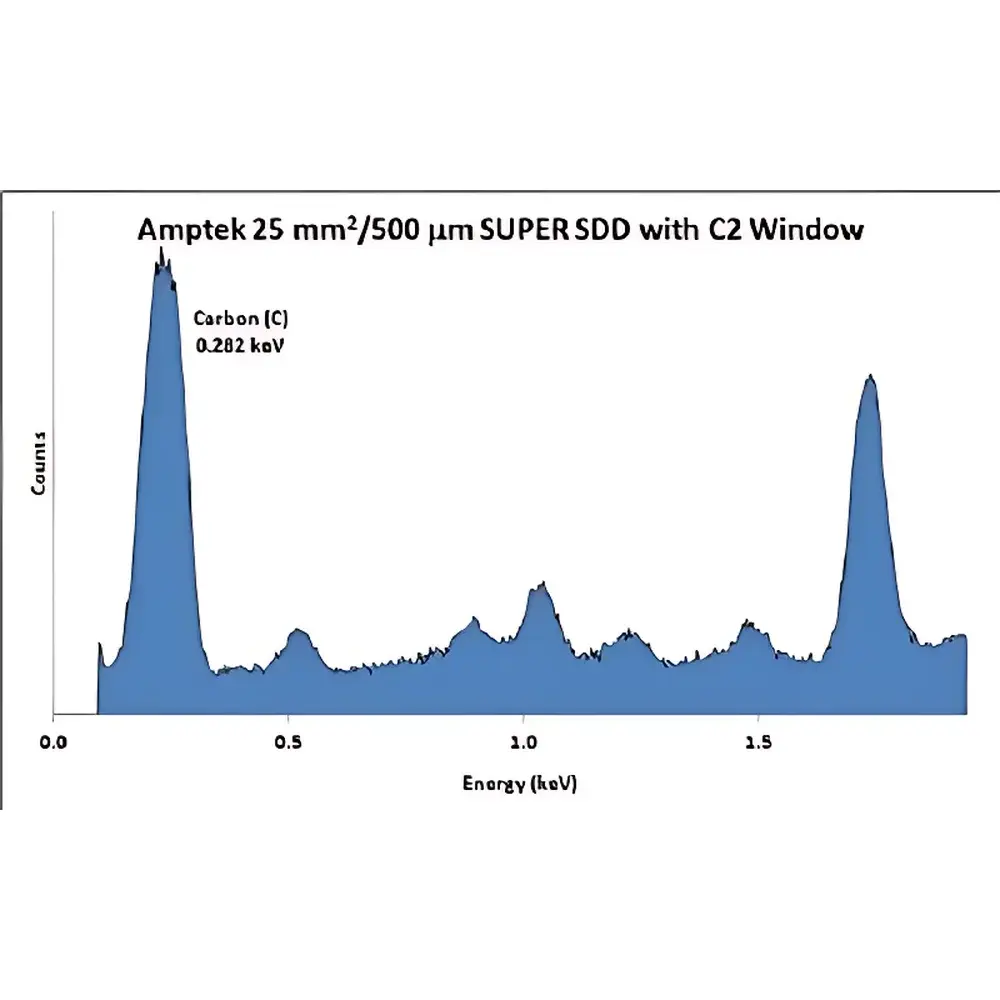
Amptek C1/C2 Low-Energy X-ray Windows for SDD Detectors
| Brand | Amptek |
|---|---|
| Origin | USA |
| Model | C1/C2 |
| Window Substrate | Silicon Nitride (Si₃N₄) |
| Front Coating | Aluminum |
| Thickness | C1 ≈ 80 nm, C2 ≈ 150 nm |
| Compatible Detectors | SuperSDD®, standard SDDs (25 mm² / 50 mm² active area) |
| Energy Range Enhancement | Extended low-energy response down to boron (B, 183 eV) and carbon (C, 277 eV) |
| Compliance | RoHS-compliant, vacuum-compatible, TEM-grid compatible |
| Mounting | Standard 3.5 mm or 5.0 mm diameter window frames |
Overview
The Amptek C1 and C2 low-energy X-ray windows are ultra-thin, freestanding silicon nitride (Si₃N₄) membranes engineered specifically for high-sensitivity energy-dispersive X-ray spectroscopy (EDS/EDX) in scanning electron microscopes (SEM), benchtop XRF analyzers, and handheld elemental analyzers. Unlike conventional beryllium (Be) entrance windows—whose atomic absorption edge at 111 eV severely attenuates soft X-rays below ~1 keV—the C1/C2 series enables quantitative detection of light elements from boron (B, Kα = 183 eV) through oxygen (O, Kα = 525 eV), with measurable transmission extending into the carbon (C, Kα = 277 eV) and nitrogen (N, Kα = 392 eV) ranges. The windows consist of a stoichiometric Si₃N₄ membrane (C1: ~80 nm thick; C2: ~150 nm thick), coated with a uniform aluminum layer (~10–20 nm) to provide electrical conductivity, mechanical stability, and enhanced low-energy photon transmission. This architecture balances structural integrity under vacuum (≤10⁻⁵ Torr) with minimal X-ray absorption—making them integral components for modern silicon drift detector (SDD) systems requiring high count-rate capability and sub-130 eV energy resolution at Mn Kα.
Key Features
- Ultra-low absorption window technology enabling direct detection of B, C, N, O, and F—elements inaccessible with standard 8 µm or 12 µm Be windows
- Si₃N₄ substrate offers superior mechanical strength and thermal stability versus polymer-based alternatives (e.g., polyimide or parylene)
- Al-coated surface prevents electrostatic charging and supports stable bias application during SDD operation
- Compatible with Amptek’s SuperSDD® platform and third-party SDDs (25 mm² and 50 mm² active areas) using standard 3.5 mm or 5.0 mm diameter mounting interfaces
- No cryogenic cooling required—designed for use with Peltier-cooled detectors operating at −20 °C to −35 °C
- RoHS-compliant and fully compatible with high-vacuum SEM chambers and inert-gas-purged XRF sample compartments
Sample Compatibility & Compliance
The C1/C2 windows support non-destructive, in-vacuum and atmospheric-pressure EDS analysis across diverse sample types—including insulating ceramics, battery cathode materials (e.g., LiCoO₂, NMC), geological silicates, polymer composites, and biological thin sections. Their performance aligns with ASTM E1508 (Standard Guide for Quantitative Analysis by Energy-Dispersive Spectroscopy) and ISO 22309:2022 (Electron probe microanalysis — Quantitative analysis using wavelength- and energy-dispersive X-ray spectrometry). When integrated into GLP- or GMP-regulated environments (e.g., pharmaceutical raw material verification or semiconductor wafer defect analysis), the windows contribute to measurement traceability by enabling repeatable low-Z quantification without matrix-dependent corrections required for Be-window-based systems. No beryllium content eliminates occupational health reporting obligations per OSHA 1910.1200 and EU REACH Annex XVII.
Software & Data Management
C1/C2 window deployment requires no firmware modification but necessitates updated detector calibration files within standard EDS acquisition software suites (e.g., Thermo Fisher TEAM™, Bruker ESPRIT™, Oxford Instruments AZtec™). Amptek provides reference spectral libraries and energy-response correction matrices (ERCs) for accurate peak deconvolution and ZAF matrix correction below 1 keV. All spectral data acquired with C1/C2 windows retain full compatibility with NIST SRM-traceable standards (e.g., NIST 610, 612, 614) and support audit-ready metadata logging per FDA 21 CFR Part 11 when used with validated laboratory information management systems (LIMS).
Applications
- Light-element mapping in lithium-ion battery electrode cross-sections (Li, B, C, O distribution)
- Quantitative oxygen stoichiometry analysis in high-κ dielectrics (e.g., HfO₂, Al₂O₃) and perovskite oxides
- In situ corrosion product identification on aerospace alloys (Mg, Al, Si, P, S in oxide/hydroxide layers)
- Carbon-content grading in carbon-fiber-reinforced polymers (CFRPs) and graphene composite films
- Forensic soil and paint chip analysis requiring B–F detection without carbon-coating artifacts
- Environmental particulate matter (PM₂.₅) speciation including ammonium sulfate ((NH₄)₂SO₄) and sodium chloride (NaCl) signatures
FAQ
What is the primary advantage of C2 over C1?
C2 provides higher transmission for elements below 500 eV (e.g., B, C, N) due to its thicker Si₃N₄ membrane (~150 nm vs. ~80 nm), which improves mechanical robustness while maintaining >40% transmission at B Kα—where C1 delivers ~0.1%.
Can C1/C2 windows be used in air-path EDS configurations?
No—they require vacuum or helium-purged environments; polymer windows remain preferred for ambient-pressure operation.
Do these windows require special handling procedures?
Yes: avoid contact with solvents, ultrasonic cleaning, or mechanical pressure; use only clean dry nitrogen purge and Class 100 laminar flow hoods during installation.
Is there a shelf-life limitation?
When stored desiccated at room temperature and protected from UV exposure, functional lifetime exceeds 5 years; accelerated aging tests show no degradation in transmission after 10⁴ hours under continuous vacuum.
How does C2 compare to traditional 0.5-mil Be windows for Na and Mg quantification?
C2 achieves 82% transmission at Na Kα (1.04 keV) versus 27% for 12 µm Be, and 87% at Mg Kα (1.25 keV) versus 47%—significantly improving peak-to-background ratio and statistical precision in low-concentration measurements.
Related Products




