
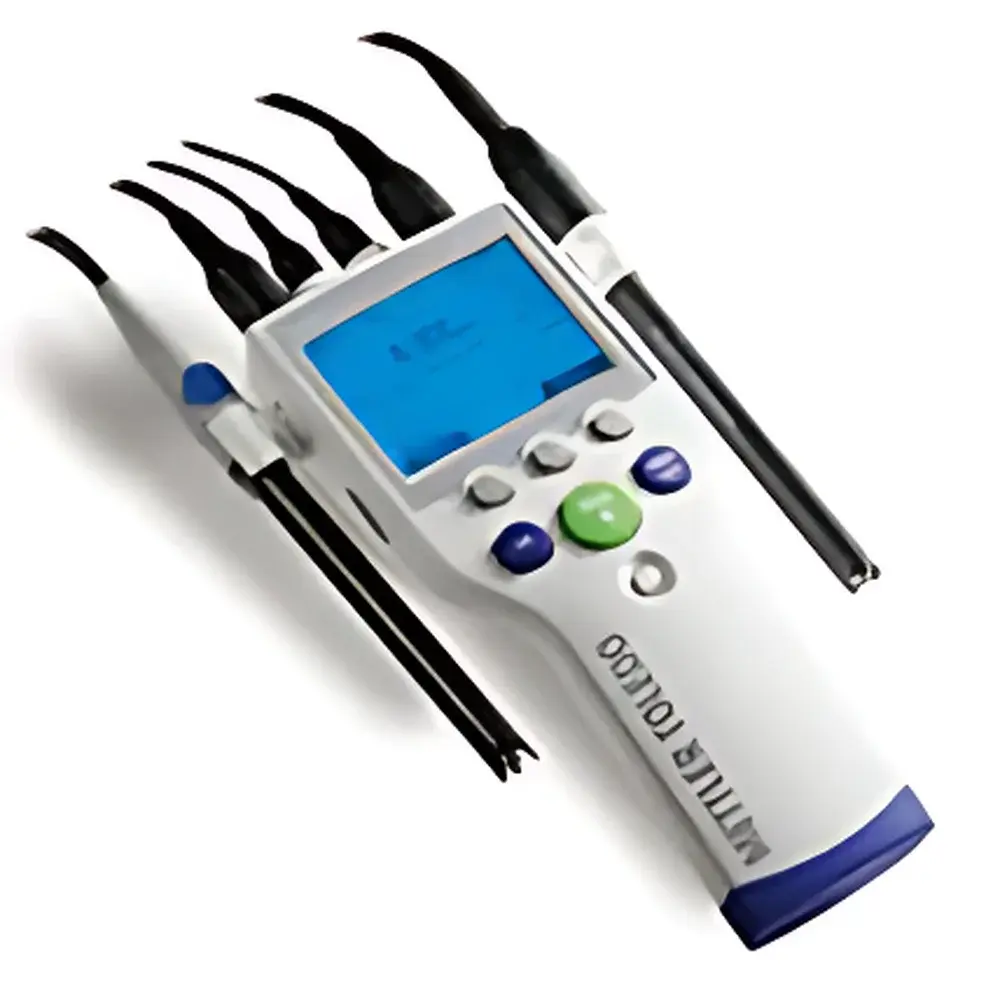
METTLER TOLEDO SevenGo Portable pH and Multiparameter Meter
| Brand | METTLER TOLEDO |
|---|---|
| Origin | Switzerland |
| Instrument Type | Portable |
| Measurement Parameters | pH, mV, Ion Concentration, Conductivity, TDS, Resistivity, Salinity, Dissolved Oxygen (DO), Temperature |
| pH Range | 0–14 |
| pH Resolution | 0.1 |
| pH Accuracy | ±0.1 |
| DO Measurement Principle | Polarographic (SG23/SG68/SG78) or Optical (SG6/SG7/SG8/SG9/SG98) |
| Temperature Compensation | Linear & Non-linear for Conductivity |
| Calibration Standards | NIST-type (China version) / USA-type (International version) |
| Ingress Protection | IP67 |
| Data Storage Capacity | Up to 500 GLP-compliant records |
| Interface | Infrared (IR) |
| Power Supply | 4× AA alkaline or NiMH rechargeable batteries |
| Electrode Technology | Intelligent Sensor Management (ISM) enabled |
| Operating Modes | Standard & Expert |
| Display | Backlit LCD |
| Compliance | GLP, ISO/IEC 17025-supportive data handling, FDA 21 CFR Part 11-ready with optional software |
Overview
The METTLER TOLEDO SevenGo series represents a family of portable, field-deployable electrochemical analyzers engineered for precision, reliability, and regulatory compliance in demanding laboratory, industrial, and environmental applications. Designed around core potentiometric and amperometric measurement principles—pH and redox potential via glass/reference electrode systems; conductivity via two- or four-electrode cells; dissolved oxygen via Clark-type polarographic or luminescence-based optical sensors—the SevenGo platform delivers traceable, reproducible results under variable ambient conditions. Its modular architecture supports single- or dual-channel configurations (SevenGo and SevenGo Duo variants), enabling simultaneous monitoring of complementary parameters such as pH + DO or conductivity + temperature—critical for process validation, wastewater characterization, aquaculture management, and field-based quality control workflows.
Key Features
- IP67-rated enclosure ensures full protection against dust ingress and immersion in water up to 1 m for 30 minutes—validated for use in humid laboratories, outdoor sampling sites, and industrial plant floors.
- Intelligent Sensor Management (ISM) technology enables plug-and-play electrode recognition, automatic calibration history tracking, and predictive maintenance alerts—reducing operator error and supporting audit-ready documentation.
- Backlit high-contrast LCD display remains legible under direct sunlight or low-light conditions, with intuitive icon-driven navigation across Standard and Expert operating modes.
- Infrared (IR) wireless interface facilitates secure, cable-free transfer of measurement data to PCs or IR-enabled printers—eliminating physical port wear and enabling rapid reporting in paper-intensive environments.
- Flexible power options include standard AA alkaline batteries (up to 2,000 hours operation) or rechargeable NiMH packs—optimized for extended field campaigns without access to mains electricity.
- GLP-compliant internal memory stores up to 500 fully timestamped, user-identifiable measurements—including electrode ID, calibration data, temperature, and environmental metadata—meeting ISO/IEC 17025 documentation requirements.
Sample Compatibility & Compliance
The SevenGo series accommodates aqueous samples across diverse matrices: buffered calibration standards (NIST-traceable or USA-type), natural waters (freshwater, seawater, effluents), pharmaceutical buffers, food extracts, and chemical process streams. All models comply with international electrochemical measurement conventions defined in ASTM D1293 (pH of water), ASTM D5391 (conductivity of pure water), and ISO 5814 (optical DO determination). The instrument’s firmware supports user-defined calibration curves, manual electrode constant entry, and configurable temperature compensation algorithms—ensuring accuracy across non-standard media. Data integrity safeguards—including electronic signatures, audit trails, and password-protected configuration changes—are compatible with FDA 21 CFR Part 11 implementation when paired with METTLER TOLEDO LabX® software.
Software & Data Management
While standalone operation requires no external software, the SevenGo integrates seamlessly with METTLER TOLEDO’s LabX® PC software suite for advanced data aggregation, statistical analysis (e.g., trend analysis, uncertainty calculation per GUM), and automated report generation. IR-transmitted datasets retain full metadata: operator ID, location tag (manually entered), calibration verification timestamps, and sensor health status. Export formats include CSV, PDF, and XML—facilitating import into LIMS or ELN platforms. Firmware updates are delivered via USB-connected PC, ensuring long-term alignment with evolving metrological standards and cybersecurity best practices.
Applications
- Environmental monitoring: On-site pH, DO, and conductivity profiling in rivers, lakes, and wastewater treatment plants—supporting EPA Method 150.1 and ISO 10523 compliance.
- Pharmaceutical QC: Buffer verification during formulation, cleaning validation, and stability testing—aligned with USP and EP 2.2.3.
- Food & beverage production: Rapid acidity checks in dairy, brewing, and juice processing lines—enabling real-time deviation detection per HACCP protocols.
- Aquaculture & hydroponics: Continuous parameter logging to maintain optimal growth conditions—integrated with climate control systems via analog output modules (optional).
- Educational laboratories: Robust, student-proof design with multilingual UI (including Chinese, English, German, French, Spanish) supports cross-curricular electrochemistry instruction.
FAQ
What calibration standards are supported?
The SevenGo accepts both NIST-traceable (China version) and USA-type (DIN/ASTM) pH and conductivity standards. Users may define custom calibration points or select from built-in standard sets.
Can the instrument store calibration data with each measurement?
Yes—GLP mode automatically embeds calibration date, buffer IDs, slope, offset, and electrode serial number into every stored record.
Is dissolved oxygen measured optically or electrochemically?
Model-dependent: SG6, SG7, SG8, SG9, and SG98 use optical (luminescence quenching) DO sensors; SG23 and SG68 use polarographic (Clark-type) sensors. Both methods meet ISO 5814 and ASTM D888 specifications.
How is temperature compensation handled for conductivity measurements?
Linear compensation (fixed α coefficient) and non-linear (natural water curve) modes are available, with manual or auto-sensing probe input.
Does the SevenGo support multi-language interfaces?
Yes—ten languages are preloaded, including Simplified Chinese, English, German, French, Spanish, Italian, Portuguese, Russian, Japanese, and Korean.





