
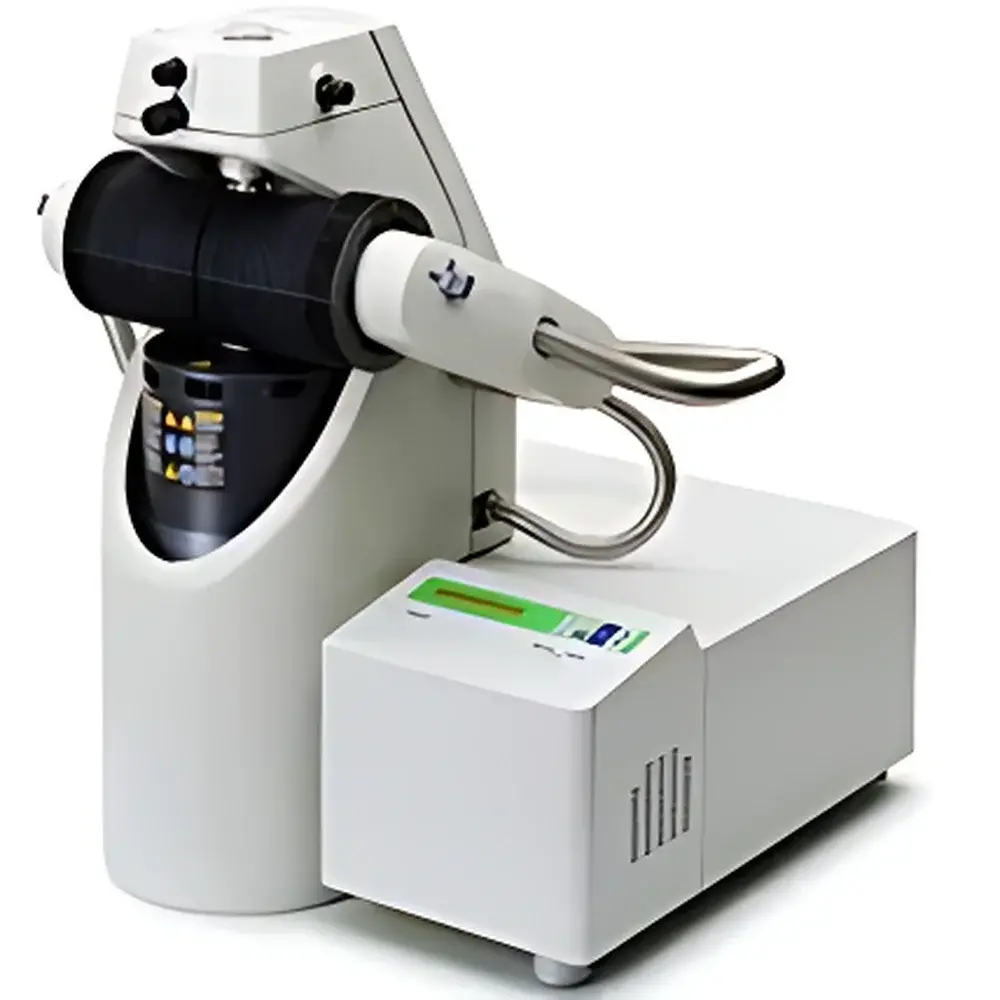
METTLER TOLEDO DMA/SDTA861 Dynamic Mechanical Analyzer with Simultaneous Differential Thermal Analysis
| Brand | METTLER TOLEDO |
|---|---|
| Origin | Switzerland |
| Model | DMA/SDTA861 |
| Instrument Type | Dynamic Mechanical Analyzer (DMA/DMTA) |
| Temperature Range | −150 to 500 °C |
| Temperature Accuracy | ±0.5 °C |
| Force Range | 0.001–40 N |
| Displacement Range | ±1.6 mm |
| Frequency Range | 0.001–1000 Hz |
Overview
The METTLER TOLEDO DMA/SDTA861 is a high-precision dynamic mechanical analyzer engineered for the quantitative characterization of viscoelastic behavior under controlled thermal and mechanical stimuli. It operates on the principle of forced oscillatory deformation—applying a sinusoidal stress or strain to a sample while simultaneously monitoring the resulting strain or stress response—to determine storage modulus (E′), loss modulus (E″), and damping factor (tan δ) as functions of temperature, frequency, or time. Uniquely, the SDTA (Simultaneous Differential Thermal Analysis) capability enables concurrent measurement of heat flow changes during mechanical testing, allowing direct correlation between structural transitions (e.g., glass transition, crystallization, melting) and mechanical property evolution. This dual-signal acquisition eliminates sequential measurement artifacts and ensures temporal alignment of thermal and mechanical events—critical for polymer development, composite qualification, and pharmaceutical solid-state stability studies.
Key Features
- True simultaneous DMA and DTA: Integrated high-sensitivity thermocouple and micro-furnace architecture enable real-time, co-located thermal and mechanical data acquisition on a single sample.
- Direct force and displacement transduction: Load cell and linear variable differential transformer (LVDT) sensors provide traceable, high-resolution mechanical signal capture without mechanical amplification or linkage error.
- On-sample temperature measurement: A calibrated thermocouple embedded in the sample holder ensures accurate, contact-based temperature reporting—eliminating furnace air or block temperature lag.
- Dual control modes: Independent force-controlled and displacement-controlled operation supports both stiff and compliant materials across wide modulus ranges (10−1 to 1012 Pa).
- Extended operational envelope: −150 °C to 500 °C temperature range accommodates cryogenic elastomers, high-performance thermoplastics, and inorganic ceramics; 0.001–1000 Hz frequency sweep covers quasi-static creep to high-frequency dynamic response.
- Full-range single-run analysis: Capable of continuous measurement from rigid glassy state through rubbery plateau into viscous melt—enabling complete viscoelastic mapping without manual intervention or sample reconfiguration.
Sample Compatibility & Compliance
The DMA/SDTA861 supports standard geometries including dual/cantilever bending, tension, compression, and shear clamping fixtures—compatible with films, fibers, molded parts, powders (in cured discs), and biomedical hydrogels. Sample mass requirements range from 10 mg to 5 g depending on geometry and modulus. The instrument complies with ISO 6721 (Plastics – Determination of dynamic mechanical properties), ASTM D4065 (Standard Practice for Plastics: Dynamic Mechanical Properties), and ASTM E1640 (Standard Test Method for Assignment of Glass Transition Temperatures by Dynamic Mechanical Analysis). Its hardware design and firmware architecture support GLP/GMP environments, including audit-trail-enabled method storage, user access control, and electronic signature readiness per FDA 21 CFR Part 11 when integrated with METTLER TOLEDO’s STARe software suite.
Software & Data Management
Controlled exclusively via METTLER TOLEDO’s STARe (Scientific Thermal Analysis and Rheology) software, the DMA/SDTA861 delivers a unified platform for experiment design, real-time visualization, multi-parameter curve fitting, and compliance reporting. STARe includes automated baseline correction, time–temperature superposition (TTS) modeling, Arrhenius and WLF equation fitting, and isoconversional kinetic analysis for thermomechanical degradation. All raw data are stored in vendor-neutral .tdms format; export options include CSV, ASCII, and XML for third-party statistical or finite-element post-processing. Software validation documentation (IQ/OQ/PQ protocols) and 21 CFR Part 11 configuration packages are available upon request for regulated laboratories.
Applications
- Polymer science: Quantifying Tg, crosslink density, filler-matrix interaction, and long-term creep compliance in thermosets, elastomers, and biodegradable polyesters.
- Pharmaceuticals: Assessing amorphous content, physical stability of amorphous solid dispersions, and excipient compatibility under accelerated humidity–temperature cycling.
- Electronics packaging: Evaluating coefficient of thermal expansion (CTE) mismatch, solder joint fatigue resistance, and underfill modulus transitions in flip-chip assemblies.
- Automotive composites: Mapping viscoelastic damping behavior of carbon-fiber-reinforced polymers across service temperature ranges (−40 °C to 120 °C).
- Academic research: Investigating molecular relaxation mechanisms in liquid crystals, ion-conducting polymers, and shape-memory alloys using multifrequency master curves.
FAQ
What distinguishes SDTA from conventional DSC-coupled DMA systems?
SDTA integrates thermal sensing directly into the mechanical test stage—ensuring identical thermal history and spatial location for both signals. Conventional setups rely on separate DSC and DMA instruments, introducing calibration drift, thermal lag, and sample heterogeneity errors.
Can the DMA/SDTA861 perform time-sweep experiments at constant temperature?
Yes—time sweeps (isothermal creep/recovery, stress relaxation) are fully supported across the entire temperature and force range, with programmable ramp rates and dwell stabilization criteria.
Is nitrogen purge required for low-temperature operation?
A dry nitrogen or argon purge is recommended below −50 °C to prevent condensation and frost formation on the sensor and sample stage, ensuring mechanical integrity and thermal uniformity.
How is temperature calibration performed?
Primary calibration uses high-purity metallic standards (e.g., indium, tin, zinc) with certified melting points; secondary verification employs NIST-traceable reference materials with known Tg transitions such as polycarbonate or poly(methyl methacrylate).
Does the system support custom fixture design?
METTLER TOLEDO offers engineering consultation and mechanical drawing review for application-specific fixtures, subject to static load and thermal expansion constraints within the instrument’s mechanical envelope.



