
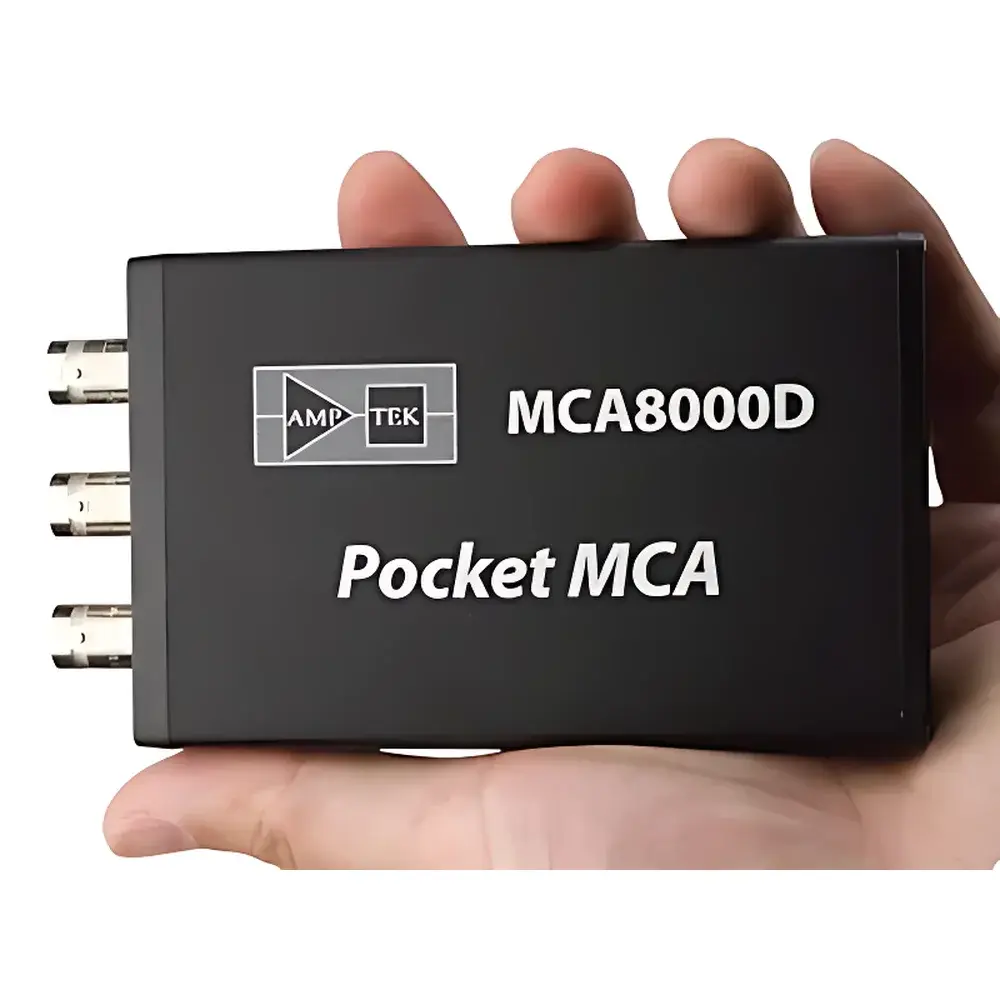
Amptek MCA8000D Digital Multichannel Analyzer for X-ray Spectroscopy Systems
| Brand | Amptek |
|---|---|
| Origin | USA |
| Model | MCA8000D |
| Detector Interface | Analog Pulse Input (Unipolar/Bipolar) |
| ADC | 100 MHz, 16-bit |
| Channel Count | Up to 8192 (8K) |
| Differential Nonlinearity | < ±0.6% |
| Integral Nonlinearity | < ±0.02% |
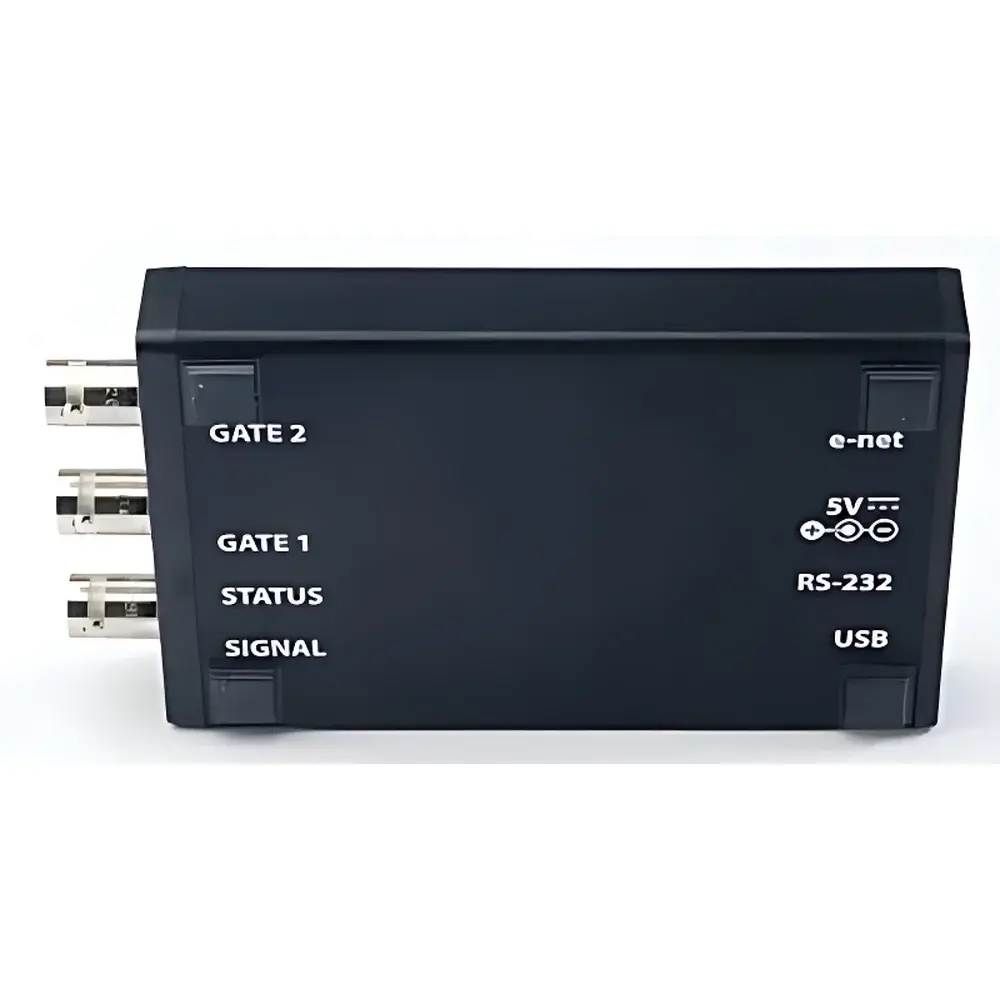
| Peak Pileup Rejection | Dual TTL-compatible Gate Inputs (GATE1/GATE2) |
| Communication Interfaces | USB 2.0 Full-Speed (12 Mbps), RS-232 (115 kbps), 10BASE-T Ethernet (10 Mbps) |
| Input Voltage Range | 0–1 V or 0–10 V (software-selectable) |
| Input Impedance | 1 kΩ or 100 kΩ (factory-configurable) |
| Minimum Pulse Height | 5 mV |
| Pulse Peaking Time | ≥500 ns (200 ns shaping) |
| Conversion Time | 10 ns |
| Sliding-Scale Linearization | Yes |
| Operating Temperature | –20 °C to +60 °C |
| Dimensions | 125 × 71 × 20 mm |
| Weight | 165 g |
| Power | +4–5.5 V DC, ≤2 W (USB or external AC/DC adapter) |
Overview
The Amptek MCA8000D is a high-performance, compact digital multichannel analyzer (MCA) engineered for precision pulse-height analysis in X-ray spectroscopy, gamma-ray detection, and particle energy measurement systems. Unlike legacy analog MCAs, the MCA8000D digitizes conditioned analog pulses—typically from preamplifiers and shaping amplifiers used with Si-PIN, SDD, CdTe, or NaI(Tl) detectors—using a 100 MHz, 16-bit analog-to-digital converter (ADC). Its architecture preserves full compatibility with conventional analog pulse shaping circuits while eliminating the drift, temperature sensitivity, and calibration instability inherent in analog peak detection hardware. The device implements real-time digital pulse processing, including sliding-scale linearization, precise threshold-based peak identification, and dual-gate coincidence/anti-coincidence logic—enabling robust spectral acquisition under variable count-rate conditions. Designed for integration into portable XRF analyzers, airborne aerosol monitors, lab-based XRD/XRF spectrometers, and educational nuclear instrumentation platforms, the MCA8000D delivers laboratory-grade spectral fidelity in a palm-sized form factor (125 × 71 × 20 mm, 165 g) with ultra-low power consumption (<2 W).
Key Features
- 100 MHz, 16-bit high-speed ADC with 10 ns conversion time—enabling high-throughput pulse processing and reduced dead time
- Software-selectable input range (0–1 V or 0–10 V) and factory-configurable input impedance (1 kΩ or 100 kΩ)
- Up to 8192-channel spectrum storage with 3-byte depth per channel (max 16.7 million counts/channel)
- Dual independent TTL-compatible gate inputs (GATE1, GATE2) supporting pileup rejection, external trigger synchronization, and anti-coincidence gating
- Three standard communication interfaces: USB 2.0 Full-Speed (12 Mbps), RS-232 (115 kbps), and 10BASE-T Ethernet (10 Mbps)
- Real-time and live timers with sub-10-ms resolution; configurable acquisition durations up to 16,777,215 seconds (≈194 days)
- Two peak detection modes: “First peak above threshold” (standard for nuclear spectroscopy) and “Maximum peak above threshold” (optimized for aerosol size distribution calibration)
- Sliding-scale linearization ensures consistent channel-to-energy mapping across gain variations and temperature shifts
- Integral nonlinearity < ±0.02% and differential nonlinearity < ±0.6% — meeting ASTM E1799-21 requirements for quantitative spectral analysis
- Onboard firmware supports ROI definition, energy calibration (linear/quadratic), spectrum export (ASCII, CSV, binary), and parameter persistence
Sample Compatibility & Compliance
The MCA8000D interfaces directly with analog output detectors commonly deployed in X-ray fluorescence (XRF), energy-dispersive X-ray spectroscopy (EDS), portable radiation survey instruments, and environmental particulate monitors. It accepts unipolar or bipolar semi-Gaussian pulses with shaping time constants ≥200 ns and peaking times ≥500 ns—making it compatible with industry-standard shaping amplifiers used in Amptek’s DP5, PX5, and X-123 detector systems. The unit complies with IEC 61000-6-3 (EMC emission limits) and IEC 61000-6-2 (immunity requirements), and its firmware architecture supports audit-trail-capable operation when integrated into GLP/GMP-regulated workflows. While not FDA 21 CFR Part 11–certified as a standalone device, the MCA8000D is routinely embedded in Class I and II diagnostic and analytical instruments where traceable energy calibration, stable gain response, and reproducible peak centroid determination are essential for ISO/IEC 17025-accredited laboratories.
Software & Data Management
The MCA8000D operates exclusively with Amptek’s DPPMCA software suite—a cross-platform application (Windows/macOS/Linux) that provides full instrument control, spectral visualization, and quantitative post-processing. Key capabilities include interactive region-of-interest (ROI) selection, multi-point energy calibration using known X-ray or gamma-ray lines (e.g., Mn Kα, Co Kα, Cs-137), automatic peak search and deconvolution, background subtraction (linear, polynomial, SNIP), and export to industry-standard formats (CSV, ASCII, .mca). All configuration parameters—including gain, offset, threshold, gate settings, and acquisition timing—are stored in non-volatile memory and persist across power cycles. For automated system integration, the device exposes a documented ASCII command protocol over all three interfaces, enabling seamless incorporation into custom LabVIEW, Python (PySerial/PyUSB), or MATLAB-based data acquisition frameworks. Optional PA Configuration Packages extend functionality for airborne particle sizing applications via calibrated pulse-height-to-diameter mapping.
Applications
- Portable and benchtop XRF analyzers for alloy verification, mining geochemistry, and RoHS/WEEE compliance screening
- EDS systems coupled to SEMs and TEMs requiring low-noise, high-resolution spectral acquisition
- Aerosol monitoring platforms measuring particle size distributions via X-ray scattering or beta attenuation
- Educational nuclear physics labs performing gamma spectroscopy, half-life measurements, and shielding studies
- Environmental radiation monitoring networks integrating with GPS-synchronized data loggers and cloud telemetry
- Quality control in semiconductor manufacturing for wafer-level contamination analysis using soft X-ray detection
FAQ
Is the MCA8000D compatible with my existing analog shaping amplifier?
Yes—the MCA8000D is designed to accept standard analog pulse outputs from commercially available shaping amplifiers with peaking times ≥500 ns and input ranges of 0–1 V or 0–10 V.
Can I perform energy calibration without external radioactive sources?
Yes—calibration can be performed using characteristic X-ray lines from sample materials (e.g., Cu Kα at 8.04 keV) or internal reference features if paired with Amptek’s calibrated detector modules.
Does the device support real-time spectrum streaming over Ethernet?
Yes—Ethernet interface enables continuous UDP packet transmission of live spectra at user-defined intervals, suitable for remote monitoring and distributed sensor networks.
What is the maximum sustainable input count rate?
While dependent on pulse width and shaping, the MCA8000D maintains <1% dead time up to ~50,000 cps with typical 500 ns peaking time pulses—validated per ASTM E1452-20 Annex A1 test methodology.
Is firmware upgrade supported in the field?
Yes—firmware updates are delivered via USB using Amptek’s DFU (Device Firmware Upgrade) utility and require no hardware modification.





