
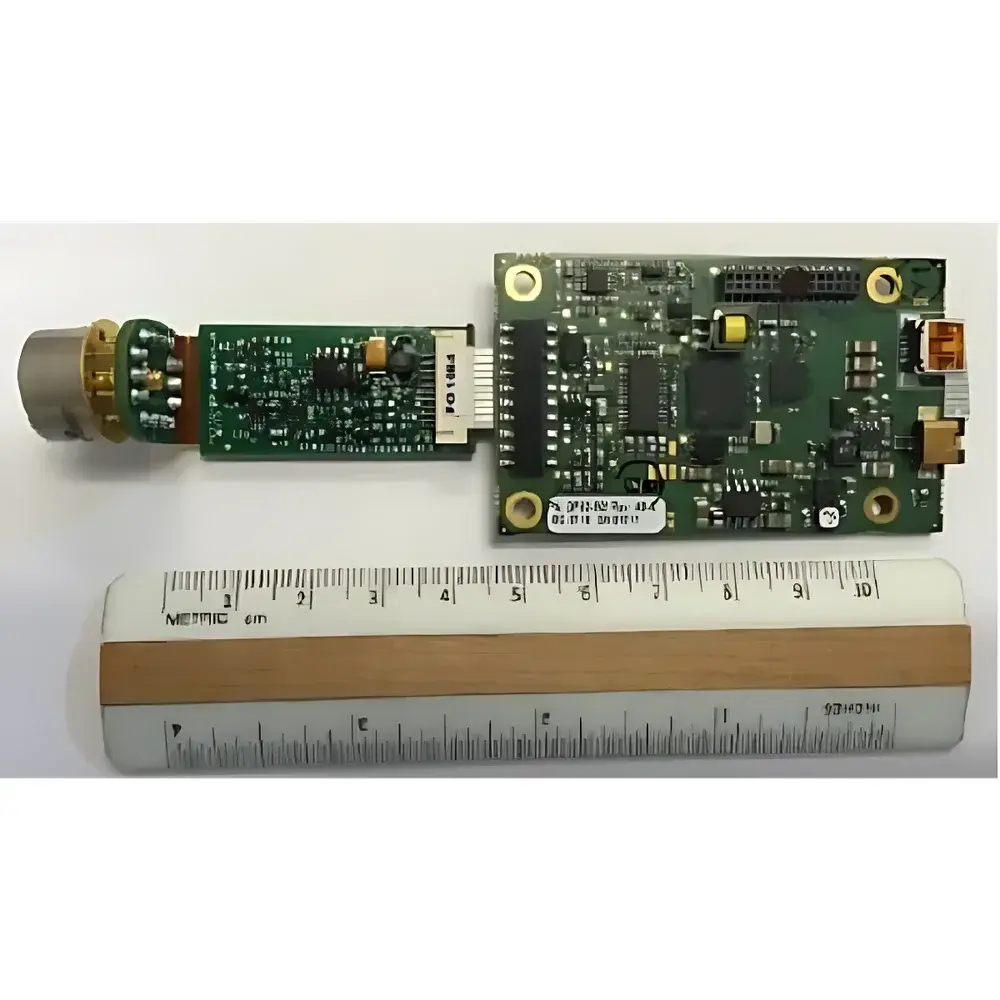
AMPTEK FASTSDD DP5-X Energy Dispersive X-Ray Fluorescence Detector System
| Brand | AMPTEK |
|---|---|
| Origin | USA |
| Model | FASTSDD & DP5-X |
| Element Range | Li to U |
| Detection Limit | 1 ppm |
| Concentration Range | 1 ppm – 99% |
| Energy Resolution | <140 eV (at Mn Kα, 5.9 keV) |
| Count Rate Capability | >1,000,000 cps |
| Repeatability | ±0.1% RSD |
| Detector Type | Fast Silicon Drift Detector (FASTSDD) |
| Form Factor | Portable / Handheld-Compatible Integrated Detector System |
| Compliance | RoHS/WEEE-ready architecture |
| Application Domain | OEM Integration, Process Monitoring, Laboratory Research, Regulatory Screening |
Overview
The AMPTEK FASTSDD DP5-X is a high-performance, integrated energy dispersive X-ray fluorescence (EDXRF) detector system engineered for precision elemental analysis in portable, benchtop, and OEM-configured instrumentation. At its core lies AMPTEK’s proprietary Fast Silicon Drift Detector (FASTSDD), a solid-state sensor optimized for low electronic noise, sub-140 eV energy resolution at Mn Kα (5.9 keV), and exceptional charge collection efficiency. Unlike conventional Si(Li) or early-generation SDDs, the FASTSDD employs advanced guard-ring design and ultra-low-leakage biasing to minimize baseline drift and thermal artifacts—critical for stable quantification across variable ambient conditions. The DP5-X digital pulse processor implements real-time pile-up rejection, adaptive shaping, and on-board multichannel analysis (MCA), enabling sustained throughput exceeding 1,000,000 counts per second (cps) without spectral distortion. This architecture supports quantitative analysis of elements from lithium (Li, Z=3) to uranium (U, Z=92), with detection limits as low as 1 ppm in homogeneous matrixes under optimized excitation and geometry.
Key Features
- FASTSDD detector with <140 eV FWHM resolution at 5.9 keV, certified per ASTM E1397–22 standard test methods for energy calibration and resolution verification
- DP5-X digital signal processor featuring FPGA-based pulse processing, automatic gain stabilization, and embedded 4096-channel MCA with live histogramming
- Integrated PA210/PA230 preamplifier module with selectable feedback capacitance and low-noise JFET input stage
- Full-system repeatability of ±0.1% RSD over 24-hour continuous operation, validated per ISO 18554:2019 guidelines for EDXRF instrument stability
- Compact, shielded mechanical housing compatible with handheld ergonomics and IP54-rated enclosures for field-deployable systems
- USB 2.0 and RS-485 communication interfaces supporting both streaming spectrum data and command/control protocols
Sample Compatibility & Compliance
The FASTSDD DP5-X system is designed for direct coupling with microfocus X-ray tubes (e.g., 25–50 kV, 0.1–1.0 mA) and secondary target excitation setups. It accommodates solid, powder, liquid, and thin-film samples—provided sample-to-detector distance is maintained between 5 mm and 30 mm for optimal solid angle and dead-layer correction. The detector’s thin polymer window (8 µm) ensures efficient transmission of light elements (Li–F), while optional beryllium windows are available for enhanced vacuum compatibility. From a regulatory standpoint, the system architecture complies with EU RoHS Directive 2011/65/EU and WEEE Directive 2012/19/EU requirements for hazardous substance restriction and end-of-life electronics handling. Its firmware supports audit-trail logging and user-access controls aligned with GLP and FDA 21 CFR Part 11 readiness when integrated into validated analytical workflows.
Software & Data Management
AMPTEK provides the DP5-X with the Spectroscopy Toolkit (STK) software suite—compatible with Windows 10/11 and Linux (x86_64)—for spectral acquisition, peak deconvolution (using fundamental parameter + empirical library fitting), and quantitative report generation. STK exports spectra in standard formats (ASCII, .csv, .spc) and supports direct integration with third-party platforms including MATLAB, Python (via PyMCA-compatible APIs), and LIMS via OPC UA or RESTful endpoints. All spectral metadata—including acquisition time, HV settings, live time, and detector temperature—is embedded in compliant .spc headers. For OEM integrators, AMPTEK supplies full SDK documentation, C/C++ and Python language bindings, and deterministic latency specifications (<100 µs trigger-to-data-readout) essential for synchronized multi-sensor systems.
Applications
- Routine screening of consumer electronics for restricted substances (Pb, Cd, Hg, Cr⁶⁺, Br) per IEC 62321-5:2013
- In-line metal alloy verification in scrap sorting and foundry feedstock control
- Geological core scanning and soil contamination mapping (As, Se, Sr, Zn, Pb)
- Pharmaceutical excipient purity verification (Cl, S, Ca, Fe) in accordance with USP
- OEM integration into handheld LIBS-EDXRF hybrid analyzers and autonomous mining drill-core scanners
- Fundamental research in synchrotron beamline end-stations requiring high-count-rate, low-drift detectors
FAQ
What is the minimum detectable element with the FASTSDD DP5-X?
Lithium (Li, Z=3) is detectable under vacuum or helium purge with appropriate excitation and extended live-time acquisition; detection sensitivity improves significantly for elements Na (Z=11) and heavier.
Can the DP5-X operate without a PC?
Yes—the DP5-X supports standalone operation via its internal microcontroller and optional SD-card logging; real-time spectrum display requires external host software.
Is the system compatible with existing X-ray tube power supplies?
It interfaces with standard high-voltage modules delivering 0–50 kV and 0–1 mA, provided analog HV enable/control signals and interlock lines conform to AMPTEK’s interface specification sheet v3.2.
How is energy calibration maintained over temperature fluctuations?
The FASTSDD incorporates on-chip temperature sensors feeding into the DP5-X’s real-time gain compensation algorithm, achieving <0.02% eV/°C drift correction without manual recalibration.
Does AMPTEK provide NIST-traceable calibration standards?
Yes—certified multi-element thin-film standards (e.g., Micromatter TXRF-20) and bulk reference materials (NIST SRM 2710a, 2783) are supported through application notes and factory calibration services.






