
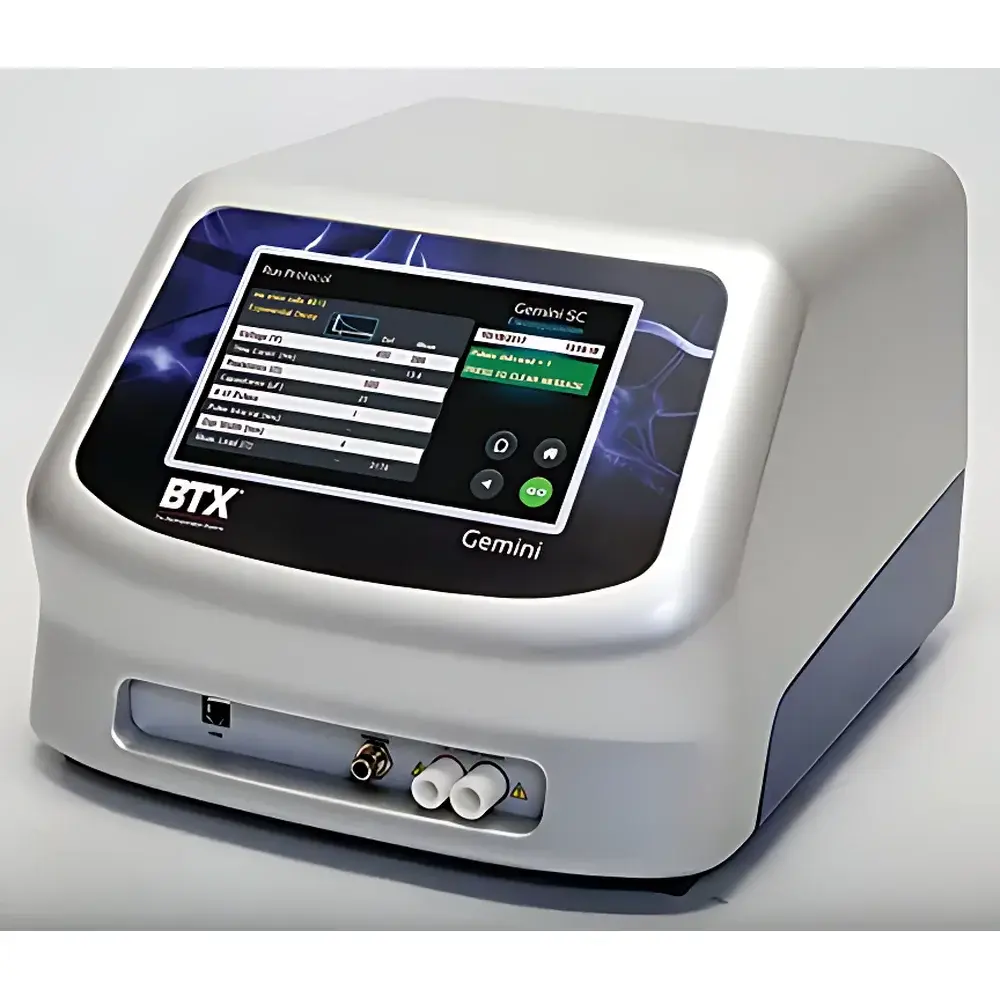
BTX Gemini SC Electroporator
| Brand | BTX |
|---|---|
| Origin | USA |
| Model | Gemini SC |
| High-Voltage Range | 510–3000 V |
| Low-Voltage Range | 10–500 V |
| Capacitance Range | 25–3275 µF |
| Pulse Form | Square Wave and Exponential Decay Wave |
| Pulse Duration | 50 µs – 100 ms |
| Number of Pulses | 1–99 |
| Discharge Time (LV) | <7 s |
| Discharge Time (HV) | <4 s |
| Resistance Range | 50–1000 Ω |
Overview
The BTX Gemini SC Electroporator is a benchtop, dual-mode electroporation system engineered for high-efficiency in vitro transfection and transformation of suspended cells. It operates on the principle of transient membrane permeabilization via controlled electrical pulse delivery—inducing nanoscale pores in cellular membranes to enable uptake of nucleic acids, proteins, or other macromolecules. Unlike reagent-dependent methods, the Gemini SC delivers reproducible, chemistry-free transfection across diverse cell types without requiring proprietary buffers or costly consumables. Its integrated architecture supports both square-wave and exponential-decay pulse profiles, each optimized for distinct biological targets: square waves provide precise temporal control for sensitive mammalian cells, while exponential decay pulses deliver high initial current suitable for robust bacterial and yeast transformation. Designed and manufactured in the United States, the system complies with IEC 61010-1 safety standards for laboratory electrical equipment and meets electromagnetic compatibility (EMC) requirements per FCC Part 15 and CE directives.
Key Features
- 7-inch capacitive touchscreen interface with intuitive graphical workflow navigation—no external computer required for routine operation.
- Dual-pulse capability: seamless switching between square-wave (50 µs–100 ms) and exponential-decay waveforms (0.5 ms–3.275 s), each with independent voltage, capacitance, resistance, and pulse number control.
- Real-time pre-pulse impedance measurement (50–1000 Ω range) to verify sample conductivity and prevent arcing or electrode damage prior to discharge.
- Active arc suppression circuitry minimizes energy dissipation as plasma discharge, protecting both electrodes and delicate biological samples.
- Short-circuit detection and automatic shutdown ensure operator and instrument safety during improper cuvette loading or electrolyte mismatch.
- Built-in protocol library includes >50 pre-validated methods for common cell lines (e.g., HEK293, CHO, Jurkat), primary T cells, E. coli DH5α, S. cerevisiae, and plant protoplasts—accessible directly from the device UI.
- Protocol import/export via USB flash drive supports method standardization across multi-user labs and GLP-compliant documentation workflows.
Sample Compatibility & Compliance
The Gemini SC is validated for use with standardized 0.1 cm, 0.2 cm, and 0.4 cm gap electroporation cuvettes (BTX ECM® series), ensuring consistent field strength distribution and minimal thermal drift. It supports suspension cultures only—not designed for adherent monolayers or tissue slices. All protocols adhere to widely cited transfection optimization frameworks described in Current Protocols in Molecular Biology and Nature Protocols. The system’s firmware and audit trail functionality support alignment with Good Laboratory Practice (GLP) and ISO/IEC 17025 documentation requirements. While not FDA 21 CFR Part 11–certified out-of-the-box, its timestamped parameter logs, user-access controls, and exportable CSV data files facilitate integration into regulated QC/QA environments when paired with validated LIMS or ELN platforms.
Software & Data Management
No proprietary software installation is required—the Gemini SC operates autonomously via embedded firmware. All experimental parameters—including voltage, capacitance, resistance, pulse count, inter-pulse interval, and waveform type—are stored locally with date/time stamps and operator ID (if enabled). Up to 200 protocol entries can be saved internally; additional methods may be loaded from USB storage in .csv or .btm format. Exported datasets include raw pulse timing traces (where applicable), measured impedance values, and discharge success/failure flags—enabling correlation analysis with downstream viability or expression assays. Firmware updates are delivered via downloadable .bin files and applied through the touchscreen interface, maintaining full backward compatibility with legacy protocols.
Applications
- Mammalian cell transfection: CRISPR/Cas9 RNP delivery into primary human T cells and iPSC-derived neurons using low-voltage square-wave protocols (10–300 V, 1–10 ms).
- Bacterial transformation: High-efficiency plasmid uptake in electrocompetent E. coli and Bacillus subtilis using high-voltage exponential decay pulses (1.8–2.5 kV, 5–25 µF).
- Yeast and fungal electroporation: Linear DNA integration in Saccharomyces cerevisiae and Aspergillus niger with optimized resistance-matched settings.
- Plant protoplast transfection: Delivery of siRNA or fluorescent dyes into Arabidopsis or tobacco mesophyll protoplasts under low-conductivity buffer conditions.
- Vaccine development: Ex vivo dendritic cell loading with mRNA encoding tumor antigens for adoptive immunotherapy studies.
FAQ
Does the Gemini SC support adherent cell electroporation?
No—this system is designed exclusively for suspension-phase cells in standard electroporation cuvettes. Adherent cells require specialized systems with parallel-plate or microfluidic electrode configurations.
Can I validate protocols for regulatory submissions using this instrument?
Yes—its deterministic pulse delivery, impedance verification, and timestamped parameter logging meet foundational requirements for method validation under ISO 13485 and ICH Q5A. Full 21 CFR Part 11 compliance requires integration with third-party electronic lab notebook (ELN) or LIMS solutions.
Is the capacitance range adjustable in 25 µF increments across the full 25–3275 µF span?
Yes—low-voltage mode supports fine-grained adjustment (25 µF steps); high-voltage mode offers discrete selections at 10, 25, and 50 µF to maintain arc stability at elevated voltages.
What safety certifications does the Gemini SC hold?
It is certified to IEC 61010-1 (Safety Requirements for Electrical Equipment for Measurement, Control, and Laboratory Use) and conforms to EN 61326-1 (EMC for laboratory equipment), with CE marking and FCC Class A compliance for electromagnetic emissions.
How frequently should calibration verification be performed?
BTX recommends annual verification using a calibrated high-voltage probe and oscilloscope per manufacturer-specified test points. No user-serviceable calibration adjustments are provided—field service by authorized BTX technicians is required for traceable recalibration.
Related Products





