
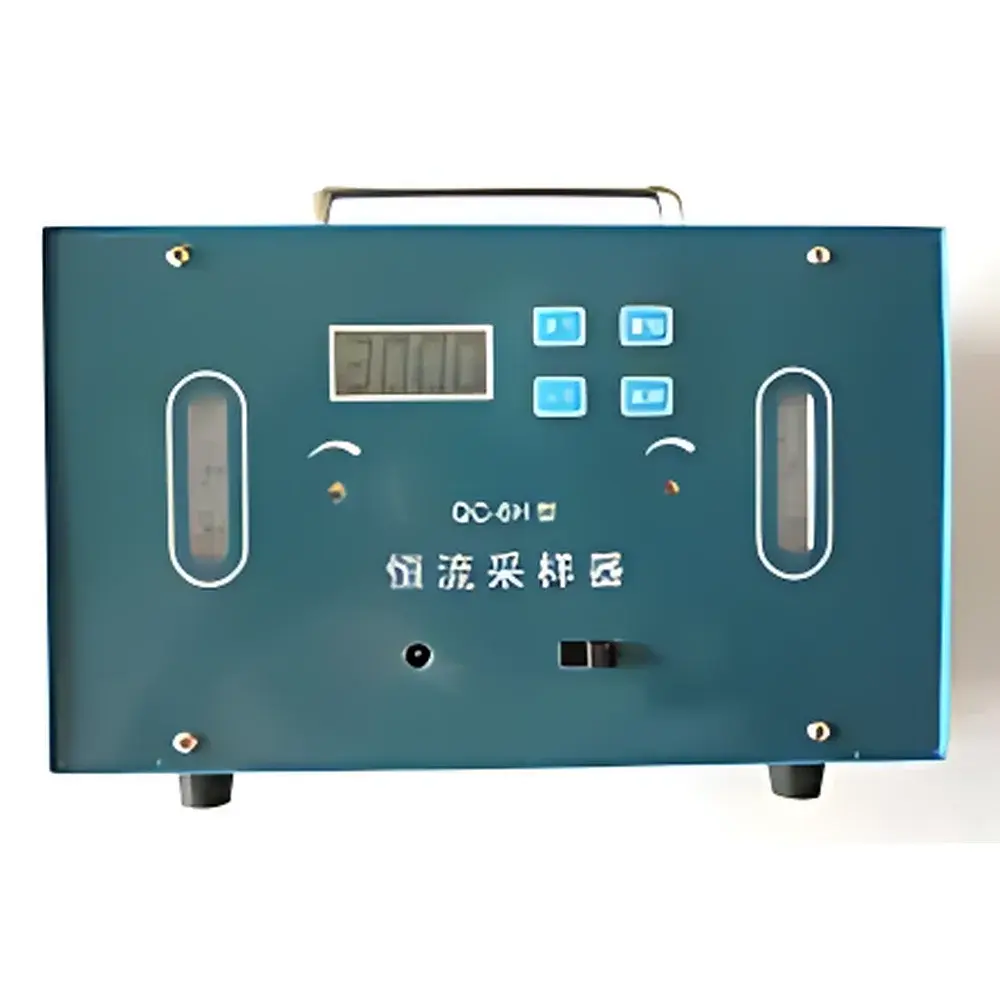
QC-6H Dual-Channel Constant-Flow Air Sampler
| Origin | Jiangsu, China |
|---|---|
| Manufacturer Type | Authorized Distributor |
| Origin Category | Domestic (PRC) |
| Model | QC-6H |
| Pricing | Available Upon Request |
| Flow Range | 0.4–0.6 L/min |
| Max. Negative Pressure | 20 kPa |
| Flow Stability | ≤5% |
| Flow Accuracy | ±5% (within −6 kPa) |
| Timer Range | 1–99 min (±0.1% error) |
| Power Supply | AC 220 V / 50 Hz or DC 7.4 V Li-ion battery |
| Continuous Operation | ≥6 h |
| Operating Temperature | −10 to +45 °C |
| Dimensions | 210 × 125 × 80 mm |
| Weight (incl. battery) | 1470 g |
Overview
The QC-6H Dual-Channel Constant-Flow Air Sampler is an engineered solution for compliant, field-deployable air sampling in indoor environmental quality (IEQ) and occupational hygiene applications. Designed in accordance with the technical requirements of GB 50325–2010 “Code for Indoor Environmental Pollution Control of Civil Building Engineering”, this instrument implements a closed-loop motor-speed-controlled constant-flow architecture—ensuring volumetric flow remains stable under variable backpressure conditions typical of sorbent tube, filter, and passive badge sampling configurations. Unlike pressure-compensated samplers relying on analog feedback, the QC-6H employs real-time rotational speed modulation of its dual brushless DC micro-pumps to maintain setpoint flow across a dynamic impedance range up to 20 kPa negative pressure. This principle enables trace-level analyte collection integrity—critical when sampling volatile organic compounds (VOCs), formaldehyde, benzene, or total volatile organic compounds (TVOC) at low flow rates where mass transfer efficiency and breakthrough risk are highly flow-dependent.
Key Features
- Dual independent sampling channels, each equipped with dedicated flow control circuitry and real-time digital display—enabling simultaneous parallel sampling for method validation or multi-analyte workflows.
- True constant-flow operation: Displayed flow value equals actual volumetric flow (L/min) at the inlet, verified across the full operating range (0.4–0.6 L/min) and under load up to 10 kPa (≥0.6 L/min maintained).
- Brushless DC motor-driven pump system with adaptive speed regulation—minimizing power consumption while delivering high torque and long-term repeatability (flow stability ≤5% over time).
- Integrated high-capacity 7.4 V lithium-ion battery pack (≥6 h continuous runtime at 0.5 L/min, −10 to +45 °C ambient), optimized for low self-discharge and thermal resilience during extended field deployment.
- Precision electromechanical timer (1–99 min, ±0.1% timing accuracy) with auto-shutdown and memory retention—supporting standardized sampling durations per GB 50325–2010 Annex B protocols.
- Compact, ergonomic housing (210 × 125 × 80 mm; 1470 g inclusive) designed for handheld portability and mounting on tripods or belt clips without compromising structural rigidity or vibration isolation.
Sample Compatibility & Compliance
The QC-6H is validated for use with standard 37-mm and 47-mm membrane filters (e.g., PTFE, PVC, mixed cellulose ester), glass fiber filters, activated carbon tubes (e.g., SKC 226-01, Anasorb® CSC), silica gel tubes, and diffusion-based passive samplers requiring precise low-flow delivery. Its flow accuracy (±5% within −6 kPa) meets the performance criteria specified in ISO 16000-22:2021 (Indoor air — Part 22: Determination of VOCs using sorbent tube/thermal desorption/GC-MS) and aligns with QA/QC expectations for NIOSH Method 0010, 1501, and EPA TO-17 sampling procedures. While not intrinsically rated for hazardous locations, it is routinely deployed in non-classified indoor environments—including residential, commercial, school, and office buildings—as part of GB 50325–2010-compliant IEQ audits.
Software & Data Management
The QC-6H operates as a standalone hardware platform with no embedded firmware-based data logging or Bluetooth/Wi-Fi connectivity. All operational parameters—including start time, duration, setpoint flow, and channel activation status—are manually recorded by the user per GLP documentation standards. For laboratories implementing electronic record systems, manual entries may be transcribed into LIMS-compatible spreadsheets or audit-trail-enabled platforms (e.g., LabWare, STARLIMS) supporting 21 CFR Part 11 compliance via secondary validation of operator logbooks. Optional external USB-powered data loggers (e.g., Onset HOBO UX100-003) can be interfaced via analog voltage output (0–5 V proportional to flow) for retrospective flow verification—though such integration requires third-party calibration and SOP documentation.
Applications
- Indoor air quality assessment per GB 50325–2010, including formaldehyde, benzene, toluene, xylene, and TVOC sampling in newly renovated residential and public buildings.
- Occupational exposure monitoring in light industrial settings where solvent vapors or particulate matter concentrations fall within TLV or MAC limits.
- Baseline ambient air characterization in urban micro-environments, educational facilities, and healthcare waiting areas.
- Method development and inter-laboratory comparison studies requiring synchronized dual-channel sampling under identical pressure-drop conditions.
- Calibration verification of personal sampling pumps using primary flow standards (e.g., dry calibrators traceable to NIM or NIST).
FAQ
Is the QC-6H certified for use in explosion-proof environments?
No. The QC-6H is not ATEX, IECEx, or NEC Class I/II/III rated. It is intended solely for use in non-hazardous, general-purpose indoor and outdoor environments.
Can the flow rate be adjusted outside the 0.4–0.6 L/min range?
No. The instrument is factory-calibrated and mechanically constrained to operate only within the 0.4–0.6 L/min range, as required by GB 50325–2010 for sorbent tube–based VOC analysis.
Does the device support data export or remote monitoring?
No. It features no onboard memory, wireless interface, or digital communication ports. All operational data must be documented manually.
What maintenance is required to ensure long-term flow accuracy?
Annual recalibration against a NIST-traceable primary standard (e.g., bubble meter or electronic calibrator) is recommended. Filter replacement before each sampling campaign and periodic inspection of inlet tubing and pump seals are essential for maintaining specified performance.
Is the battery pack replaceable by the end user?
Yes. The sealed 7.4 V lithium-ion battery module is user-replaceable using standard Torx T8 tools; replacement units are available through authorized distributors with CE-marked safety certification.
Related Products







