
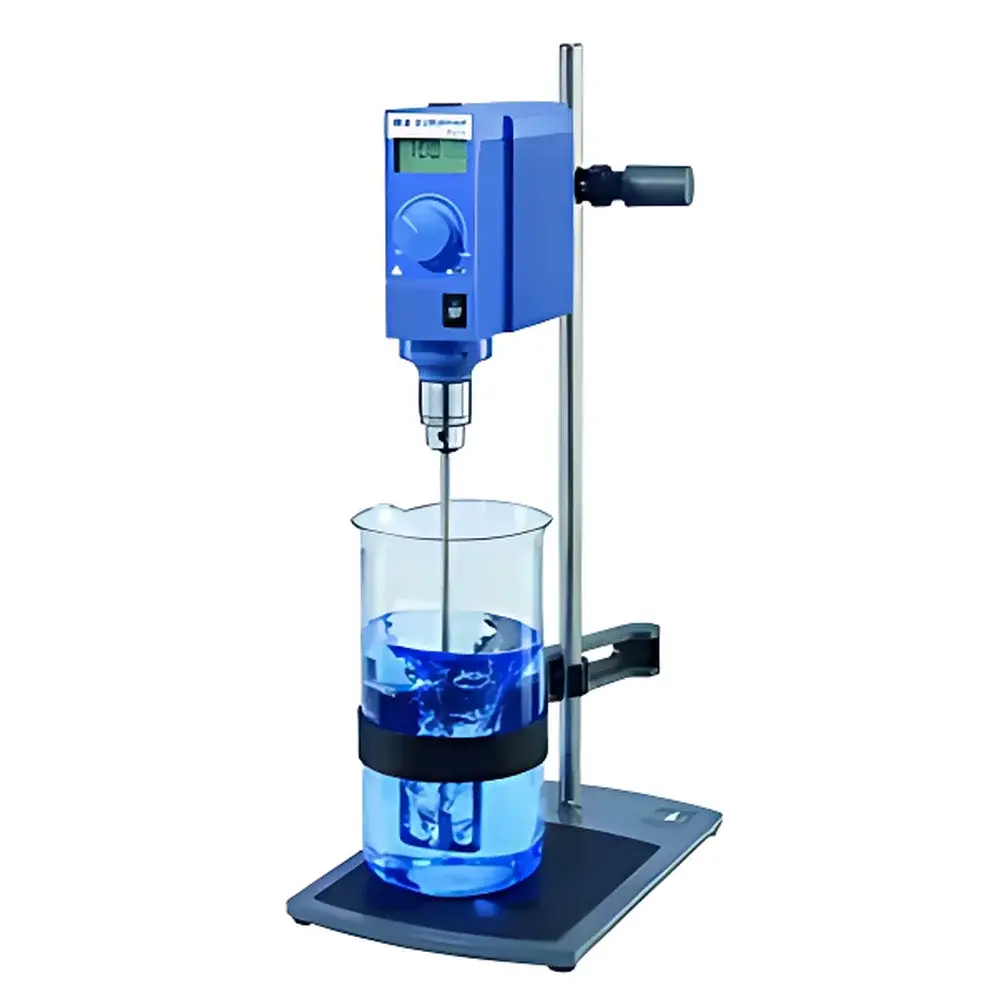
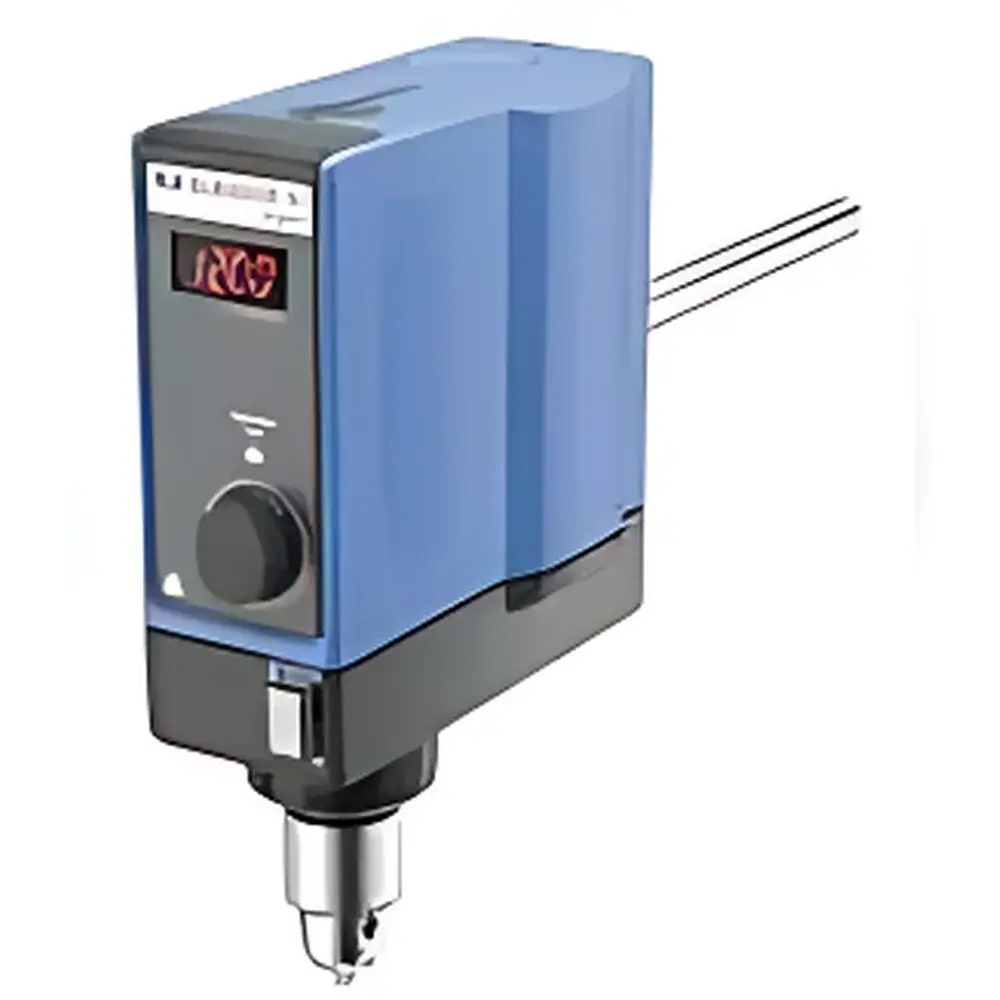
IKA Eurostar 20 Digital Display Mechanical Stirrer
| Brand | IKA |
|---|---|
| Origin | Germany |
| Model | Eurostar 20 |
| Max. Stirring Volume | 15 L |
| Speed Range | 0/30–2000 rpm |
| Motor Type | Brushless DC Motor |
| Output Power | 42 W |
| Max. Torque | 20 N·cm |
| Speed Accuracy | ±1 rpm (n > 300 rpm), ±3 rpm (n < 300 rpm) |
| Speed Display | LED |
| Shaft Clamping Range | 0.5–10 mm |
| Hollow Shaft Diameter | 11 mm |
| IP Rating | IP42 |
| Dimensions (W×H×D) | 86 × 248 × 208 mm |
| Weight | 4.4 kg |
| Ambient Temp. | 5–40 °C |
| Relative Humidity | ≤80 % |
| Voltage | 230 / 115 / 100 V, 50/60 Hz |
Overview
The IKA Eurostar 20 Digital Display Mechanical Stirrer is a precision-engineered laboratory stirrer designed for reliable, repeatable mixing of low- to medium-viscosity liquids—primarily aqueous solutions, buffers, suspensions, and dilute polymer systems. Built upon a brushless DC motor architecture, it eliminates carbon brush wear, ensuring long-term speed stability and reduced maintenance requirements over conventional brushed motor designs. Its microprocessor-controlled drive system maintains constant rotational speed across load variations—a critical requirement for reproducible homogenization, dissolution testing, and reagent preparation in regulated environments. Unlike gear-driven stirrers, the Eurostar 20 employs fully electronic, stepless speed control, enabling fine-grained adjustment from 30 rpm up to 2000 rpm with real-time LED feedback of both setpoint and actual speed. The unit is rated for continuous 100% duty cycle operation under nominal load conditions, making it suitable for unattended overnight protocols in QC labs and academic research settings.
Key Features
- Brushless DC motor delivering 42 W output power and 20 N·cm maximum torque—optimized for consistent performance across viscosity gradients up to 10,000 mPa·s
- Stepless electronic speed control with ±1 rpm accuracy above 300 rpm and ±3 rpm below—enabling precise method replication per SOPs
- Integrated safety circuitry including thermal overload protection, short-term overtorque tolerance, and automatic fault detection with alphanumeric error code display
- Hollow shaft design (11 mm internal diameter) permitting insertion of temperature probes or pH electrodes during active stirring—supporting real-time process monitoring
- Low-noise mechanical architecture and vibration-damped aluminum housing (coated cast aluminum + thermoplastic polymer) for stable benchtop operation
- Smooth ramp-up start function minimizing splashing and improving operator safety during vessel loading
- IP42-rated enclosure providing protection against solid objects >1 mm and vertically falling water droplets—suitable for standard laboratory ambient conditions (5–40 °C, ≤80 % RH)
Sample Compatibility & Compliance
The Eurostar 20 is validated for use with glass, stainless steel, and PTFE-coated vessels ranging from 50 mL beakers to 15 L jacketed reactors. Its clamping system accommodates stirring rods from 0.5 mm to 10 mm diameter—including standard Teflon-coated, propeller, and anchor geometries. While not intrinsically rated for explosive atmospheres or autoclave sterilization, its construction complies with EN 61010-1 (Safety Requirements for Electrical Equipment for Measurement, Control, and Laboratory Use) and conforms to EMC Directive 2014/30/EU. For GxP-regulated workflows, the device supports audit-ready documentation when paired with IKA’s Labworldsoft® software (optional), which logs timestamped speed events, error codes, and runtime duration—facilitating alignment with FDA 21 CFR Part 11 data integrity expectations where electronic records are employed.
Software & Data Management
Though standalone operation requires no software, the Eurostar 20 is compatible with IKA’s Labworldsoft® PC-based control and documentation platform via RS232 interface. This enables remote parameter setting, real-time speed trending, event-triggered data capture (e.g., on overload or stall), and export of CSV-formatted logs for traceability. All speed changes, fault entries, and operational durations are time-stamped and stored locally within the device’s non-volatile memory—even during power interruption—ensuring continuity in GLP/GMP-aligned validation protocols. Firmware updates are performed via standard serial connection, maintaining backward compatibility with existing lab infrastructure.
Applications
- Preparation of culture media, buffer solutions, and calibration standards in microbiology and molecular biology labs
- Dissolution testing of pharmaceutical tablets and capsules per USP , requiring strict speed repeatability and minimal mechanical drift
- Homogenization of colloidal suspensions, nanoparticle dispersions, and emulsions in materials science R&D
- pH-adjusted titration setups where simultaneous stirring and probe immersion is required (leveraging hollow shaft capability)
- Long-duration stability studies involving thermal baths or cold rooms—supported by continuous-duty rating and wide voltage/frequency compatibility (100–230 V, 50/60 Hz)
FAQ
Does the Eurostar 20 support external temperature feedback for integrated speed modulation?
No—it lacks built-in temperature sensing or closed-loop thermal control; speed must be manually set or externally coordinated via Labworldsoft®.
Can the stirrer be mounted on third-party stands or custom fixtures?
Yes—the 16 mm diameter extension arm is standardized and compatible with common lab clamp systems (e.g., Fischer Scientific, VWR, and generic ISO 8079-compliant mounts).
Is the hollow shaft compatible with all standard probe diameters?
It accepts probes up to 10 mm OD; however, optimal sealing and minimal wobble require probes with smooth, cylindrical profiles and tight-tolerance fits.
What maintenance is required for long-term reliability?
No scheduled lubrication or brush replacement is needed; periodic inspection of shaft coupling integrity and cleaning of ventilation slots is recommended per IKA Maintenance Guide Rev. 4.2.
How does the Eurostar 20 compare to the Eurostar 40 in terms of torque and thermal management?
The Eurostar 40 delivers 40 N·cm max torque and higher thermal dissipation capacity, supporting heavier loads and extended high-speed operation—while the Eurostar 20 prioritizes compactness, quietness, and cost-efficiency for routine low-to-mid viscosity tasks.



