
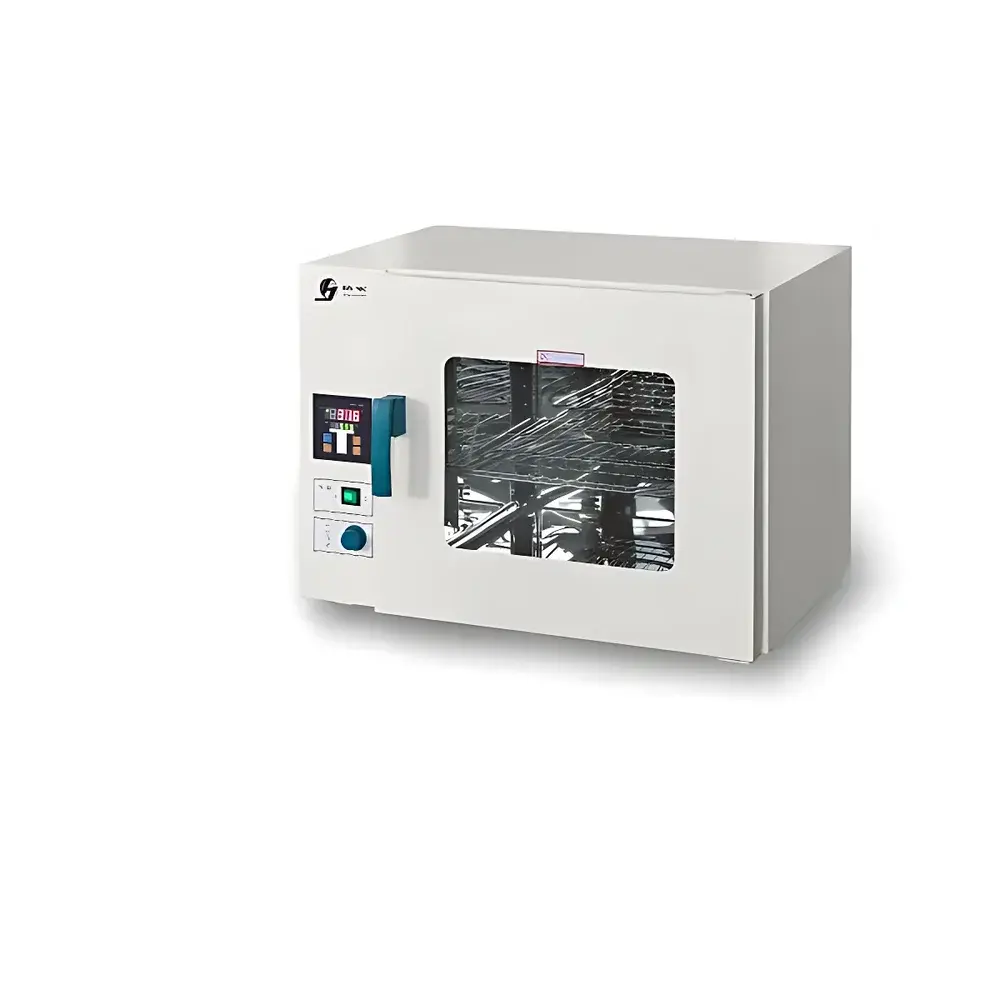
JingHong DHG-9203A & DHG-9203Y Forced-Air Laboratory Drying Oven
| Brand | JingHong |
|---|---|
| Origin | Shanghai, China |
| Model | DHG-9203A, DHG-9203Y |
| Temperature Range | Ambient +10 °C to 200 °C |
| Temperature Uniformity | ±1 °C |
| Temperature Resolution | 0.1 °C |
| Chamber Dimensions (W×D×H) | 600 × 550 × 645 mm |
| External Dimensions (W×D×H) | 892 × 785 × 835 mm |
| Working Environment | 5–40 °C |
| Interior Material | Stainless Steel |
| Heating Method | Forced-Air Circulation |
| Instrument Type | General-Purpose Drying Oven |
Overview
The JingHong DHG-9203A and DHG-9203Y are precision-engineered forced-air laboratory drying ovens designed for consistent thermal processing in industrial, academic, and quality control environments. These models operate on the principle of convective heat transfer, utilizing a low-noise centrifugal blower and optimized airflow ductwork to ensure uniform temperature distribution across the entire working chamber. Unlike natural convection ovens, the forced-air architecture minimizes thermal stratification—critical for applications requiring reproducible drying kinetics, moisture removal, or thermal stabilization of samples. The ovens comply with fundamental thermal stability requirements outlined in ISO 17025-accredited laboratory practices and support routine compliance workflows aligned with ASTM E145 (Standard Specification for Gravity-Convection and Forced-Ventilation Ovens) and USP (Thermal Analysis – Drying and Moisture Content Determination).
Key Features
- Stainless steel interior chamber (grade 304) resistant to corrosion, oxidation, and repeated thermal cycling—ensuring long-term dimensional stability and ease of decontamination.
- Microprocessor-based PID temperature controller with dual digital display: one for setpoint, one for real-time chamber temperature; includes auto-tuning, power limiting, and programmable timer (up to 999 minutes).
- Forced-air circulation system featuring an adjustable-speed fan and symmetrical air inlet/outlet configuration, validated to maintain ≤±1 °C temperature deviation across the full load volume at 100 °C.
- Robust insulation using high-density mineral fiber (≥100 mm thickness) minimizing external surface temperature rise and improving energy efficiency during extended operation.
- Front-access double-layer tempered glass door with magnetic seal and integrated safety lock—enabling visual monitoring without compromising thermal integrity.
- Over-temperature protection circuit with independent mechanical thermostat (cut-off at 220 °C) and audible alarm for fail-safe operation.
Sample Compatibility & Compliance
The DHG-9203A/Y accommodates standard laboratory sample formats including petri dishes, weighing boats, crucibles, glassware, polymer films, and metal coupons up to 600 mm wide. Its chamber volume (214.5 L) supports batch processing under GLP/GMP-aligned conditions when paired with documented calibration procedures. The oven is suitable for applications referenced in ISO 5725 (accuracy of measurement methods), ASTM D2244 (color measurement after thermal exposure), and ICH Q5C (stability testing of biopharmaceuticals). While not intrinsically certified for hazardous location use (e.g., ATEX/IECEx), it meets CE marking requirements for electromagnetic compatibility (EMC Directive 2014/30/EU) and low-voltage safety (LVD Directive 2014/35/EU) when installed per manufacturer-specified ventilation clearances.
Software & Data Management
These models operate as standalone instruments with no embedded data logging or network connectivity. However, they are compatible with external USB or RS-485 data acquisition systems via analog output (0–5 V or 4–20 mA) for continuous temperature recording. When integrated into regulated environments, users may implement 21 CFR Part 11-compliant electronic records by pairing the oven with validated third-party chart recorders or SCADA platforms that provide audit trails, user access controls, and electronic signatures. Routine calibration verification should follow internal SOPs referencing NIST-traceable reference thermometers and documented temperature mapping protocols (minimum 9-point grid per ICH Q7 Annex 19).
Applications
- Drying of moisture-sensitive powders, granules, and filter papers in pharmaceutical QC laboratories.
- Baking of coated substrates and curing of epoxy resins in materials science research.
- Pre-conditioning of test specimens prior to tensile, adhesion, or thermal expansion analysis (per ASTM D618).
- Sterilization of non-critical lab tools and glassware at ≥160 °C for 2 hours (validated per ISO 17665-1).
- Melting point determination support through controlled wax or polymer sample conditioning.
- Residual solvent removal from chromatography vials and HPLC sample preparation trays.
FAQ
What is the maximum recommended operating temperature for continuous use?
The DHG-9203A/Y is rated for continuous operation up to 200 °C. Sustained use above this threshold may accelerate insulation degradation and compromise temperature uniformity.
Does the oven include validation documentation or factory calibration certificates?
No pre-installed calibration certificate is supplied. Users must perform initial IQ/OQ validation per their site’s qualification protocol, using accredited thermocouples and documented mapping procedures.
Can the DHG-9203A/Y be used for sterilization of medical devices?
It is not classified as a medical device sterilizer per ISO 13485 or EN 554. For terminal sterilization, dedicated steam autoclaves or dry-heat sterilizers meeting ISO 17665 are required.
Is the stainless steel chamber electropolished or passivated?
The interior uses standard mill-finish 304 stainless steel. Electropolishing or citric acid passivation can be performed post-purchase if required for ultra-high-purity applications.
What maintenance intervals are recommended for the blower motor and control electronics?
Inspect fan blades and bearings every 6 months; clean air intake filters quarterly. Verify PID controller accuracy annually using traceable reference standards.



