
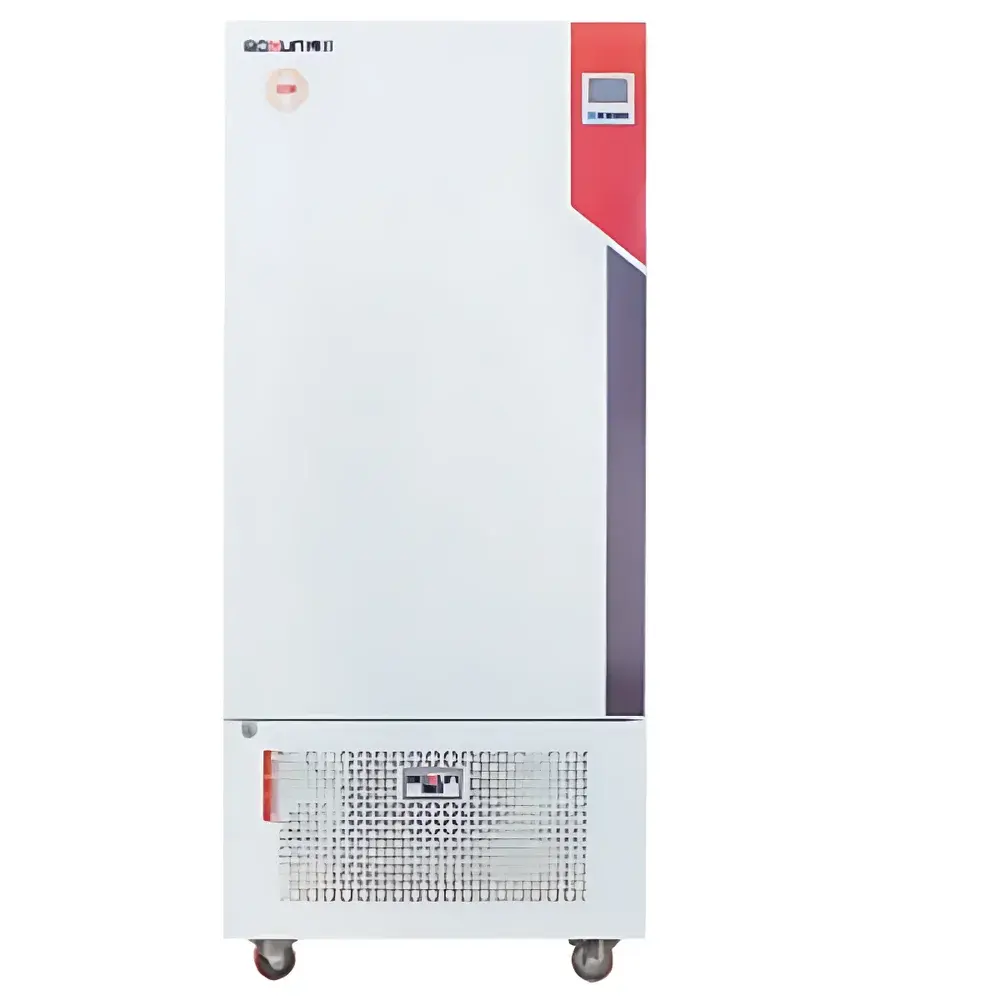
BOXUN BMJ-160C Mold Incubator with Temperature & Humidity Control
| Brand | BOXUN |
|---|---|
| Origin | Shanghai, China |
| Control Method | Digital Touchscreen Interface |
| Air Circulation | Forced Convection (Centrifugal Blower) |
| Temperature Range | 4–60 °C (non-humidified mode) |
| Temperature Fluctuation | ±0.5 °C at 25 °C |
| Temperature Uniformity | ±1 °C at 25 °C |
| Humidity Range | 50–90 %RH |
| Humidity Fluctuation | ±5 %RH |
| Capacity | 150 L |
| External Dimensions (W×D×H) | 650×680×1400 mm |
| Internal Dimensions (W×D×H) | 510×390×760 mm |
| Power Input | 1300 W |
| Timer Range | 0–9999 min |
| Shelf Capacity | 3 adjustable stainless-steel shelves |
| Refrigerant | Eco-friendly non-CFC refrigerant |
| Compliance | Designed to support GLP-compliant environmental simulation workflows |
| Interface | RS-485 port for external data logging and system integration |
| Programmability | Up to 30 segments × 99 cycles |
| Safety Features | Over-temperature alarm, auto-recovery after power interruption, mechanical door lock, frost-free refrigeration system with intelligent defrost algorithm |
Overview
The BOXUN BMJ-160C Mold Incubator is a precision-engineered environmental chamber specifically designed for controlled fungal cultivation, microbial preservation, and BOD-related biological assays in regulated laboratory environments. It operates on a dual-control principle—simultaneous regulation of temperature and relative humidity—enabling reproducible growth conditions for Aspergillus, Penicillium, Cladosporium, and other hyphal-forming microorganisms requiring stable moisture profiles. The unit employs a forced-convection architecture driven by a high-efficiency centrifugal blower, integrated with an optimized air duct network to ensure rapid thermal equilibration and minimal spatial gradient across the entire 150 L working volume. Its refrigeration system utilizes an internationally certified non-CFC compressor and a passive, energy-efficient defrost mechanism that eliminates thermal disturbance during extended incubation cycles—critical for uninterrupted mycological studies lasting 7–28 days.
Key Features
- Robust construction: Cold-rolled steel exterior with electrostatic epoxy coating; mirror-finish 304 stainless-steel interior chamber resistant to corrosion and routine disinfection protocols.
- Intelligent climate control: PMMA II operating system with backlit LCD interface displaying real-time temperature, humidity, elapsed time, and status alerts—including over-temperature cutoff and sensor fault detection.
- Enhanced uniformity: Precision-engineered airflow path ensures ≤±1 °C temperature uniformity and ≤±5 %RH humidity stability at setpoints within the operational range (10–40 °C / 50–90 %RH).
- Secure access & monitoring: Integrated mechanical door lock prevents unauthorized entry; dual-layer tempered glass observation window with inner seal minimizes condensation and maintains internal integrity.
- Modular utility interfaces: Two 30/60 mm (ID/OD) pass-through ports on lateral walls accommodate probes, tubing, or gas lines without compromising chamber integrity.
- Power resilience: Parameter memory retention and automatic recovery function preserve user-defined programs and setpoints following grid failure or system reset.
- Regulatory-ready infrastructure: RS-485 serial interface enables connection to centralized lab management systems for audit-trail generation and remote parameter logging—supporting alignment with ISO/IEC 17025 and FDA 21 CFR Part 11 documentation requirements when paired with validated software.
Sample Compatibility & Compliance
The BMJ-160C accommodates standard microbiological vessels including Petri dishes (up to 150 mm diameter), slant tubes, broth culture flasks, and multi-well plates—arranged across three independently adjustable stainless-steel shelves. Its sealed chamber design supports anaerobic or low-oxygen cultivation when used with supplemental gas mixtures (e.g., N2/CO2). The unit meets structural and performance benchmarks referenced in ASTM D3273 (Standard Test Method for Resistance to Growth of Mold on the Surface of Interior Coatings in an Environmental Chamber) and ISO 846 (Plastics — Evaluation of the Effect of Microorganisms). While not certified as Class II biosafety equipment, its containment capability satisfies general-purpose fungal isolation and enumeration protocols required by APHA, CLSI M38-A3, and Chinese Pharmacopoeia Chapter 1107 (Microbiological Examination of Nonsterile Products).
Software & Data Management
The BMJ-160C does not include embedded PC-based software but provides deterministic serial communication via RS-485 (Modbus RTU protocol) for integration into third-party laboratory information management systems (LIMS) or SCADA platforms. Users may configure up to 30 programmable segments per cycle (99 cycles total), enabling complex ramp-hold sequences—for example: 24 h at 25 °C/75 %RH → 48 h at 30 °C/85 %RH → cooldown phase. All parameter changes are timestamped and retained in non-volatile memory. When connected to compliant data acquisition hardware, the system supports electronic record generation meeting ALCOA+ principles (Attributable, Legible, Contemporaneous, Original, Accurate, Complete, Consistent, Enduring, Available) under GxP-regulated workflows.
Applications
- Environmental microbiology: Enumeration of airborne and waterborne molds per EPA/ISO 16000-17 and HACCP-aligned surface sampling protocols.
- Pharmaceutical quality control: Stability testing of excipients and finished dosage forms under accelerated humidity stress conditions (ICH Q1A–Q1E).
- Agricultural research: Spore germination kinetics, antifungal agent screening, and host-pathogen interaction studies under defined hygrothermal regimes.
- Clinical mycology: Isolation and morphological differentiation of dermatophytes and opportunistic fungi from clinical specimens.
- Educational laboratories: Hands-on training in aseptic technique, colony isolation, and environmental influence on fungal dimorphism.
FAQ
What is the minimum operating temperature when humidity control is active?
The humidified temperature range is constrained to 10–40 °C to prevent condensation-induced instability in the saturated vapor environment.
Can the incubator maintain humidity without active cooling?
Yes—the heating and humidification subsystems operate independently of the refrigeration circuit, allowing stable RH maintenance at ambient or elevated temperatures up to 40 °C.
Is calibration traceability provided with the unit?
Factory calibration certificates (NIST-traceable reference sensors) are available upon request; users are advised to perform periodic verification using accredited dry-well calibrators and chilled-mirror hygrometers.
How often does the water reservoir require refilling during continuous operation?
With the standard 5 L external tank and typical 75 %RH setpoint usage, refill intervals average 48–72 hours depending on ambient lab temperature and door-opening frequency.
Does the BMJ-160C comply with electromagnetic compatibility (EMC) directives for EU deployment?
The unit conforms to IEC 61326-1:2013 for laboratory equipment emissions and immunity; CE marking requires end-user verification against local installation conditions and supplementary shielding if deployed near sensitive analytical instrumentation.





