
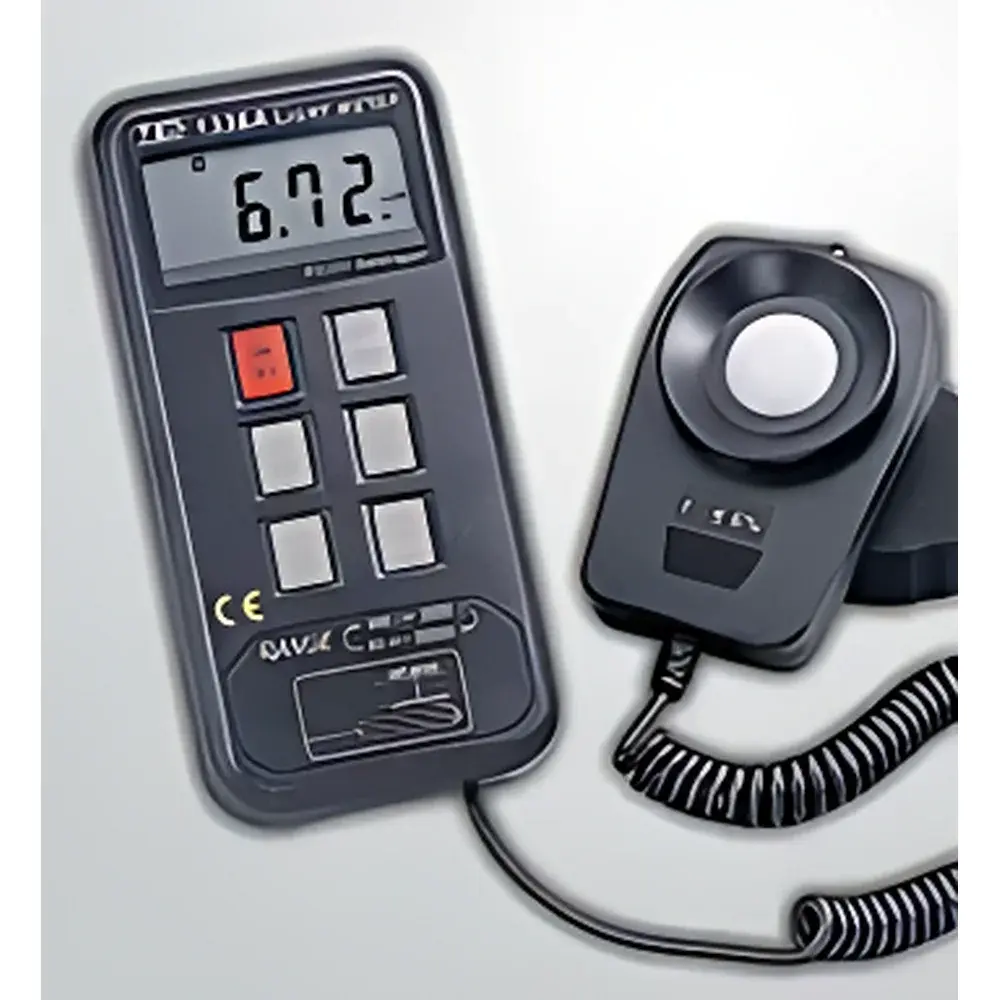
TES-1336A Memory-Function Illuminance Meter
| Origin | Jiangsu, China |
|---|---|
| Manufacturer Type | Authorized Distributor |
| Origin Category | Domestic (PRC) |
| Model | TES-1336A |
| Pricing | Available Upon Request |
| Measurement Range | 0–20,000 lux / ft-candles (1 fc = 10.76 lux) |
| Display | 3½-digit LCD |
| Ranges | 20 / 200 / 2,000 / 20,000 lux/fc |
| Overload Indication | “OL” |
| Resolution | 0.01 lux (0.01 fc) |
| Accuracy | ±(3% rdg + 5 digits) |
| Repeatability | ±2% |
| Temperature Coefficient | ±0.1%/°C |
| Sampling Rate | 2.5 readings/sec |
| Sensor | Silicon photodiode |
| Data Storage Capacity | Up to 255 memory groups, 16,000 total records |
| RS-232 Interface | 9600 bps, includes 9-pin to 25-pin adapter |
| Operating Conditions | 0–40°C (32–104°F), 10–80% RH |
| Storage Conditions | −10–60°C (14–140°F), 10–70% RH |
| Power Supply | One 9V alkaline battery (IEC 6F22 / NEDA 1604 / 006P) |
| Battery Life | Approx. 50 hours continuous use |
| Detector Cable Length | 150 cm |
| Detector Dimensions | 87.5 × 60 × 29 mm (L×W×H) |
| Meter Body Dimensions | 146 × 70 × 39 mm (L×W×H) |
| Weight | 300 g |
| Standard Accessories | Instruction manual, protective holster, 9V battery, RS-232 cable, 9-pin-to-25-pin adapter, calibration rod, software disk |
Overview
The TES-1336A Memory-Function Illuminance Meter is a precision handheld optical measurement instrument engineered for reliable, repeatable quantification of visible light intensity in photometric units—lux (lx) and foot-candles (fc). Based on the fundamental principle of photopic spectral response (CIE 1931 standard luminosity function), the device employs a calibrated silicon photodiode sensor with cosine-corrected diffuser to ensure angular response compliance with ISO/CIE illumination measurement standards. Its dual-unit capability (0–20,000 lx / 0–1863 fc) and 0.01 lx resolution support applications ranging from workplace lighting audits and architectural daylighting validation to laboratory photobiology setup verification and industrial quality control of display backlight uniformity. Designed for field and benchtop deployment, the meter operates without external power sources and integrates non-volatile memory architecture to retain measurements independently of real-time connectivity.
Key Features
- High-resolution 3½-digit LCD display with automatic range selection and overload indication (“OL”) for immediate diagnostic feedback
- Four manually selectable measurement ranges (20 / 200 / 2,000 / 20,000 lux/fc) optimized for dynamic lighting environments
- Integrated data logging system storing up to 255 grouped sessions and 16,000 individual readings—ideal for time-series illumination mapping and shift-based environmental monitoring
- RS-232 serial interface (9600 bps) with included 9-pin to 25-pin adapter and dedicated software disk for structured data export, timestamped record management, and CSV-compatible reporting
- Cosine-corrected photodiode detector with 150 cm flexible cable enables remote placement while maintaining angular response fidelity per CIE S 007/E:2020
- Robust mechanical design: compact housing (146 × 70 × 39 mm), 300 g mass, and IP54-rated enclosure suitable for industrial and facility management use cases
- Thermal stability compensation (±0.1%/°C) ensures measurement consistency across ambient temperature fluctuations typical in uncontrolled indoor settings
Sample Compatibility & Compliance
The TES-1336A is compatible with steady-state and slowly varying broadband visible light sources (380–780 nm), including LED, fluorescent, incandescent, and metal halide lamps. It is not intended for pulsed, UV, or IR radiation measurement. The instrument conforms to photometric measurement practices defined in ISO 8995-1:2002 (Lighting of work places), IESNA RP-1-20, and EN 12464-1:2021. While not certified to ANSI/NEMA C78.377A or IEC 62471 for photobiological safety assessment, its spectral response aligns with CIE standard observer functions for illuminance. No GLP/GMP or FDA 21 CFR Part 11 validation is provided; however, audit-ready data logs—including timestamps, operator IDs (via software input), and calibration metadata—support internal QA documentation workflows.
Software & Data Management
The bundled Windows-compatible application enables bidirectional communication via RS-232, supporting batch download, filtering by group ID or timestamp, and export to comma-separated values (CSV) for integration into LIMS or Excel-based analysis pipelines. Each logged record includes raw digitized value, selected range, unit (lux/fc), and acquisition time (derived from host PC clock upon transfer). Software features include configurable auto-download triggers, pass/fail threshold alerts based on user-defined limits, and printable calibration certificate templates. Data integrity is preserved through sequential record numbering and write-once memory allocation—preventing accidental overwrites during active logging.
Applications
- Occupational health & safety: Verification of OSHA-recommended illuminance levels (e.g., ≥500 lx for detailed assembly tasks)
- Building commissioning: Validation of daylight harvesting systems and artificial lighting controls per ASHRAE 90.1 and LEED EQ Credit 8.1
- Educational laboratories: Teaching photometry fundamentals, inverse-square law verification, and spectral weighting concepts
- Museum & archival facilities: Monitoring light exposure of sensitive artifacts against ISO 11799:2015 preservation thresholds
- Manufacturing QA: Consistency checks for inspection booth lighting, PCB soldering station illumination, and cleanroom task lighting
- Energy auditing: Quantifying lighting retrofit savings by comparing pre- and post-installation lux profiles across floor plans
FAQ
What is the spectral response range of the TES-1336A sensor?
The silicon photodiode incorporates a CIE-standard photopic filter, providing effective responsivity between 380 nm and 780 nm, closely matching the V(λ) luminous efficiency function.
Does the device support automatic data synchronization with cloud platforms?
No—the TES-1336A lacks Wi-Fi, Bluetooth, or Ethernet interfaces. Data transfer is exclusively via RS-232 to a local Windows PC using supplied software.
Is calibration traceable to national standards?
The instrument is factory-calibrated against NIST-traceable reference standards; a calibration certificate is available upon request (additional fee applies). Annual recalibration is recommended per ISO/IEC 17025 guidelines.
Can the memory be cleared selectively (e.g., delete one group but retain others)?
No—memory management is global: formatting erases all 255 groups and 16,000 records. Selective deletion is only possible post-export via the PC software.
What is the maximum allowable humidity during operation?
Continuous operation is rated up to 80% relative humidity at 40°C; condensation must be avoided to prevent sensor drift or electrical shorting.



