
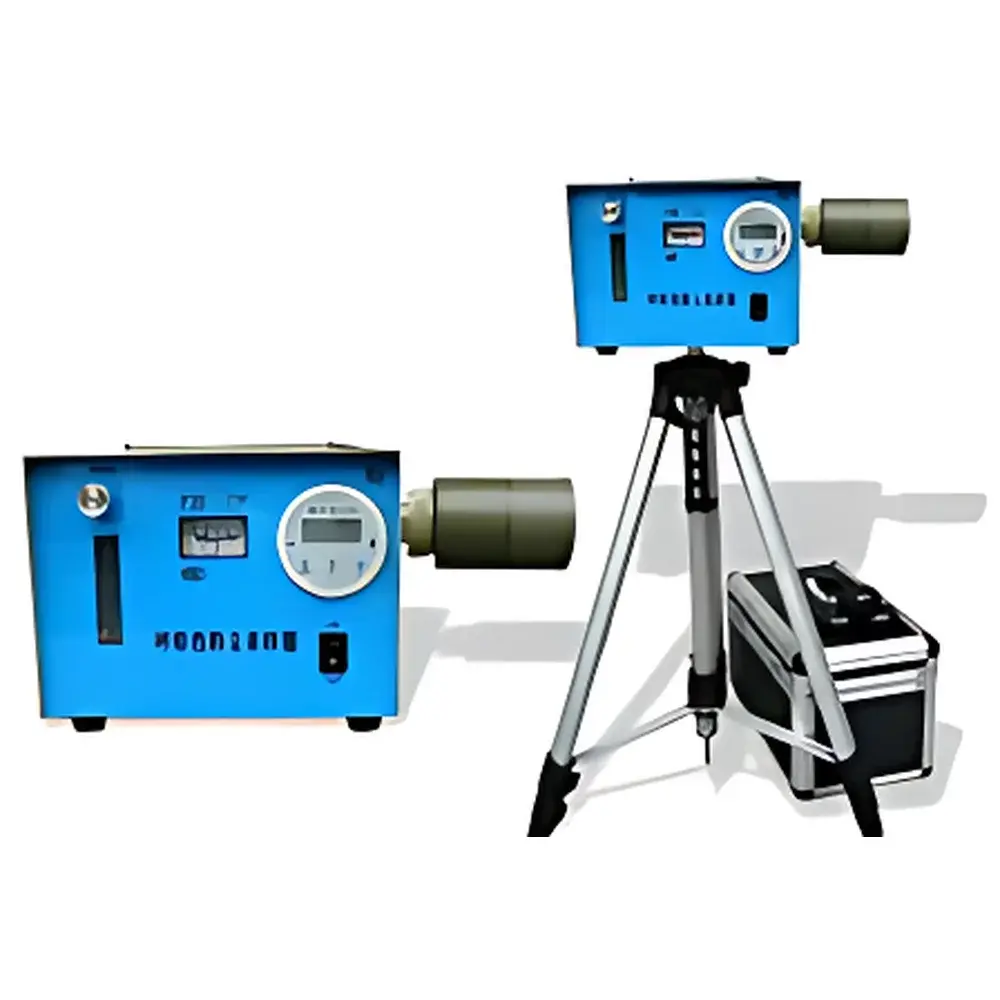
TH-30 Respirable Dust Sampler
| Origin | Jiangsu, China |
|---|---|
| Manufacturer Type | Authorized Distributor |
| Origin Category | Domestic (PRC) |
| Model | TH-30 |
| Pricing | Available Upon Request |
| Flow Range Options | 5–30 L/min, 3–30 L/min, 5–25 L/min, or 10–25 L/min |
| Sampling Duration | Up to 99 h 59 min |
| Vacuum Pressure | >3000 Pa |
| Operating Temperature | −20 °C to +40 °C |
| Relative Humidity | ≤85% RH |
| Dimensions | 180 × 130 × 125 mm |
| Weight | ~2.0 kg |
| Noise Level | <80 dB(A) |
| Continuous Runtime | >180 min (fully charged) |
Overview
The TH-30 Respirable Dust Sampler is a portable, microprocessor-regulated air sampling instrument engineered for precise collection of respirable and total airborne particulate matter in occupational and environmental monitoring applications. It operates on the principle of size-selective inertial separation—utilizing a calibrated cyclonic or impactor-based preseparator (supplied as standard with 25 mm glass impaction plates coated with silicone oil) to isolate particles ≤10 µm aerodynamic diameter (PM₁₀) and specifically those conforming to the British Medical Research Council (BMRC) respirable dust convention (50% cut-point at 4.0 µm, with ≥90% collection efficiency for particles <1.0 µm and 7.07 µm). At the designated flow rate of 20 L/min, the integrated respirable dust sampling head meets ISO 7708:1995 and EN 481:1993 criteria for respirable fraction definition. The device employs a robust vane-type vacuum pump delivering stable, low-pulsation aspiration under variable backpressure conditions, ensuring high reproducibility across extended field deployments.
Key Features
- Four selectable constant-flow ranges (3–30 L/min, 5–25 L/min, 10–25 L/min, or 5–30 L/min), digitally regulated via embedded microcontroller for ±3% flow accuracy over full operating temperature and battery voltage range
- High-resolution LCD display with intuitive menu navigation for time setting, real-time flow indication, and battery status monitoring
- Dual-power architecture supporting both AC mains (220 V, 50 Hz) and rechargeable Ni-MH battery pack (12 V nominal), enabling uninterrupted operation in remote or mobile settings
- Extended timing capability: programmable duration from 1 minute to 99 hours 59 minutes with automatic power cutoff upon completion
- Compact ergonomic design (180 × 130 × 125 mm; ~2.0 kg) optimized for personal (belt-mounted) or tripod-based stationary sampling per OSHA Method ID-125G and NIOSH Method 0600
- Acoustically damped pump assembly maintaining noise emission below 80 dB(A) — compliant with ISO 11202:2017 for workplace instrumentation
- Thermally stabilized flow control circuitry ensuring performance stability across −20 °C to +40 °C ambient conditions and ≤85% relative humidity
Sample Compatibility & Compliance
The TH-30 supports standardized gravimetric analysis of both respirable and total dust fractions using certified 25 mm or 40 mm mixed-cellulose ester (MCE), polyvinyl chloride (PVC), or polytetrafluoroethylene (PTFE) filter media. When equipped with the supplied 25 mm impactor head and silicone-oil-coated glass substrate, it achieves particle-size selectivity aligned with the BMRC curve at 20 L/min—verified per ISO/IEC 17025-accredited calibration protocols. The instrument satisfies core requirements of national occupational exposure standards including GBZ/T 192.2–2007 (China), EN 13205:2012 (European respirable dust sampling), and ASTM D7144-15 (Standard Practice for Determination of Respirable Dust Mass Concentration). Its mechanical construction and electrical safety comply with IEC 61010-1:2010 for laboratory and field-use measurement equipment.
Software & Data Management
While the TH-30 operates as a standalone hardware platform without embedded wireless connectivity or proprietary software, its digital timer and flow-control firmware support GLP-compliant documentation workflows. All sampling parameters—including set flow rate, start/stop timestamps, and battery voltage logs—are retained in non-volatile memory and visible on the LCD during operation. Users may manually record metadata (e.g., location, sampler ID, filter ID, operator name) alongside gravimetric results in accordance with ISO/IEC 17025 traceability requirements. For laboratories implementing electronic lab notebooks (ELN) or LIMS integration, the TH-30’s deterministic operational behavior enables reliable data mapping into structured analytical records. Optional external data loggers (e.g., USB-connected analog output modules) may be interfaced for continuous flow and runtime telemetry in long-term environmental monitoring campaigns.
Applications
- Occupational hygiene assessments in mining, construction, foundries, ceramics, and pharmaceutical manufacturing per OSHA 1910.1000 and EU Directive 2004/37/EC (CARC)
- Indoor air quality (IAQ) surveys in schools, offices, and healthcare facilities evaluating PM₂.₅ and respirable silica exposure
- Regulatory compliance testing for cement plants, coal handling facilities, and abrasive blasting operations under local ambient air quality standards
- Field validation of engineering controls (e.g., local exhaust ventilation efficiency) through paired upstream/downstream sampling
- Research-grade aerosol characterization in university laboratories and government environmental agencies requiring traceable, repeatable gravimetric endpoints
FAQ
What flow rate must be used to ensure BMRC-compliant respirable dust collection?
A constant flow of 20 L/min is mandatory when using the supplied 25 mm impactor head with silicone-oil-coated glass substrate to meet BMRC fractional collection specifications.
Can the TH-30 operate continuously for an 8-hour shift?
Yes—the fully charged Ni-MH battery supports >180 minutes of continuous operation; for full-shift sampling, users should deploy AC power or carry spare batteries calibrated per manufacturer’s charging protocol (14–16 hours standard charge time).
Is the instrument suitable for explosive atmospheres?
No—the TH-30 is not intrinsically safe or ATEX-certified; for hazardous area use, consult the manufacturer’s explosion-proof variants (e.g., TH-30EX series) designed to IEC 60079-0 and EN 60079-11 standards.
How is flow calibration performed?
Calibration requires traceable primary standards (e.g., dry calibrator or bubble meter) at reference conditions (25 °C, 101.3 kPa); users should perform pre- and post-sampling checks per ISO 11097:2016 and document deviations exceeding ±5% of setpoint.
Does the TH-30 include audit-trail functionality for regulatory submissions?
It maintains internal timestamped runtime logs but lacks FDA 21 CFR Part 11-compliant electronic signatures; manual logbooks with operator signatures and QA review signatures satisfy GLP/GMP documentation requirements for gravimetric dust analysis.







