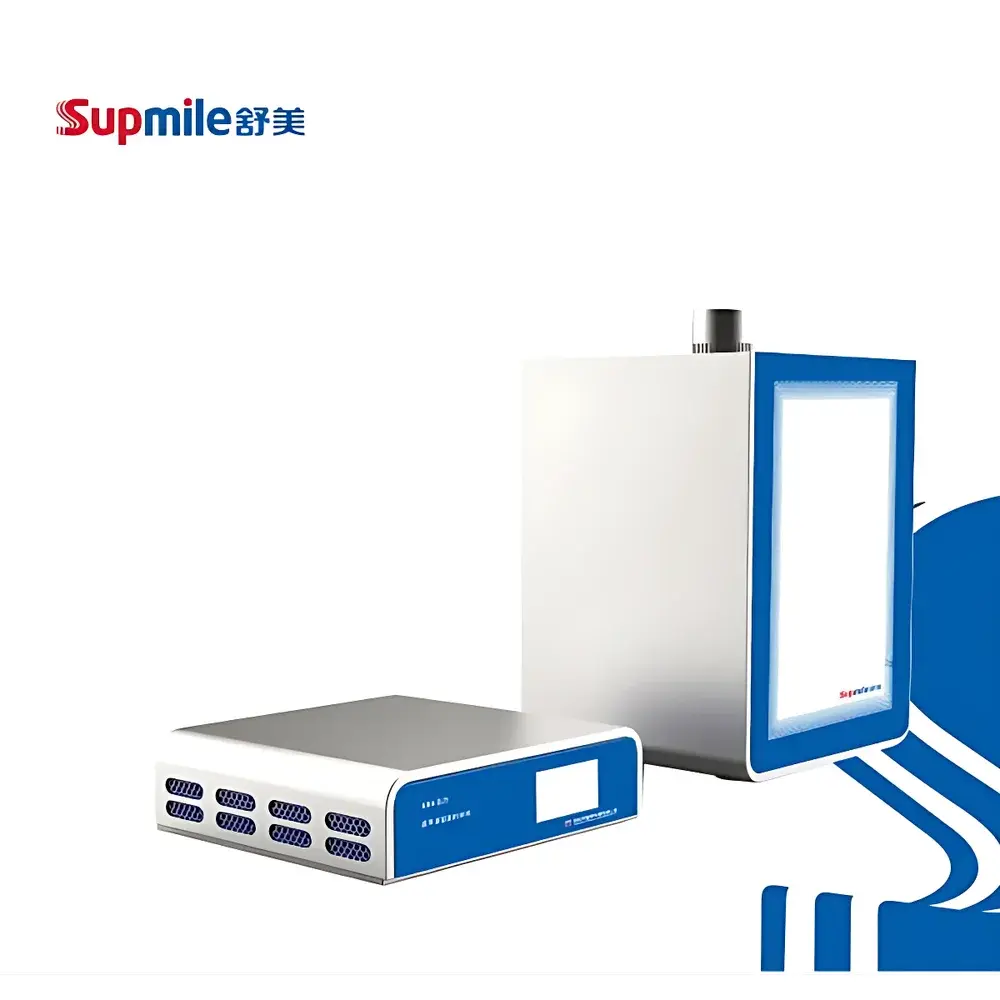
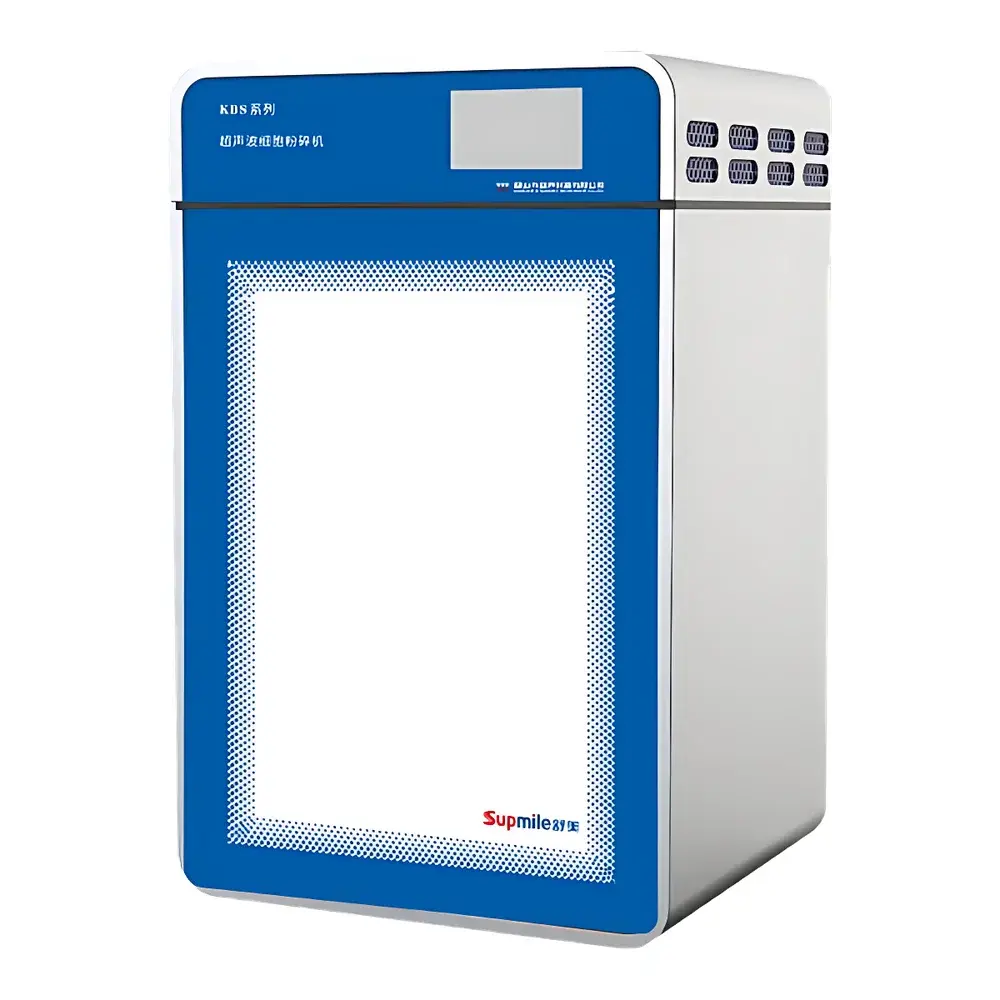
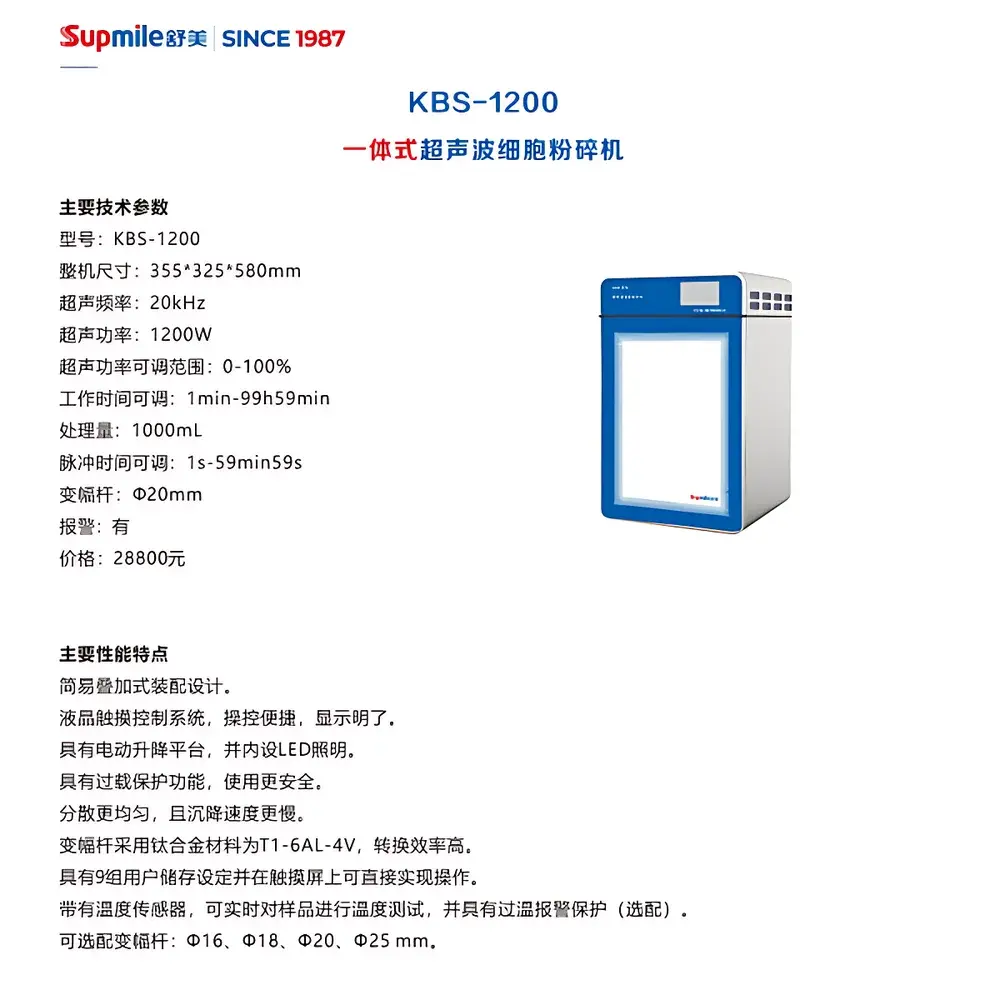
Shumei KBS-1200 Integrated Ultrasonic Cell Disruptor
| Brand | Shumei |
|---|---|
| Origin | Jiangsu, China |
| Manufacturer Type | Direct Manufacturer |
| Instrument Type | Ultrasonic Cell Disruptor |
| Model | KBS-1200 |
| Frequency | 20 kHz |
| Output Power | 1200 W |
| Adjustable Power Range | 0–100% |
| Time Setting Range | 1 min – 99 h 59 min |
| Pulse Duration | 1 s – 59 min 59 s |
| Maximum Sample Volume | 1000 mL |
| Horn Diameter Options | Φ16, Φ18, Φ20 (standard), Φ25 mm |
| Horn Material | Ti-6Al-4V Titanium Alloy |
| Safety Features | Overload Protection, Overtemperature Alarm (optional), LED Illumination, Motorized Vertical Stage |
| Control Interface | LCD Touchscreen with 9 User-Programmable Protocols |
| Dimensions (W×D×H) | 355 × 325 × 580 mm |
Overview
The Shumei KBS-1200 Integrated Ultrasonic Cell Disruptor is an engineered solution for controlled, scalable lysis of biological cells, subcellular organelles, and microbial suspensions. It operates on the principle of high-intensity ultrasonic cavitation—where rapid pressure fluctuations in liquid media generate transient microbubbles that collapse violently, producing localized shear forces, shockwaves, and microstreaming sufficient to disrupt cellular membranes without significant thermal denaturation when operated under optimized duty cycles. Designed for benchtop use in academic laboratories, biopharmaceutical process development, and QC/QA environments, the KBS-1200 delivers reproducible mechanical energy input across volumes up to 1000 mL, supporting both batch and semi-continuous processing protocols. Its integrated architecture eliminates external generator–transducer cabling, reducing acoustic coupling losses and improving operational stability over extended runtimes.
Key Features
- Integrated ultrasonic system with built-in 20 kHz piezoelectric transducer and Ti-6Al-4V titanium alloy horn (standard Φ20 mm), offering superior acoustic transmission efficiency and corrosion resistance in aqueous and mildly aggressive buffers.
- Motorized vertical stage with precision height adjustment and integrated LED illumination—enabling consistent horn immersion depth control and real-time visual monitoring of sample homogeneity during sonication.
- Full-touch LCD interface with nine programmable user profiles; each storing independent settings for power percentage, total duration, pulse-on/pulse-off timing, and temperature alarm threshold (when optional probe sensor is installed).
- Comprehensive safety architecture including automatic overload shutdown, thermal cutoff protection (with optional RTD-based temperature monitoring), and hardware interlocks preventing operation without proper horn attachment or coolant circulation (if water-cooled variant is configured).
- Modular horn compatibility: supports interchangeable horns (Φ16, Φ18, Φ20, Φ25 mm) to match impedance requirements for varying viscosity, volume, and cell type—e.g., Φ16 mm for low-volume, high-shear applications; Φ25 mm for large-batch homogenization with reduced peak intensity per unit area.
Sample Compatibility & Compliance
The KBS-1200 accommodates a broad range of biological matrices—including bacterial cultures (E. coli, Bacillus spp.), yeast (S. cerevisiae), mammalian suspension cells (CHO, HEK293), plant tissue extracts, and viral lysates—without requiring chemical lysis reagents or freeze-thaw cycling. Its mechanical disruption mechanism preserves native protein conformation and nucleic acid integrity when combined with appropriate cooling strategies (e.g., ice-water bath or recirculating chiller). The instrument meets CE marking requirements for electromagnetic compatibility (EN 61326-1) and electrical safety (EN 61010-1). While not certified to ISO 13485 or FDA 21 CFR Part 11 out-of-the-box, its programmable protocol storage, audit-ready parameter logging (via optional USB export), and deterministic power delivery support GLP-compliant workflows in regulated R&D settings.
Software & Data Management
The embedded firmware enables timestamped parameter recording for each sonication cycle—including actual RMS power output, cumulative runtime, pulse count, and (if equipped) real-time temperature traces. Data are stored internally and exportable via USB flash drive in CSV format for traceability and post-processing in MATLAB, Python, or LIMS platforms. No proprietary software installation is required; configuration and diagnostics occur entirely through the onboard touchscreen. For integration into automated lab environments, optional RS-232 or TTL-level trigger I/O ports allow synchronization with external pumps, chillers, or robotic arms—supporting unattended multi-step lysis workflows compliant with SOP-driven manufacturing practices.
Applications
- Preparative extraction of intracellular proteins, enzymes, and inclusion bodies from recombinant expression systems.
- Nucleic acid isolation for next-generation sequencing library preparation where enzymatic digestion must be avoided.
- Preparation of antigenic lysates for immunoassay development and monoclonal antibody production.
- Disruption of biofilms and extracellular polymeric substances (EPS) in environmental microbiology studies.
- Homogenization of lipid nanoparticles (LNPs) and liposomal formulations during early-stage formulation screening.
- Cell membrane permeabilization for electroporation enhancement or dye loading in flow cytometry assays.
FAQ
What is the maximum recommended continuous operating time per cycle?
The KBS-1200 supports uninterrupted operation up to 99 hours and 59 minutes per program; however, for thermal management and transducer longevity, continuous runs exceeding 30 minutes are advised only with active cooling and periodic duty-cycle modulation.
Is the temperature sensor included by default?
No—the RTD-based temperature monitoring module is an optional accessory. When installed, it provides real-time feedback and triggers automatic shutdown if user-defined thresholds (e.g., 4°C–45°C range) are exceeded.
Can this instrument be validated for GMP environments?
Yes—while the base unit does not carry formal GMP certification, its deterministic control logic, non-volatile protocol storage, and repeatable energy delivery enable IQ/OQ/PQ validation per ASTM E2500 and ISO/IEC 17025 guidelines when supported by documented calibration procedures and maintenance logs.
How does horn diameter affect lysis efficiency?
Smaller-diameter horns concentrate acoustic energy into narrower zones, increasing local shear stress—ideal for small-volume, high-yield lysis. Larger diameters distribute energy more broadly, reducing cavitation intensity per unit area but improving uniformity in viscous or heterogeneous samples.
Does the system support external triggering or automation interfaces?
Yes—optional RS-232 serial communication and TTL-compatible start/stop trigger inputs enable integration with laboratory information management systems (LIMS), PLCs, or robotic liquid handlers for fully traceable, high-throughput sample processing.