
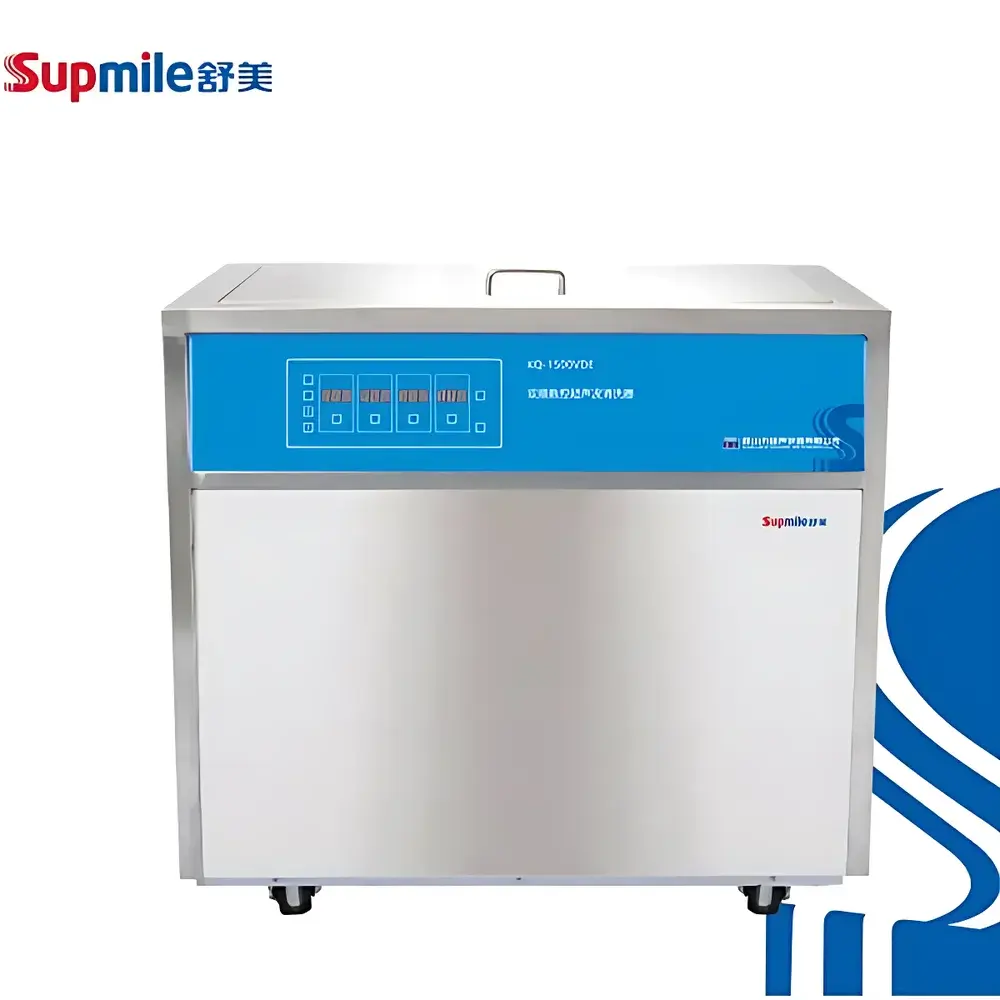
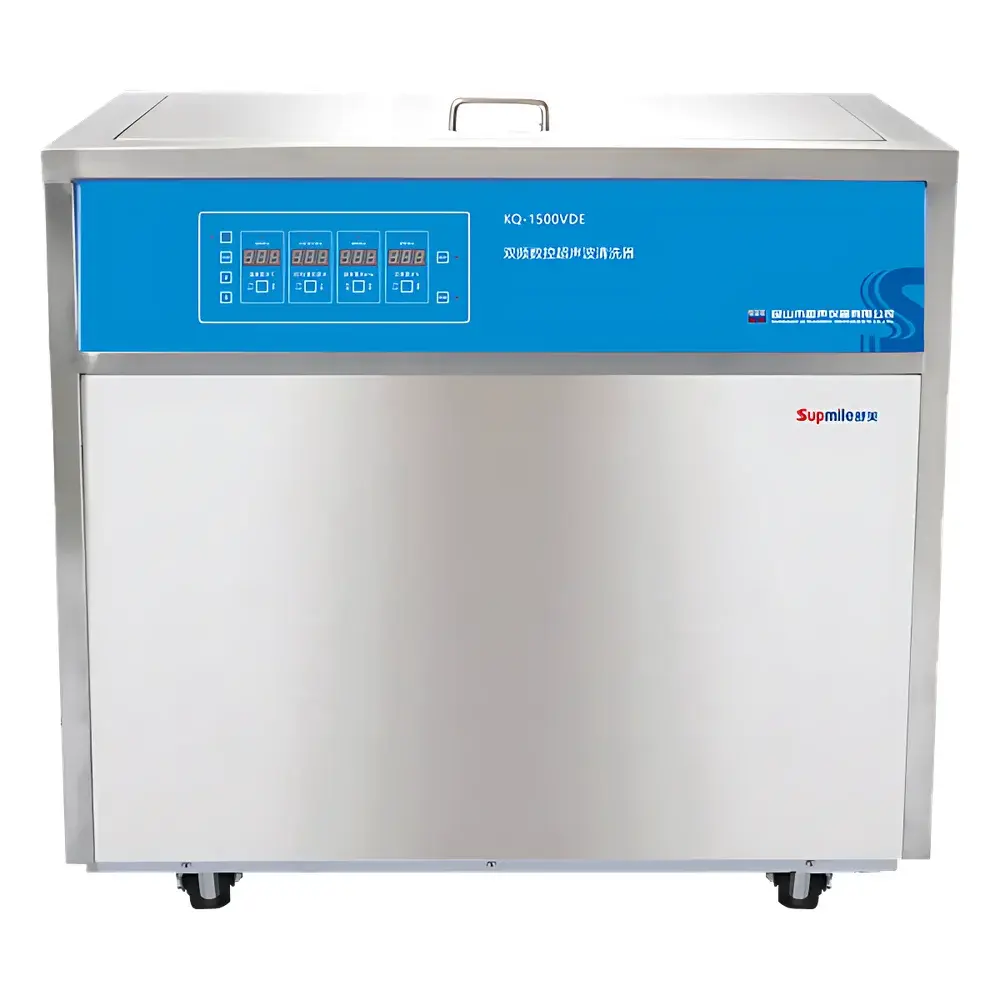
Shumei KQ-1500VDE Dual-Frequency Digital Ultrasonic Cleaner
| Brand | Shumei |
|---|---|
| Origin | Jiangsu, China |
| Manufacturer Type | Direct Manufacturer |
| Instrument Type | General-Purpose Ultrasonic Cleaner |
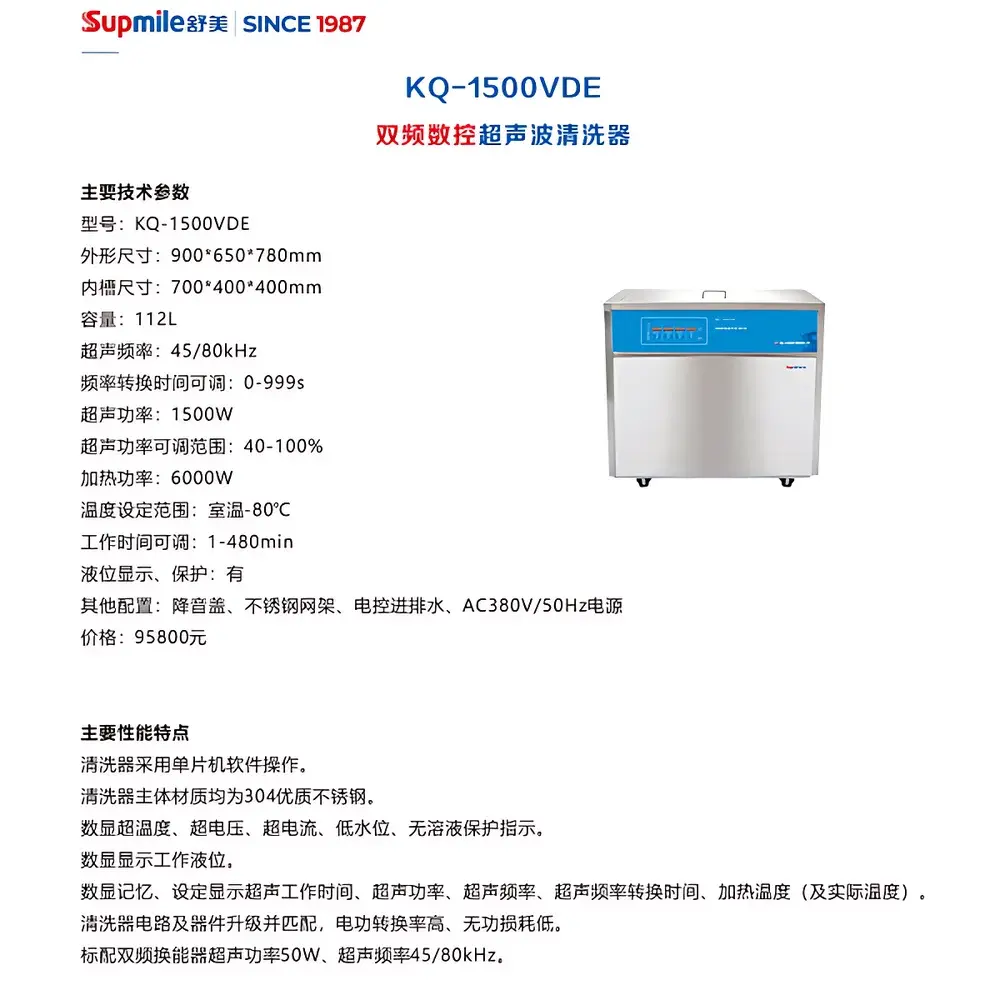
| Capacity | 112 L |
| Ultrasonic Frequencies | 45 kHz / 80 kHz |
| Total Ultrasonic Power | 1500 W |
| Power Adjustment Range | 40–100% |
| Heating Power | 6000 W |
| Temperature Control Range | Ambient to 80 °C |
| Timer Range | 1–480 min |
| Frequency Switching Interval | 0–999 s |
| Noise Reduction Lid | Included |
| Automatic Fill/Drain | Electrically Controlled |
| Power Supply | AC 380 V, 50 Hz |
| Tank Dimensions (L×W×H) | 700 × 400 × 400 mm |
| External Dimensions (L×W×H) | 900 × 650 × 780 mm |
| Construction Material | 304 Stainless Steel |
| Safety Protections | Low-Level Fluid Detection, Over-Temperature, Over-Voltage, Over-Current, Dry-Run Prevention |
| Display | Digital LED Interface with Real-Time Parameter Monitoring |
Overview
The Shumei KQ-1500VDE Dual-Frequency Digital Ultrasonic Cleaner is an industrial-grade laboratory cleaning system engineered for high-reproducibility removal of particulate contaminants, organic residues, and thin-film deposits from precision components, glassware, metal parts, and medical instruments. It operates on the principle of acoustic cavitation—where controlled ultrasonic energy at two discrete frequencies (45 kHz and 80 kHz) generates microbubble implosion in aqueous or solvent-based cleaning media. The dual-frequency architecture enables optimized cleaning across a broad range of substrate geometries and contaminant types: lower-frequency operation (45 kHz) delivers higher cavitation intensity for robust particle dislodgement from macro-surface features, while the higher frequency (80 kHz) provides finer, more uniform energy distribution suited for delicate surfaces and sub-micron residue removal. Designed for continuous operation in QC laboratories, R&D facilities, and GMP-compliant manufacturing environments, the unit integrates thermal regulation, programmable duty cycles, and fail-safe fluid-level monitoring to ensure process consistency and equipment longevity.
Key Features
- Microprocessor-controlled digital interface with real-time display of temperature, ultrasonic power level, operating frequency, frequency switching interval (0–999 s), elapsed time, and actual tank liquid level.
- Dual-frequency transducer array (45 kHz / 80 kHz) with independent amplitude control; total nominal acoustic output: 1500 W, adjustable from 40% to 100% in 1% increments.
- Integrated heating system (6000 W) with PID temperature regulation, enabling precise setpoint control from ambient to 80 °C ±1 °C over full tank volume.
- Stainless steel tank and housing constructed entirely from ASTM A240 304 stainless steel—electropolished interior surface minimizes particle adhesion and supports cleanroom-compatible maintenance protocols.
- Comprehensive safety architecture including automatic shutdown on low fluid level detection, over-temperature, over-voltage, over-current, and dry-run conditions.
- Electrically actuated fill-and-drain system with solenoid valves and level sensors—enabling repeatable, hands-free batch processing and integration into automated lab workflows.
- Acoustically damped hinged lid with silicone gasket seal reduces airborne noise to ≤65 dB(A) at 1 m distance and prevents evaporative loss during heated operation.
Sample Compatibility & Compliance
The KQ-1500VDE accommodates a wide variety of sample formats—including beakers, flasks, Petri dishes, surgical tools, optical lenses, semiconductor wafers (with appropriate fixturing), and printed circuit board assemblies—within its 112 L tank volume. Its dual-frequency capability ensures compatibility with both high-mass industrial components and fragile analytical substrates requiring gentle yet effective decontamination. The system conforms to IEC 61000-6-3 (EMC emissions) and IEC 61000-6-2 (immunity) standards. While not certified for sterile processing per ISO 13485 or EN 13060, it supports validation protocols aligned with ISO 15883-1 for washer-disinfectors when operated with validated cleaning chemistries and documented cycle parameters. All electrical components meet IP22 ingress protection requirements for indoor laboratory use.
Software & Data Management
The embedded control firmware supports full cycle parameter logging—including start/stop timestamps, temperature ramp profiles, power modulation history, and fault event records—with non-volatile memory retention for ≥10,000 cycles. Data export is available via RS-232 serial interface (ASCII protocol) for integration into LIMS or MES platforms. Though no proprietary PC software is bundled, the device complies with Modbus RTU register mapping conventions, enabling third-party SCADA integration. Audit trail functionality meets GLP and FDA 21 CFR Part 11 foundational requirements when paired with external electronic signature and access-control systems.
Applications
- Pre-analytical sample preparation: cleaning HPLC vials, autosampler needles, and chromatography columns to prevent carryover contamination.
- Medical device reprocessing: pre-sterilization cleaning of endoscopes, laparoscopic instruments, and orthopedic implants prior to autoclaving.
- Materials science: removal of polishing compounds from metallographic specimens and oxide layers from wafer substrates.
- Pharmaceutical manufacturing: cleaning of stainless-steel contact parts used in tablet presses and capsule fillers under cGMP documentation practices.
- Electronics manufacturing: post-reflow flux residue removal from PCBAs without damaging solder joints or conformal coatings.
FAQ
What is the recommended cleaning solution for this unit?
Aqueous alkaline or neutral pH detergents compatible with stainless steel and ultrasonic cavitation are recommended; avoid chlorinated solvents or highly acidic formulations unless explicitly approved by the detergent manufacturer for ultrasonic use.
Can the unit operate continuously for extended periods?
Yes—the system is rated for uninterrupted operation up to 8 hours per cycle with active thermal management and duty-cycle monitoring. For >8-hour applications, periodic cooldown intervals are advised to maintain transducer longevity.
Is validation support documentation provided?
Factory calibration certificates for temperature and timer accuracy are included. IQ/OQ protocol templates and traceable sensor calibration data can be supplied upon request for qualified customers.
Does the unit support remote monitoring or network connectivity?
No built-in Ethernet or Wi-Fi module is integrated; however, RS-232 output allows connection to external PLCs or data loggers for centralized monitoring.
How often should the transducers be serviced or replaced?
Under normal usage (≤6 hrs/day), transducer service life exceeds 10,000 operational hours. Visual inspection and impedance testing every 6 months are recommended as part of preventive maintenance.



