
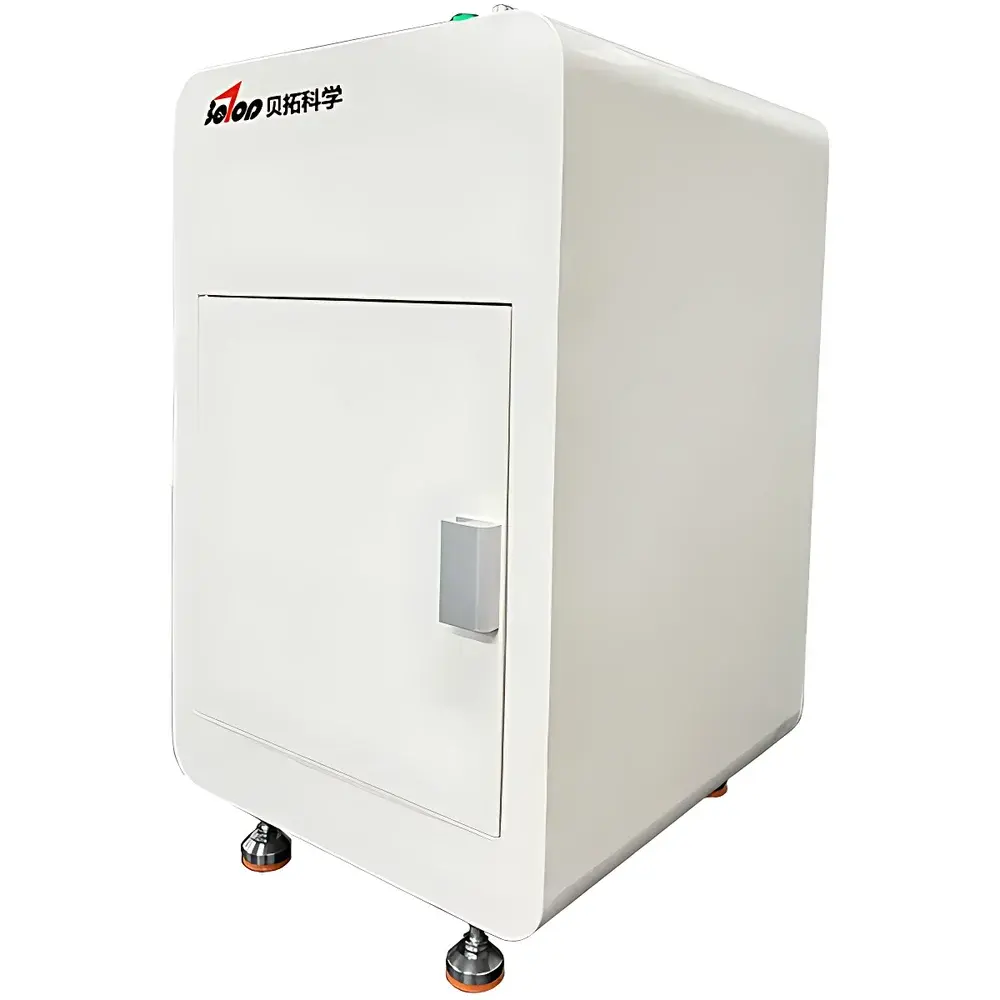
Betop Scientific ATR1000 Automated Reflectance and Transmittance Spectrophotometer
| Brand | Betop Scientific |
|---|---|
| Origin | Guangdong, China |
| Manufacturer Type | Direct Manufacturer |
| Origin Category | Domestic (China) |
| Model | ATR1000 |
| Configuration | Fully Automatic |
| Spectral Range | 200–2500 nm (UV-VIS-NIR) |
| Measurement Modes | Absolute Reflectance & Transmittance |
| Optical Architecture | Integrated Fixed-Fiber Optic Path |
| Sample Compartment | Light-Tight Enclosed Chamber |
| Optional Accessory | Integrating Sphere (custom-configurable) |
| Data Output | Full Spectral Curve + Multi-Point Quantitative Reporting |
| Compliance Ready | ASTM E308, ISO/CIE 15, USP <857>, GLP/GMP-aligned Audit Trail Support |
Overview
The Betop Scientific ATR1000 Automated Reflectance and Transmittance Spectrophotometer is an engineered optical measurement system designed for high-stability, quantitative spectral characterization of solid and thin-film materials across the ultraviolet, visible, and near-infrared (UV-VIS-NIR) spectrum — from 200 nm to 2500 nm. It operates on a dual-beam, fixed-fiber-coupled optical architecture grounded in calibrated reference-based photometric principles. Unlike scanning monochromator systems with moving gratings or slits, the ATR1000 employs a robust, alignment-free optical path stabilized by integrated fiber optics and precision-machined optical mounts. Its fully enclosed sample chamber eliminates ambient light interference, ensuring measurement repeatability under standard laboratory conditions. The instrument is purpose-built for industries requiring traceable, production-grade optical property verification — particularly where batch-to-batch consistency, coating uniformity, or spectral edge definition (e.g., cut-on/cut-off wavelengths) must be rigorously documented.
Key Features
- Fully automated multi-point positioning: Motorized XYZ stage enables programmable spatial mapping of reflectance/transmittance across heterogeneous or large-area samples without manual repositioning.
- Real-time spectral acquisition: Captures full 200–2500 nm spectra in under 3 seconds per measurement point, with configurable averaging and noise-reduction algorithms.
- Threshold-based pass/fail evaluation: Users define wavelength-specific acceptance limits (e.g., R > 99.5% at 1064 nm; T < 0.1% at 850 nm); software generates immediate compliance flags and exportable QA reports.
- Modular optical configuration: Supports both direct specular reflectance/transmittance and diffuse-integrated measurements via optional NIST-traceable integrating sphere (diameter: 150 mm, BaSO₄-coated, 2π geometry).
- Stable optical train: All fibers are factory-aligned and epoxied; no user-accessible collimation adjustments required — minimizing drift over thermal cycles or extended operation.
- Intuitive GUI with scriptable workflows: Drag-and-drop method builder supports sequence automation (e.g., “measure center + four corners → apply filter → compare against master curve”).
Sample Compatibility & Compliance
The ATR1000 accommodates planar and moderately curved substrates up to 150 mm × 150 mm and 25 mm thick, including polished wafers (Si, GaAs, InP), coated optical glass (BK7, fused silica), ITO/ITO-free touch panels, AR/HR multilayer stacks, and textured polymer films. Surface roughness up to Ra = 5 µm is supported when used with the integrating sphere option. All firmware and data handling comply with GLP and GMP documentation requirements: full audit trail (user ID, timestamp, parameter set, raw spectrum hash), electronic signature support, and 21 CFR Part 11–ready configuration options. Calibration is traceable to NIST SRM 2036 (reflectance) and SRM 930e (transmittance), with annual recalibration intervals defined per ISO/IEC 17025:2017.
Software & Data Management
The included Betop OptiSuite v4.2 software runs on Windows 10/11 (64-bit) and provides native support for spectral math operations (subtraction, ratio, derivative), ASTM E308 CIE color space conversion (CIELAB, CIEDE2000), and ISO 13468 haze correlation modeling. Raw data exports in CSV, XML, and JCAMP-DX formats ensure compatibility with LIMS and enterprise QA databases. Batch reporting templates adhere to ISO 10110-7 (optical element certification) and SEMI F20 (semiconductor wafer metrology) standards. Remote monitoring and scheduled calibration alerts are enabled via encrypted HTTPS API.
Applications
- Semiconductor manufacturing: HR coating validation on laser diode facets (R > 99.9% @ 808 nm), anti-reflection performance of Si solar cell ARC layers.
- Optoelectronics: Spectral uniformity mapping of OLED microdisplay substrates and AR/VR waveguide combiners.
- Photovoltaics: Quantification of parasitic absorption in perovskite thin-film stacks and front-surface reflection losses in bifacial modules.
- Precision optics: Certification of broadband dielectric mirrors, UV-grade fused silica transmittance windows, and IR-transmitting chalcogenide glasses.
- Materials R&D: In-situ degradation studies of UV-curable coatings under accelerated aging (via time-resolved spectral tracking).
FAQ
What spectral resolution is achievable with the ATR1000?
Spectral resolution is hardware-defined by the spectrometer module and typically ranges from 1.2 nm (FWHM) at 350 nm to 4.8 nm at 2200 nm — optimized for signal-to-noise balance across the full range.
Can the ATR1000 measure absolute reflectance of highly scattering samples?
Yes — when equipped with the optional integrating sphere, it delivers CIE-compliant total reflectance (specular + diffuse) per ISO 9050 and ASTM E1331.
Is remote calibration or service available?
Field calibration services are offered globally via Betop-certified engineers; remote diagnostics and firmware updates are supported through secure TLS-encrypted channels.
Does the system support custom spectral weighting functions?
Yes — users may import arbitrary weighting curves (e.g., photopic V(λ), solar AM1.5G, or proprietary sensor response) for weighted integral calculations (e.g., luminous transmittance, photon flux).
How is stray light managed in the 200–2500 nm range?
A combination of double-monochromator design, order-sorting filters, and real-time dark-current subtraction ensures stray light < 0.01% at 220 nm and < 0.001% above 800 nm.




