
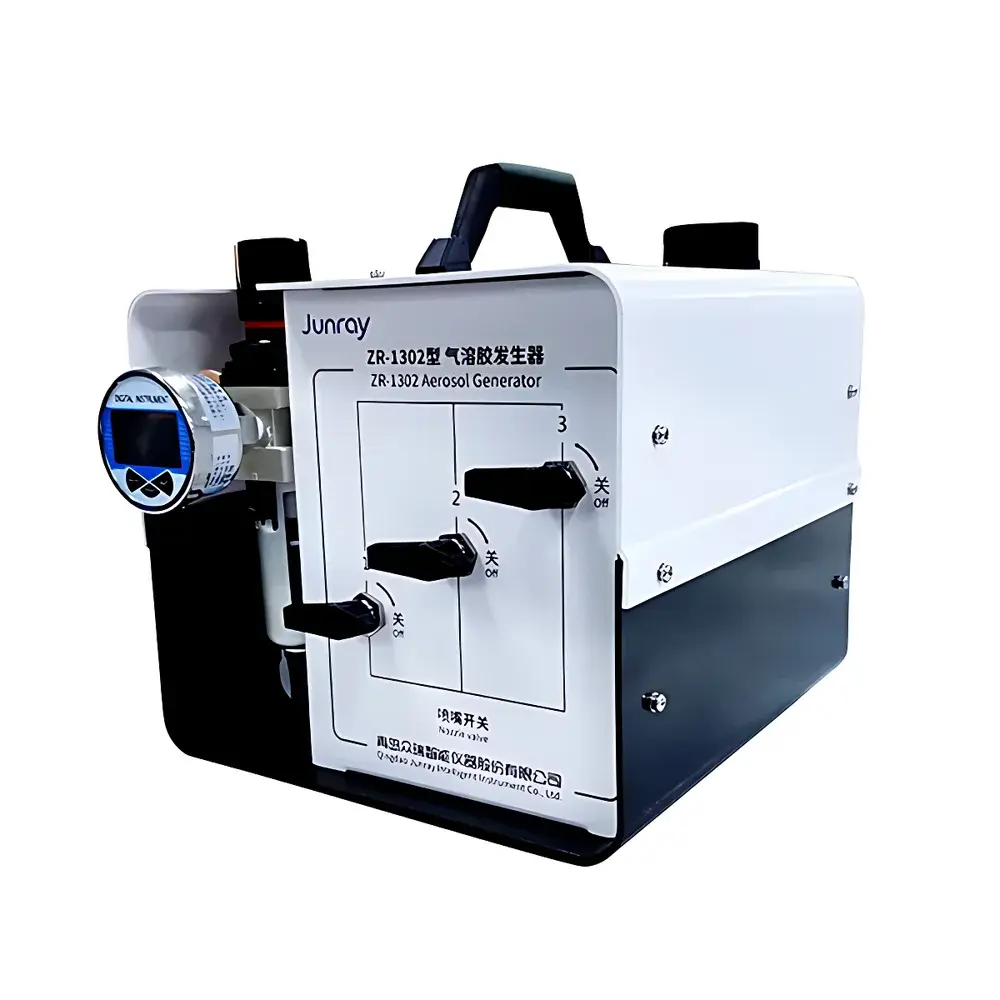
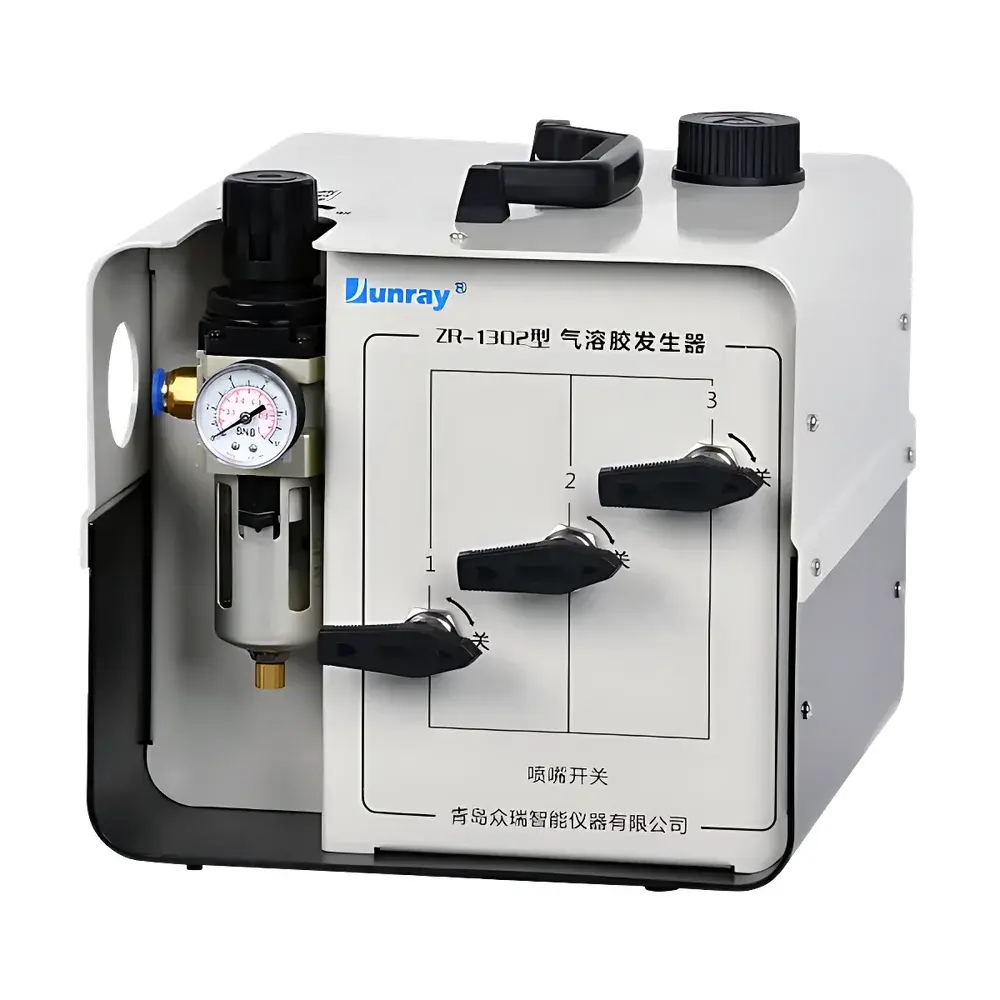
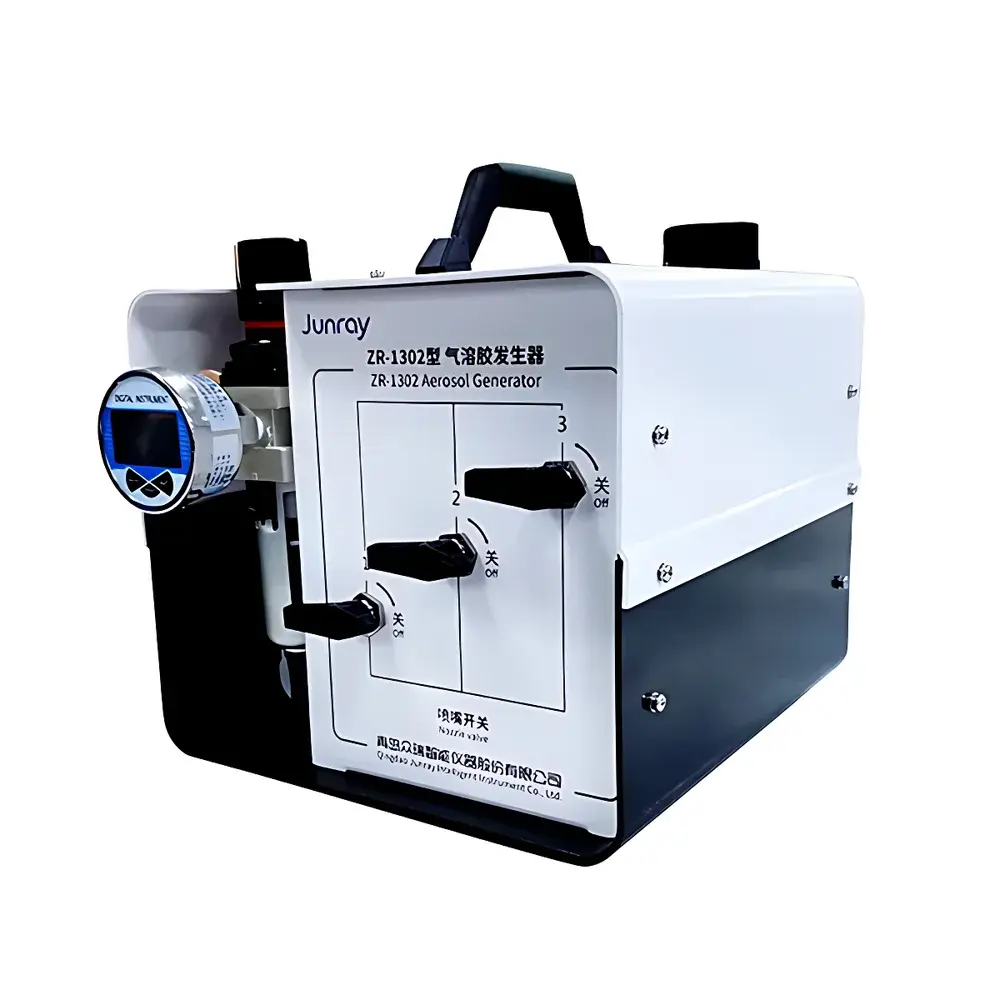
Junray ZR-1302 Aerosol Generator
| Brand | Junray |
|---|---|
| Origin | Shandong, China |
| Manufacturer Type | Direct Manufacturer |
| Model | ZR-1302 |
| Aerosol Output Range | 10–100 μg/L (at 23–230 m³/min airflow) |
| Nozzle Configuration | 1–3 Laskin nozzles (adjustable via integrated flow control valve) |
| Compatible Test Aerosols | DOP, DOS, PAO |
| Particle Size Distribution | Compliant with ISO 14644-3:2005 and GB/T 13554–2008 |
| Power Supply | 220 VAC, 50 Hz |
| Compressed Air Requirement | External source (4–7 bar, oil-free, dry) |
| Weight | ≤12 kg (excluding air compressor) |
Overview
The Junray ZR-1302 Aerosol Generator is a precision-engineered instrument designed for controlled generation of polydisperse liquid-phase test aerosols—primarily Di-Octyl Phthalate (DOP), Di-Octyl Sebacate (DOS), and Polyalphaolefin (PAO)—for integrity testing of high-efficiency particulate air (HEPA) and ultra-low penetration air (ULPA) filters. It operates on the principle of pneumatic atomization through calibrated Laskin nozzles, leveraging laminar compressed air flow to produce stable, reproducible aerosol clouds with defined mass concentration and aerodynamic particle size distribution. The device is purpose-built for quantitative filter leak detection in cleanrooms, biological safety cabinets (BSCs), pharmaceutical manufacturing suites, and hospital isolation environments, where regulatory compliance with ISO 14644-3:2005, GB 50591–2010, YY 0569–2005, and the 2010 Pharmaceutical GMP Guidelines is mandatory.
Key Features
- Modular Laskin nozzle array with integrated three-position selector valve—enables precise selection of 1, 2, or 3 active nozzles to fine-tune aerosol output without external reconfiguration.
- Stable aerosol mass concentration range of 10–100 μg/L across a broad volumetric airflow envelope (23–230 m³/min), supporting both localized scanning and whole-chamber challenge tests.
- Externally supplied compressed air architecture reduces unit weight (<12 kg) and eliminates onboard air compression noise, heat generation, and maintenance overhead—enhancing portability and long-term operational reliability.
- Optimized internal gas dynamics ensure uniform velocity profiles across all nozzles, minimizing spatial heterogeneity and improving aerosol dispersion repeatability between successive test runs.
- Multi-aerosol compatibility: validated for use with DOP (ISO 14644-3 reference material), DOS (non-phthalate alternative), and PAO (USP-compliant substitute), enabling alignment with evolving regulatory preferences and occupational safety requirements.
- Particle size distribution meets the geometric mean diameter (GMD) and standard deviation (σg) specifications outlined in ISO 14644-3:2005 Annex B and GB/T 13554–2008, ensuring metrological traceability during filter efficiency validation.
Sample Compatibility & Compliance
The ZR-1302 is engineered for compatibility with standard aerosol photometers (e.g., TSI 9550, MET ONE HHPC+) and condensation particle counters (CPCs) used in upstream/downstream filter testing protocols. Its output characteristics satisfy the aerosol challenge criteria specified in ISO 14644-3:2005 §B.3.2 (particle count mode) and §B.3.3 (mass concentration mode), as well as the minimum challenge concentration thresholds required by YY 0569–2005 for Class II and III biological safety cabinets. All operational parameters—including nozzle calibration, pressure stability, and aerosol homogeneity—are documented per GLP-aligned internal verification procedures. The instrument supports audit-ready documentation workflows compliant with FDA 21 CFR Part 11 when paired with validated data acquisition software.
Software & Data Management
While the ZR-1302 operates as a hardware-controlled analog generator (no embedded microprocessor or touchscreen interface), it integrates seamlessly into digital test platforms via standardized analog I/O signals (0–10 VDC or 4–20 mA) for real-time airflow and pressure monitoring. When deployed alongside TSI’s FMS or similar certified filter testing software suites, the generator’s operational state—including selected nozzle count, inlet pressure, and nominal concentration setting—is logged with time-stamped metadata. All calibration records, maintenance logs, and performance verification reports are structured to support GMP Annex 1 and EU GMP Chapter 4 documentation requirements, including full revision history and electronic signature capability in validated environments.
Applications
- Leak testing of HEPA/ULPA filters in cleanroom classifications ISO Class 5–8 (GB 50591–2010).
- Performance qualification of biological safety cabinets (BSCs) per YY 0569–2005 and NSF/ANSI 49.
- Validation of HVAC filtration systems in pharmaceutical aseptic processing areas (2010 GMP Guide, Section 3.2.1).
- Calibration and challenge testing of aerosol photometers and optical particle counters.
- Research-grade aerosol exposure studies requiring repeatable, low-volatility organic droplet generation.
FAQ
What compressed air specifications are required for optimal operation?
A clean, oil-free, and desiccated air supply at 4–7 bar (60–100 psi) is mandatory. Dew point must be ≤−40 °C, and particulate content ≤0.1 μm at 1 ppm w/w.
Is the ZR-1302 suitable for use with PAO instead of DOP?
Yes—the nozzle geometry and fluidic design have been verified for PAO (viscosity ~35 cSt at 25 °C), delivering equivalent aerosol spectra and concentration linearity.
Does the instrument include factory calibration documentation?
Each unit ships with a Certificate of Conformance referencing ISO/IEC 17025-accredited nozzle flow calibration data and aerosol concentration verification at three airflow setpoints (23, 115, and 230 m³/min).
Can the ZR-1302 be operated continuously for extended periods?
Continuous operation is supported for up to 4 hours at nominal settings; thermal management and pressure regulation circuits maintain stability within ±2% concentration drift over this interval.
How is compliance with ISO 14644-3 verified during user qualification?
Users perform particle size distribution analysis using a cascade impactor or aerodynamic particle sizer (APS), cross-referencing measured GMD and σg against Table B.1 in ISO 14644-3:2005 Annex B.
Related Products







