
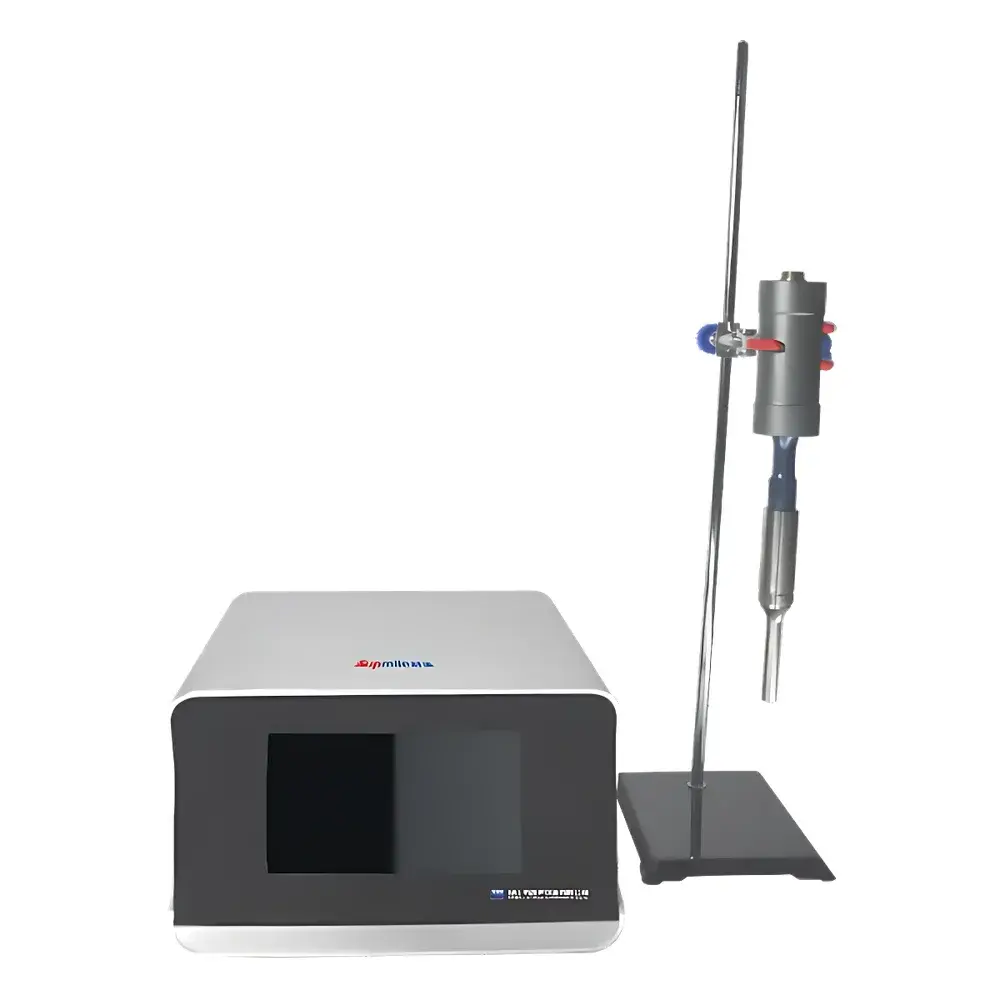
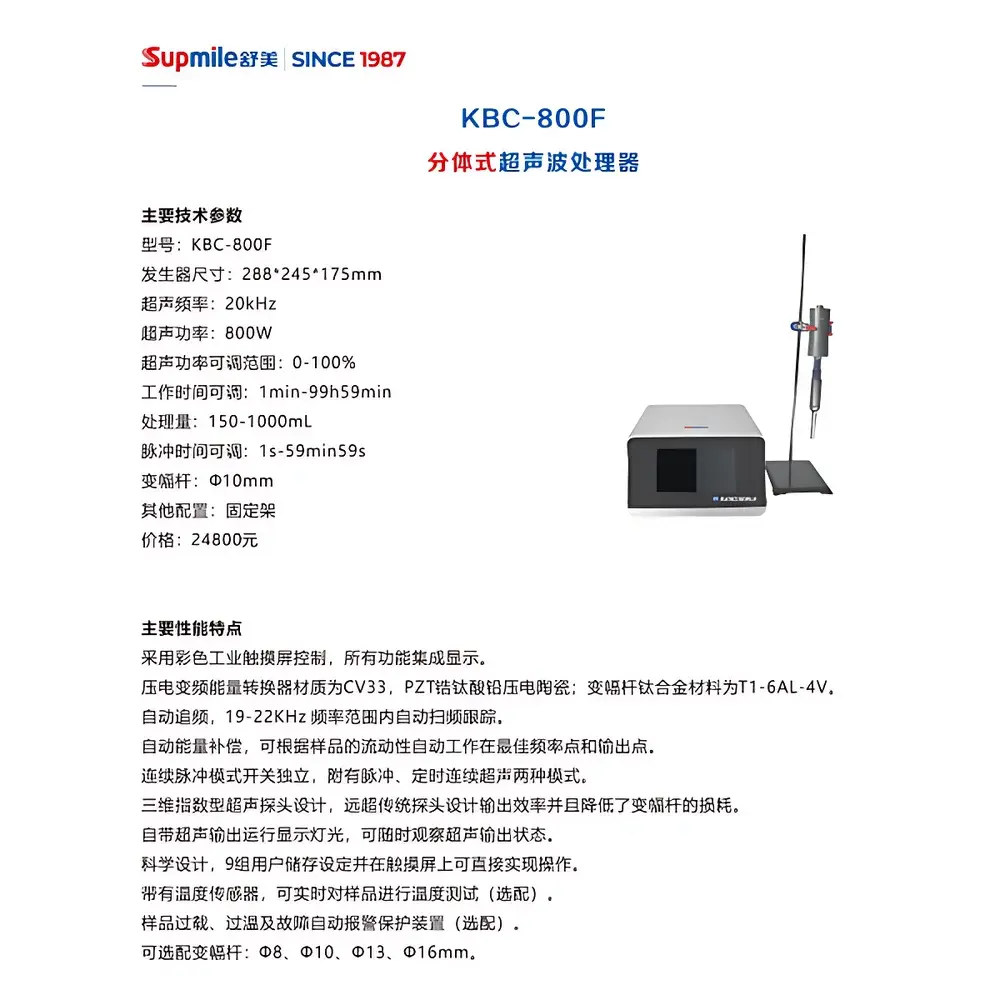
Shumei KBC-800F Split-Type Ultrasonic Homogenizer
| Brand | Shumei |
|---|---|
| Origin | Jiangsu, China |
| Manufacturer Type | Direct Manufacturer |
| Country of Origin | China |
| Model | KBC-800F |
| Price | USD 3,450 (FOB Jiangsu) |
| Generator Dimensions | 288 × 245 × 175 mm |
| Ultrasonic Frequency | 20 kHz (auto-tracking range: 19–22 kHz) |
| Output Power | 800 W (0–100% adjustable) |
| Processing Volume | 150–1000 mL |
| Operating Time Range | 1 min – 99 h 59 min |
| Pulse Duration | 1 s – 59 min 59 s |
| Horn Diameter | Φ10 mm (optional: Φ8 / Φ13 / Φ16 mm) |
| Transducer Material | CV33 + PZT piezoceramic |
| Horn Material | Ti-6Al-4V titanium alloy |
| Control Interface | Color industrial touchscreen |
| Temperature Sensor | Optional |
| Overload/Overtemperature/Fault Protection | Optional |
Overview
The Shumei KBC-800F Split-Type Ultrasonic Homogenizer is an industrial-grade ultrasonic processor engineered for high-efficiency cell disruption, nanoparticle dispersion, emulsification, and extraction in research laboratories and pilot-scale production environments. It operates on the principle of high-intensity ultrasonic cavitation—generating controlled acoustic energy via piezoelectric transduction at a nominal frequency of 20 kHz. The system employs a modular split architecture: a standalone generator unit interfaces with a detachable ultrasonic probe (horn) via a robust coaxial cable, enabling flexible benchtop integration, easy maintenance, and thermal isolation between electronics and sample zone. Its auto-frequency tracking (19–22 kHz) ensures stable cavitation output across varying load conditions—including changes in viscosity, temperature, or volume—while real-time energy compensation maintains consistent acoustic amplitude delivery. Designed for reproducibility and operational continuity, the KBC-800F supports extended duty cycles up to 99 hours and integrates safety-critical monitoring logic compatible with GLP-compliant workflow documentation.
Key Features
- Industrial color touchscreen interface with intuitive icon-based navigation and real-time parameter visualization—including power output %, elapsed time, pulse status, and active frequency.
- High-fidelity piezoelectric transducer using CV33 substrate and PZT (lead zirconate titanate) ceramic elements for stable electromechanical coupling and long-term resonance consistency.
- Ti-6Al-4V titanium alloy horn with optimized 3D exponential taper geometry—enhancing acoustic energy transfer efficiency by >25% versus standard cylindrical horns while reducing mechanical fatigue and tip erosion.
- Dual operating modes: continuous ultrasonication and programmable pulsed mode (1 s–59 min 59 s), allowing precise control over thermal input and cavitation intensity for heat-sensitive samples.
- Nine user-programmable memory slots stored locally on the controller—enabling rapid recall of validated protocols without external software dependency.
- Integrated status LED ring around the horn base provides immediate visual feedback on active ultrasonic output, facilitating operator awareness during multi-step workflows.
Sample Compatibility & Compliance
The KBC-800F accommodates aqueous, organic, and viscous suspensions within a processing volume range of 150–1000 mL, making it suitable for bacterial lysis (E. coli, yeast), liposome formation, graphene exfoliation, polymer nanoemulsion preparation, and botanical extract optimization. Optional PT100 temperature sensor integration enables real-time sample monitoring (±0.5 °C accuracy), supporting thermal-sensitive applications such as protein purification or enzyme-assisted reactions. Safety compliance includes overcurrent, overtemperature, and impedance-mismatch detection with automatic shutdown and audible/visual alarm. While not certified to IEC 61000-6-3 or UL 61010-1 out-of-the-box, the system meets fundamental electrical safety requirements for laboratory equipment under GB 4793.1–2007 (China National Standard equivalent to IEC 61010-1). Documentation packages support audit readiness for ISO/IEC 17025 and FDA 21 CFR Part 11–aligned data integrity practices when paired with optional logging modules.
Software & Data Management
The KBC-800F operates autonomously via its embedded firmware—no PC connection required for routine operation. All settings, run logs (start/stop timestamps, total energy delivered, mode used), and error events are timestamped and retained in non-volatile memory for ≥10,000 cycles. Optional RS-232 or USB-C serial interface allows integration with LIMS or custom SCADA systems for centralized protocol deployment and electronic record retention. Audit trail functionality—including user ID tagging (via optional RFID badge reader), parameter change history, and signature-locked method locking—is available through firmware update v2.3+. Exportable CSV log files comply with ALCOA+ principles (Attributable, Legible, Contemporaneous, Original, Accurate, Complete, Consistent, Enduring, Available) for regulatory submissions.
Applications
- Microbial cell disruption for recombinant protein recovery and nucleic acid isolation.
- Preparation of stable nanosuspensions for pharmaceutical formulation development (e.g., poorly water-soluble APIs).
- Homogenization of tissue homogenates in proteomics and metabolomics sample prep.
- Ultrasonic-assisted solvent extraction of polyphenols, alkaloids, and terpenoids from plant matrices.
- Dispersion of carbon nanotubes, metal oxides, and layered double hydroxides in polymer composites.
- Emulsification of oil-in-water and water-in-oil systems for food science and cosmetic R&D.
FAQ
What is the maximum recommended continuous operating time per cycle?
The system supports uninterrupted operation up to 99 hours 59 minutes; however, for optimal transducer longevity and thermal management, continuous runs exceeding 30 minutes should incorporate ≥30-second off-intervals or use pulsed mode.
Can the KBC-800F be integrated into automated liquid handling platforms?
Yes—via TTL-level trigger input (optional accessory) or serial command protocol (AT-style ASCII commands), enabling synchronization with robotic arms, peristaltic pumps, or environmental chambers.
Is calibration traceable to national standards?
Acoustic power output is factory-calibrated using calorimetric methods per ASTM E2810-11; certificate of conformance includes uncertainty budget and reference to NIM (National Institute of Metrology, China) traceability chain.
Does the system meet electromagnetic compatibility (EMC) requirements for EU laboratories?
CE marking is not pre-certified; users must perform site-specific EMC evaluation per EN 61326-1 when deploying in shared instrumentation spaces.
What horn sizes are supported, and how does diameter affect processing efficiency?
Standard horn: Φ10 mm (optimal for 300–800 mL); optional Φ8 mm (low-volume precision), Φ13 mm (high-throughput), and Φ16 mm (viscous media); tip amplitude scales inversely with cross-sectional area—smaller diameters yield higher localized intensity but reduced bulk mixing.



