
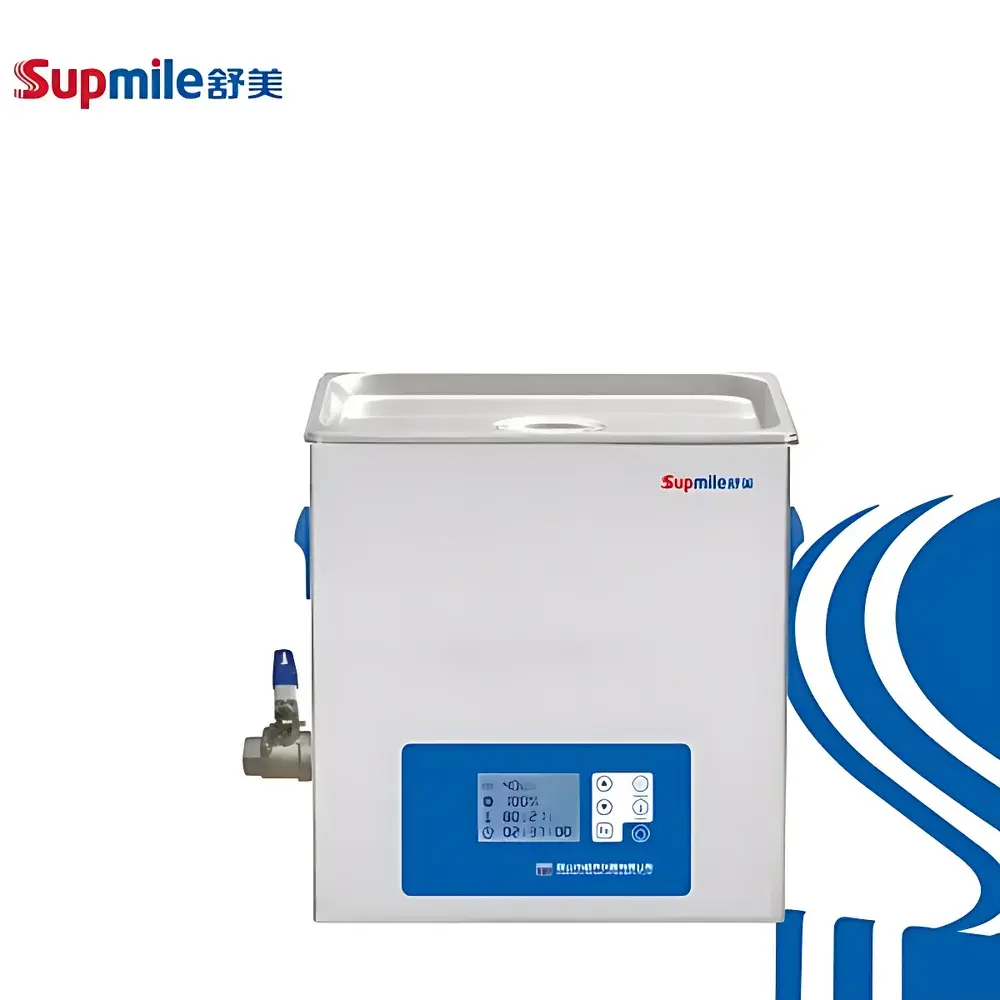
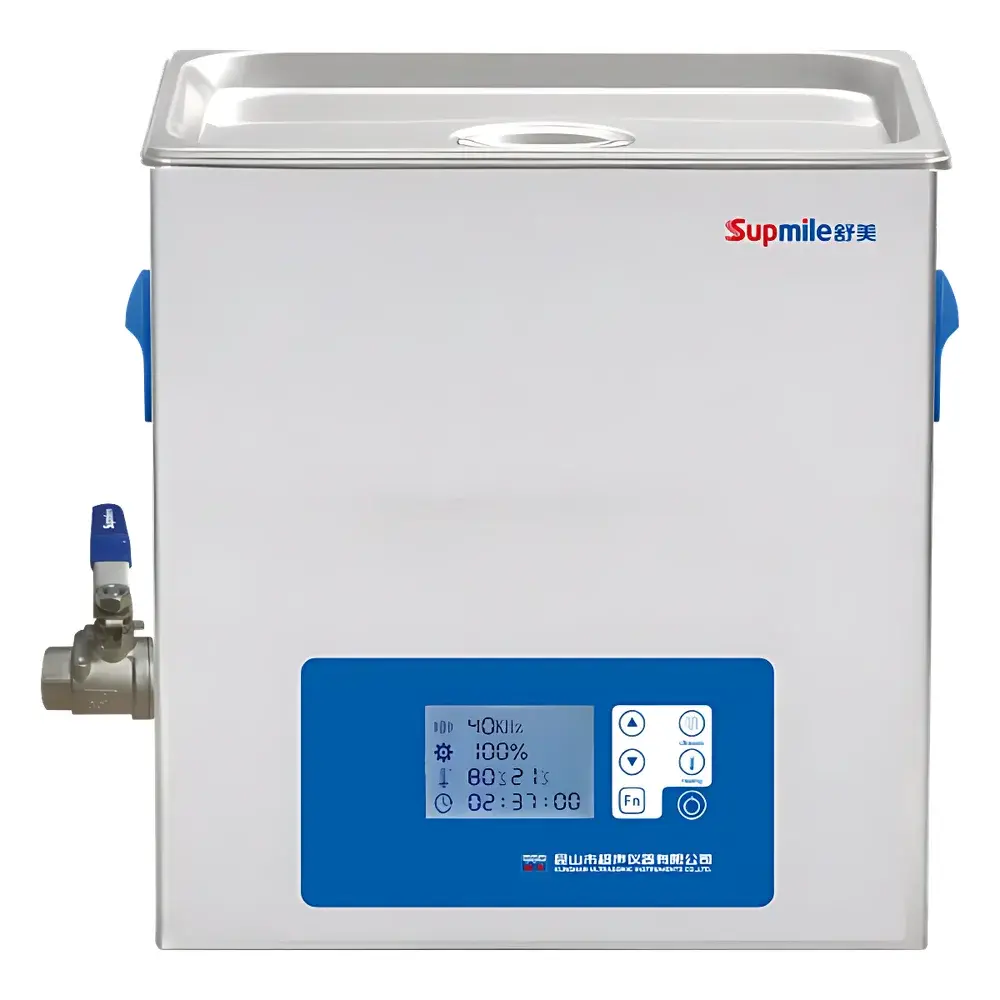
Shumei KQ-VSM Series Quiet-Operation Ultrasonic Cleaner
| Brand | Shumei |
|---|---|
| Origin | Jiangsu, China |
| Manufacturer Type | Direct Manufacturer |
| Product Category | Domestic |
| Model | KQ-VSM |
| Instrument Type | General-Purpose |
| Tank Capacity | ≥10 L |
| Ultrasonic Frequency | 40 kHz (standard default for general lab cleaning) |
| Ultrasonic Power Output | ≥300 W |
| Power Adjustment Range | 0–100% continuous |
| Heating Power | 400 W |
| Temperature Control Range | Ambient to 80 °C |
| Timer Range | 0–24 h |
| Sound-Dampening Lid | Yes |
| Manual Fill/Drain Valve | Yes |
| Liquid Level Protection | Yes |
| Construction | 304 Stainless Steel Tank & Housing |
| Noise Level | <60 dB(A) at 1 m |
| Electrical Supply | AC 220 V / 50 Hz |
Overview
The Shumei KQ-VSM Series Quiet-Operation Ultrasonic Cleaner is an engineered solution for precision laboratory cleaning tasks requiring consistent cavitation energy, thermal stability, and acoustic containment. Designed around the principle of high-frequency ultrasonic cavitation—typically operating at 40 kHz—the unit generates microscopic vacuum bubbles in aqueous or mild solvent media that collapse with localized energy release, effectively dislodging particulate contaminants, organic residues, and biofilms from surfaces of delicate instruments, glassware, surgical tools, and microfluidic components. Unlike conventional ultrasonic cleaners, the KQ-VSM integrates a proprietary acoustic enclosure system—including a sealed sound-dampening lid and vibration-isolated tank mounting—to reduce operational noise to <60 dB(A) at 1 meter, meeting ISO 14040-compliant ambient noise thresholds for shared laboratory environments. Its 304 stainless steel monolithic tank (300 × 240 × 150 mm internal dimensions; 10 L nominal volume) ensures corrosion resistance, structural rigidity, and compatibility with alkaline, neutral, and low-concentration acidic cleaning solutions used in ISO 15883-1–validated reprocessing workflows.
Key Features
- Continuous 0–100% ultrasonic power adjustment via capacitive touch interface, enabling optimization of cavitation intensity for sensitive substrates (e.g., optical lenses, MEMS devices) without compromising cleaning efficacy.
- Precise temperature control from ambient to 80 °C using PID-regulated heating (400 W), supporting thermally enhanced cleaning protocols aligned with ASTM F3127 for residue removal validation.
- Programmable timer (0–24 h) with auto-shutdown and hold functionality, facilitating unattended overnight decontamination cycles compliant with GLP documentation requirements.
- Integrated liquid level sensor prevents dry-run operation and triggers automatic shutdown, satisfying IEC 61000-4-11 immunity and safety compliance for Class II laboratory equipment.
- High-Q piezoelectric transducers mounted on the tank bottom deliver uniform energy distribution across the entire bath volume, minimizing standing-wave dead zones and ensuring reproducible cleaning performance per ISO 13408-1 Annex B guidance.
- Full 304 stainless steel construction—including tank, housing, mesh basket, and support tray—ensures long-term durability, ease of decontamination, and resistance to chloride-induced pitting in saline or detergent-rich media.
Sample Compatibility & Compliance
The KQ-VSM accommodates a broad range of sample geometries and materials, including but not limited to borosilicate glassware (vials, cuvettes, pipette tips), stainless steel surgical instruments, titanium dental implants, ceramic substrates, and polymer-based microplates. Its non-aggressive, non-abrasive cleaning mechanism preserves surface integrity and dimensional accuracy—critical for metrology-grade components. The unit meets CE marking requirements under the EU Machinery Directive 2006/42/EC and Electromagnetic Compatibility Directive 2014/30/EU. Optional documentation packages support IQ/OQ validation per FDA 21 CFR Part 11 when paired with audit-trail-enabled software modules (see Software & Data Management section).
Software & Data Management
While the base KQ-VSM operates via standalone touch interface, optional RS-485 or USB-C connectivity enables integration with centralized laboratory management systems (LIMS) or automated workflow platforms. Firmware supports timestamped event logging—including start/stop times, setpoint parameters, fault codes, and temperature/power profiles—for traceability in regulated environments. When deployed with validated third-party software (e.g., LabArchives ELN or Thermo Fisher SampleManager), the device satisfies data integrity requirements under ALCOA+ principles and supports electronic signature capture per 21 CFR Part 11 Subpart C.
Applications
- Pre-analytical sample preparation: removal of PCR inhibitors from nucleic acid extraction tubes and sequencing flow cells.
- QC/QA cleaning of HPLC injection valves, autosampler vials, and GC liners prior to calibration runs.
- Sterile processing support: adjunct cleaning step before steam sterilization of reusable laparoscopic instruments (per AAMI ST79:2017).
- Materials science: debubbling of sol-gel coatings and dispersion homogenization of nanoparticle suspensions.
- Electronics manufacturing: flux residue removal from PCB assemblies prior to AOI inspection.
FAQ
What is the standard ultrasonic frequency for the KQ-VSM series?
The unit operates at 40 kHz—a widely adopted frequency balancing cavitation intensity and penetration depth for general-purpose laboratory cleaning.
Does the KQ-VSM support validation documentation for GMP environments?
Yes—upon request, Shumei provides Factory Acceptance Test (FAT) reports, material certifications (EN 10204 3.1), and customizable IQ/OQ templates compatible with common validation frameworks.
Can the unit be operated without heating?
Yes—the heating function is fully independent and may be disabled while maintaining full ultrasonic output and timing control.
Is the drain valve compatible with standard laboratory floor drain connections?
The manual drain valve features a 1/2″ NPT external thread, allowing direct connection to standard PVC or stainless steel drainage lines with appropriate adapters.
What maintenance is required for long-term reliability?
Routine cleaning of the tank interior and periodic inspection of the transducer mounting bolts and seal integrity are recommended every 6 months; no scheduled replacement parts are required within the first 5 years of typical use.
Related Products



