
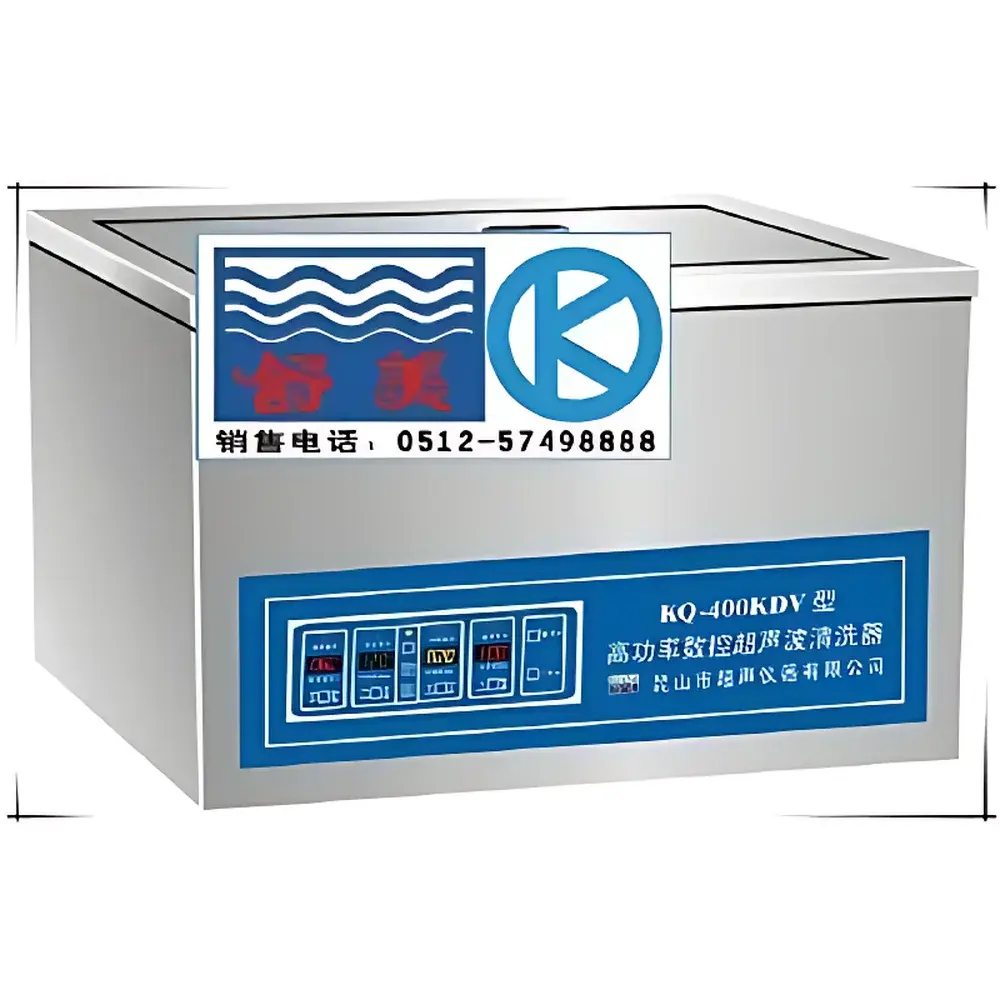
Shumei KQ-400KDV Desktop High-Power Digital Ultrasonic Cleaner
| Brand | Shumei |
|---|---|
| Origin | Jiangsu, China |
| Manufacturer Type | Direct Manufacturer |
| Country of Origin | China |
| Model | KQ-400KDV |
| Dimensions (W×D×H) | 410×350×380 mm |
| Inner Tank Dimensions (W×D×H) | 300×240×180 mm |
| Tank Capacity | 13 L |
| Ultrasonic Frequency | 40 kHz |
| Ultrasonic Power Output | 400 W |
| Power Adjustment Range | 40–100 % |
| Heating Power | 600 W |
| Temperature Control Range | 10–80 °C |
| Timer Range | 1–480 min |
| Cumulative Operating Time Display | up to 999,999 h |
| Water Level Sensing Range | 1–140 mm |
| Heating Element | Stainless Steel Immersion Heater |
| Tank Material | 304 Stainless Steel |
| Lid | Acoustic-Dampening Stainless Steel Cover with Auto-Vapor Recovery |
| Basket Material | Polypropylene Mesh Rack |
| Control System | Embedded Microcontroller-Based Digital Interface |
| Safety Features | Over-Temperature, Over-Current, Low-Water, and Dry-Run Protection |
Overview
The Shumei KQ-400KDV is a benchtop high-power digital ultrasonic cleaner engineered for laboratories requiring precise, repeatable, and traceable cleaning, degassing, emulsification, cell disruption, and solvent extraction. It operates on the principle of piezoelectric transduction—converting high-frequency electrical energy (40 kHz) into mechanical vibrations transmitted through liquid media. These vibrations generate controlled cavitation: the formation, growth, and implosive collapse of microscopic vacuum bubbles that produce localized shockwaves (up to ~5,000 K and ~1,000 atm transiently), enabling micro-scale mechanical scrubbing without surface abrasion. Unlike analog or low-power units, the KQ-400KDV integrates closed-loop digital control over ultrasonic intensity, thermal profile, liquid level, and exposure duration—ensuring process consistency across analytical sample prep, pharmaceutical QC, materials science specimen preparation, and life science workflows.
Key Features
- 400 W nominal ultrasonic output with continuous 40–100% power adjustment via digital interface—enabling optimization for delicate biological samples or robust industrial parts.
- Integrated 600 W stainless steel immersion heater with ±1 °C temperature stability across 10–80 °C range; real-time display of both setpoint and actual bath temperature.
- Precision water-level sensing (1–140 mm resolution) with dual visual indicators: preset fill level and real-time liquid height—critical for maintaining optimal cavitation depth and avoiding transducer damage.
- Digital timer with 1–480 minute programmable duration and cumulative operational counter (displayed in hours, up to 999,999 h)—supporting equipment lifecycle tracking and preventive maintenance scheduling.
- Acoustic-dampening stainless steel lid featuring condensate recovery channel to minimize volatile solvent loss and reduce ambient noise to ≤65 dB(A) at 1 m distance.
- Full-spectrum safety architecture: automatic shutdown on low-water detection, dry-run prevention, over-current/over-voltage monitoring, and thermal cut-off at 90 °C.
- Microcontroller-based firmware with non-volatile memory storing user-defined protocols—including power, time, temperature, and fill level settings—for immediate recall and reproducible operation.
Sample Compatibility & Compliance
The KQ-400KDV accommodates a broad range of sample formats: glassware (vials, cuvettes, chromatography columns), metal components (surgical tools, optical mounts), silicon wafers, printed circuit boards, and biological tissue specimens—all without risk of surface pitting when operated within recommended parameters. Its 300 × 240 × 180 mm stainless steel 304 tank ensures chemical resistance to aqueous solutions, mild alkaline detergents, and common organic solvents (e.g., isopropanol, acetone, ethanol). The unit complies with IEC 61000-6-3 (EMC emission limits) and IEC 61000-6-2 (immunity standards). While not certified for ISO 13485 or FDA 21 CFR Part 11 out-of-the-box, its digital audit trail (time-stamped parameter logs, cumulative runtime, error flags) supports GLP/GMP-aligned documentation when integrated into validated laboratory procedures.
Software & Data Management
The KQ-400KDV operates autonomously via its embedded single-chip controller—no external PC or proprietary software required. All operational data (set values, measured bath temperature, actual power delivery, elapsed time, fluid level, fault codes) are retained in non-volatile memory and displayed simultaneously on a high-contrast LCD. Parameter history is not exportable via USB or network interface; however, the cumulative hour counter and event-triggered error codes (e.g., “E01: Low Water”, “E03: Overtemp”) provide foundational traceability for internal QA audits. For regulated environments, users may manually record setup parameters and runtime logs in electronic lab notebooks (ELNs) compliant with ALCOA+ principles.
Applications
- Pharmaceutical & Biotechnology: Cleaning HPLC vials and autosampler needles; degassing mobile phases; dispersing nanoparticle suspensions; lysing cultured cells prior to protein extraction.
- Materials Science: Removing polishing residues from metallographic samples; debubbling ceramic slurries; preparing graphene oxide dispersions.
- Electronics Manufacturing: Precision removal of flux residues from PCB assemblies prior to AOI inspection.
- Academic Research: Standardized sample prep for SEM/TEM grid cleaning; solvent exchange in cryo-EM workflows; homogenization of lipid vesicles.
- Quality Control Labs: Reproducible cleaning of reference standards and calibration artifacts per ASTM D2601 and ISO 14644-1 particle-counting protocols.
FAQ
What is the maximum allowable solvent volume for optimal cavitation performance?
The tank’s 13 L capacity is rated for full-fill operation, but optimal ultrasonic efficiency occurs when liquid depth is maintained between 100–140 mm—ensuring uniform energy distribution across the transducer array.
Can this unit be used with flammable solvents such as acetone or hexane?
Only in well-ventilated fume hoods with vapor-recovery lid fully engaged; heating function must be disabled, and ambient temperature must remain below solvent flash point.
Is the plastic mesh basket autoclavable?
No—the polypropylene rack is chemically resistant but not rated for repeated steam sterilization; alternative PTFE-coated stainless steel baskets are available as accessories.
Does the unit support external trigger input or RS-232 communication?
No—control and monitoring are exclusively local via front-panel interface; no external I/O ports are provided.
How often should the transducer array be inspected for performance drift?
Annual verification using a calibrated hydrophone or calorimetric power meter is recommended; consistent deviation >±5% from nominal 400 W output warrants service evaluation.
Related Products



