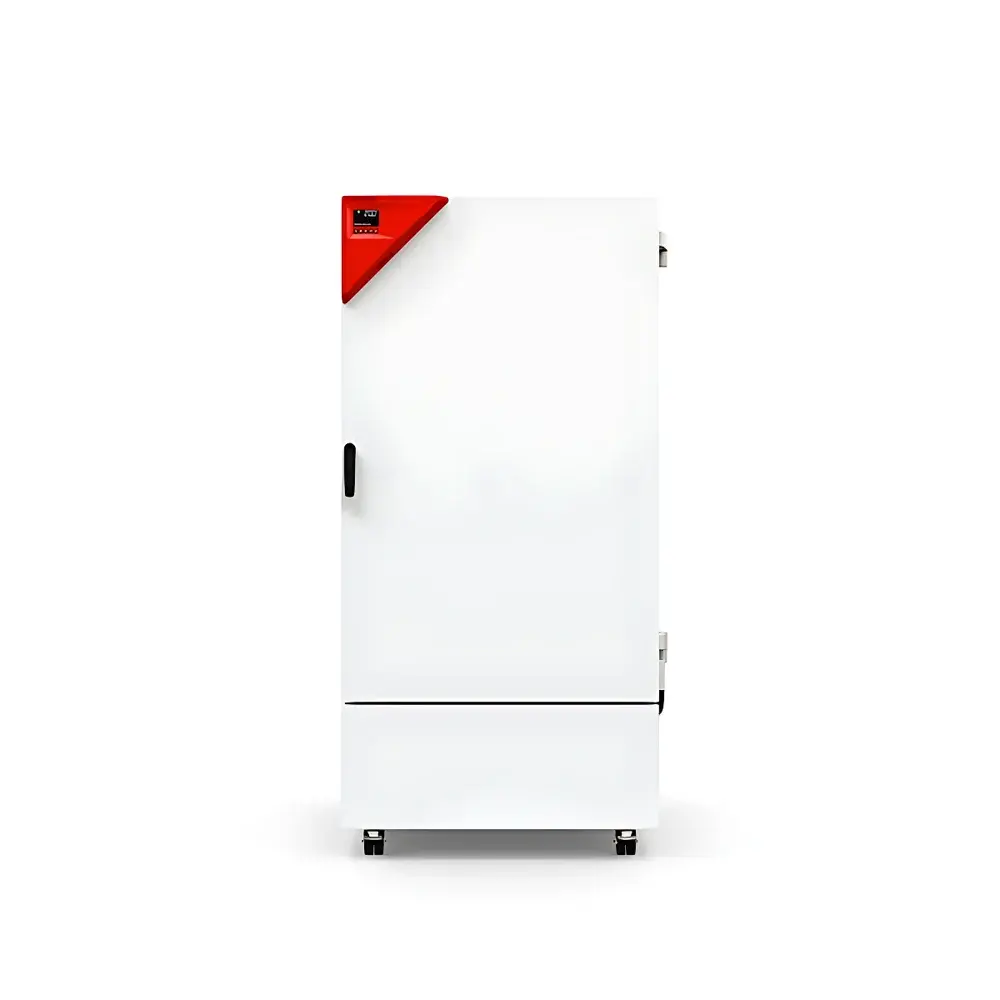
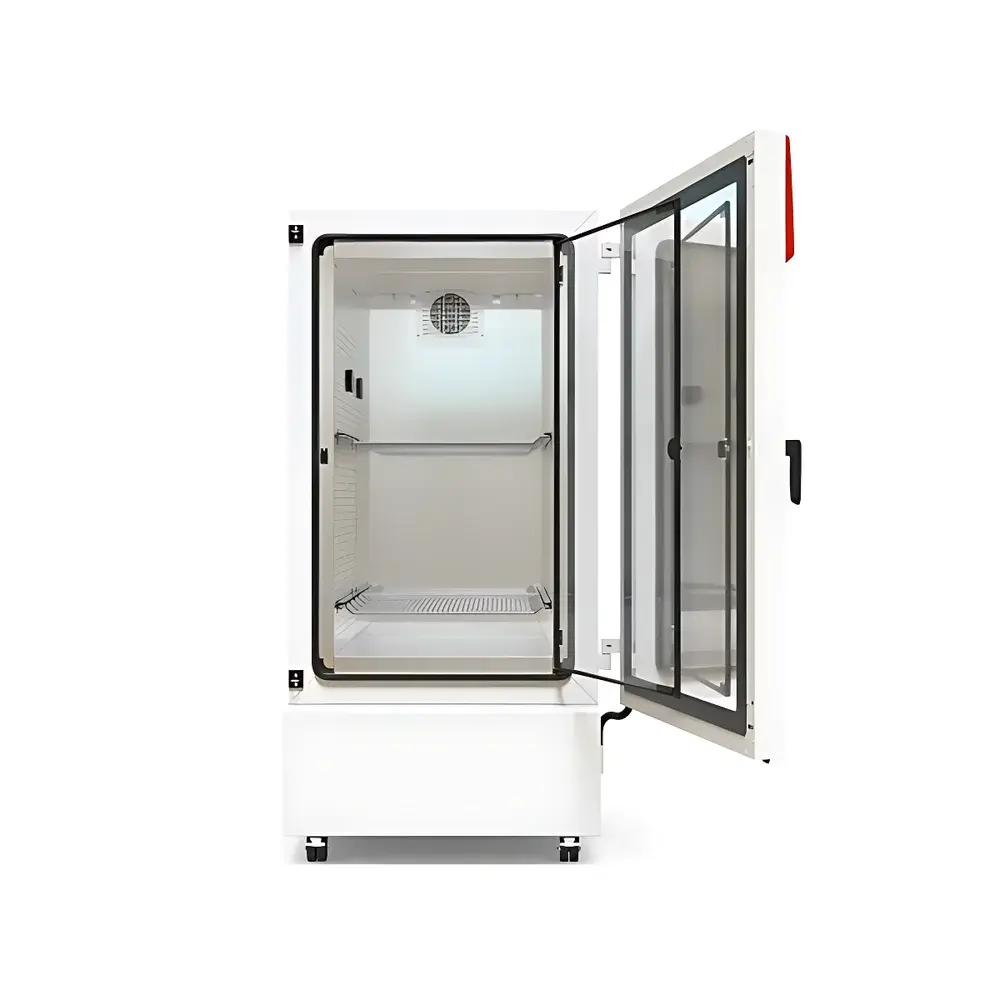
BINDER KB 470 Low Temperature Incubator
| Brand | BINDER |
|---|---|
| Origin | Germany |
| Manufacturer | BINDER GmbH |
| Type | Imported |
| Model | KB 470 |
| Cooling Method | Compressor-based refrigeration |
| Heating Method | Water-jacketed heating |
| Temperature Range | 0 °C to +70 °C |
| Temperature Stability | ±0.1 °C |
| Temperature Uniformity | ±0.2 °C at 37 °C |
| Chamber Volume | 472 L |
| External Dimensions (W×H×D) | 930 mm × 1951 mm × 900 mm |
| Refrigerant | R-600a |
| Insulation | HIT multi-layer jacket technology |
| Interior | Stainless steel (AISI 304) |
| Inner Door | Safety glass with metal oxide coating |
| Shelves | 2 adjustable stainless steel shelves |
| Data Logging | Internal recorder with USB export (open-format CSV) |
| Connectivity | Ethernet + USB |
| Safety Class | DIN 12880 Class 3.3 (optical & acoustic alarm) |
| Dry-heat sterilization program | Yes |
| Power-saving mode | Variable-frequency compressor drive (40% lower energy consumption vs. predecessor) |
Overview
The BINDER KB 470 Low Temperature Incubator is a high-precision, laboratory-grade environmental chamber engineered for reproducible microbial cultivation, cell culture maintenance, and long-term stability testing under controlled sub-ambient to moderate elevated temperatures. Operating on a dual-mode thermal management principle—compressor-driven active cooling combined with water-jacketed uniform heating—the KB 470 delivers exceptional thermal stability (±0.1 °C) and spatial uniformity (±0.2 °C at 37 °C) across its 472 L stainless-steel interior. Its operational range of 0 °C to +70 °C supports diverse applications including psychrophilic organism growth, cold-acclimation studies, enzyme kinetics at low temperatures, and pre-incubation protocols requiring precise chilling prior to assay initiation. The unit complies with DIN 12880:2015 for incubator safety classification (Class 3.3), incorporating redundant temperature monitoring, independent overtemperature protection, and self-diagnostic routines that verify sensor integrity, fan function, and refrigerant circuit status upon startup.
Key Features
- APT.line™ preheating technology ensures rapid, homogeneous chamber warm-up while minimizing thermal overshoot and gradient formation.
- HIT (High Insulation Technology) multi-layer outer jacket provides superior thermal resistance, reducing ambient heat exchange and improving energy efficiency by up to 40% compared to previous-generation models.
- Variable-frequency compressor system dynamically modulates cooling output to match real-time thermal load—eliminating on/off cycling and enhancing both temperature stability and component longevity.
- Dry-heat sterilization program (up to 180 °C) enables in-situ decontamination of the stainless-steel interior without chemical agents, supporting GLP-compliant workflows and reducing cross-contamination risk.
- Optically coated safety glass inner door minimizes condensation and maintains visibility during low-temperature operation; integrated door heating prevents frost accumulation.
- Two height-adjustable, load-rated stainless-steel shelves accommodate standard ISO/ANSI-compliant culture vessels, flasks, and multiwell plates.
- Large-diameter access port (with silicone plug) allows uninterrupted connection of external sensors, gas lines, or sampling tubing during continuous operation.
Sample Compatibility & Compliance
The KB 470 accommodates a broad spectrum of biological and pharmaceutical samples—including agar plates, liquid cultures in Erlenmeyer flasks, suspension bioreactors, and stability test chambers—without compromising thermal fidelity. Its stainless-steel (AISI 304) interior resists corrosion from repeated cleaning agents and ethanol-based disinfectants. The unit meets IEC 61010-1 for laboratory equipment safety and is designed to support regulatory compliance in GxP environments: internal data logging satisfies ALCOA+ principles (Attributable, Legible, Contemporaneous, Original, Accurate), and optional Ethernet connectivity enables integration into networked validation systems compliant with FDA 21 CFR Part 11 requirements. Dry-heat sterilization validation can be documented per ISO 14644-1 (cleanroom classification) and EU GMP Annex 1 guidelines for sterile process simulation.
Software & Data Management
The KB 470 includes an embedded microprocessor controller with intuitive menu navigation and password-protected parameter configuration. All temperature setpoints, alarms, sterilization cycles, and runtime logs are stored in non-volatile memory. Measurement data—including chamber temperature, setpoint deviation, and event timestamps—is recorded at user-defined intervals (1 s to 60 min) and exported via USB as plain-text CSV files compatible with Excel, MATLAB, and LIMS platforms. Optional BINDER CLEVER Control software (available separately) enables remote monitoring, multi-unit fleet management, automated report generation, and electronic signature functionality aligned with 21 CFR Part 11 audit-trail requirements. Ethernet interface supports Modbus TCP protocol for integration into centralized building management systems (BMS).
Applications
- Low-temperature cultivation of psychrotrophic bacteria (e.g., Pseudomonas fluorescens, Listeria monocytogenes) for food safety challenge studies.
- Stability testing of biologics, vaccines, and mRNA formulations per ICH Q5C and Q1A(R2) guidelines.
- Pre-chilling of reagents, centrifuge rotors, and electrophoresis apparatus prior to cold-sensitive assays.
- Controlled acclimation of plant tissue cultures and fungal isolates prior to cryopreservation.
- Environmental simulation for accelerated aging of polymer-based medical devices per ISO 11607-1.
- Long-duration weekend or overnight incubation protocols using programmable dual-setpoint scheduling (e.g., ramp to 4 °C post-culture for sample preservation).
FAQ
Does the KB 470 support humidity control?
No—this model is a dry-air incubator. Humidity control is available only in BINDER’s CO₂ incubator series (e.g., CB series) and climate chambers (MKF series).
Can the dry-heat sterilization cycle be validated?
Yes—temperature mapping during sterilization can be performed using external calibrated thermocouples connected via the access port; cycle parameters comply with EN 285 for steam sterilizer equivalence where applicable.
Is the internal data logger compliant with 21 CFR Part 11?
The built-in logger meets data integrity fundamentals (ALCOA+); full Part 11 compliance requires use of BINDER CLEVER Control software with electronic signatures, audit trails, and role-based access control.
What maintenance is required for the compressor system?
The sealed R-600a refrigeration circuit is maintenance-free; annual verification of door seal integrity, condenser coil cleanliness, and calibration of primary Pt100 sensor is recommended per ISO/IEC 17025.
How is temperature uniformity verified across the chamber volume?
BINDER performs 9-point mapping per DIN 12880 during factory qualification; users may conduct periodic verification using a NIST-traceable 9-sensor array placed at standardized locations (center, corners, mid-height).